CWU Biological Sciences graduate student earns praise for research findings
- April 13, 2023
- David Leder
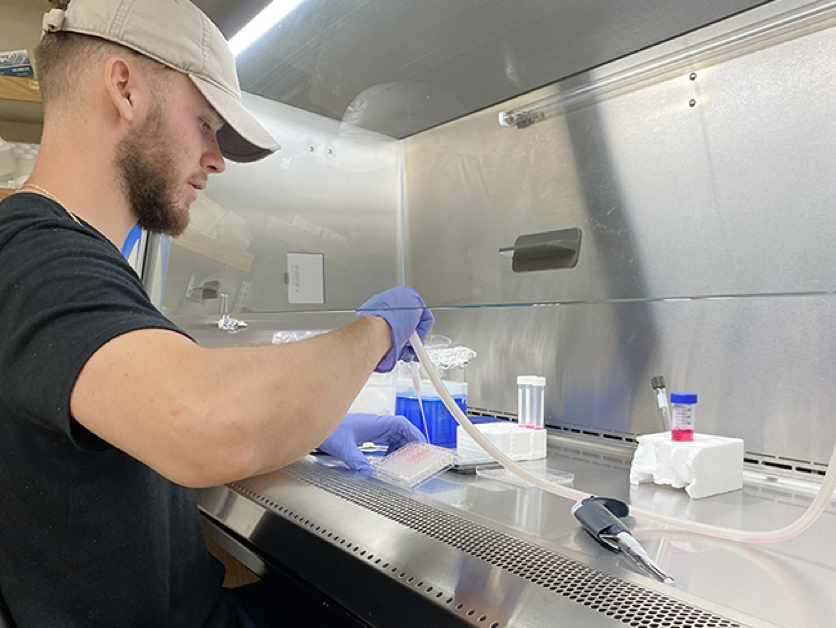
A Central Washington University Biological Sciences graduate student and his colleagues are being hailed for their cell culture research.
Kyle Sease has been studying the potential health effects of human exposure to phthalates, a component of many plastics, also known as a "plasticizer." Due to growing concerns about the dangers of phthalates, researchers around the country have been searching for safer alternatives.
Sease and his team found that the chemical acetyl tributyl citrate (ATBC) might not be the best replacement for phthalates because it appears to interfere with the growth and maintenance of neurons.
Their work was featured in Neuro Science News last month and they presented their findings at Discover BMB, the annual meeting of the American Society for Biochemistry and Molecular Biology, March 25-28 in Seattle.
"In the past, industries have promptly shifted away from the usage of toxic chemicals only to produce an equally toxic chemical, so this is something we are actively trying to avoid repeating," Sease said.
"Our study suggests that ATBC, but not other non-phthalate alternatives, could interfere with cells that maintain brain health. We think this finding warrants further testing of ATBC at different doses, in different settings and in whole organism models."
The Neuro Science News article explains that phthalates are used in hundreds of products, often to enhance durability or allow materials to bend and stretch. Studies have shown that phthalate exposure can affect the reproductive system and early development in a range of animals, although the health impacts in humans are not clear.
ATBC has emerged as a leading phthalate alternative as companies seek to shift away from phthalates, and is currently used in a variety of materials and products, including food and food packaging. But Sease's research indicates this change may, in fact, be harmful to humans.
The research team discovered this by growing cultures of neuroblastoma cells, which are known to behave similarly to the glial cells that support and protect neurons in the brain. They then used molecular methods to study how ATBC and other chemicals affect genes and processes involved in cellular division.
The findings suggest that ATBC could interfere with the ability for glial cells to regenerate, which can reduce their ability to protect neural cells and lead to neurodegeneration and accelerated aging.
The research suggests it is also possible that ATBC exposure during early development-when neurons are actively growing and dividing-could affect neurons directly and interfere with brain development. Since neurons do not typically regrow once damaged, any effects on the brain likely would be permanent.
Along the way, Sease's team discovered that two other phthalate alternatives did not show the same effects as ATBC.
"We found that two other plasticizers did not appear to affect cell division in these cells, so further understanding the different effects of different plasticizers will allow us to understand better how to make safe ones," Sease said.
CWU News

New faculty help advance CWU Construction Management’s record of success
October 21, 2026 by Rune Torgersen

Washoe’s story featured on BBC international broadcast
October 19, 2026 by Rune Torgersen