New academic facility expected to be a hub for CWU students, environmental stewardship
- February 9, 2026
- Rune Torgersen

As the North Academic Complex (NAC) nears completion, Central Washington University looks to a future of sustainability leadership and shared experience.
The latest addition to the Ellensburg campus’ increasingly modernized footprint is inching ever closer to a ribbon-cutting ceremony in fall 2026 that will officially introduce the state-of-the-art facility to the public.
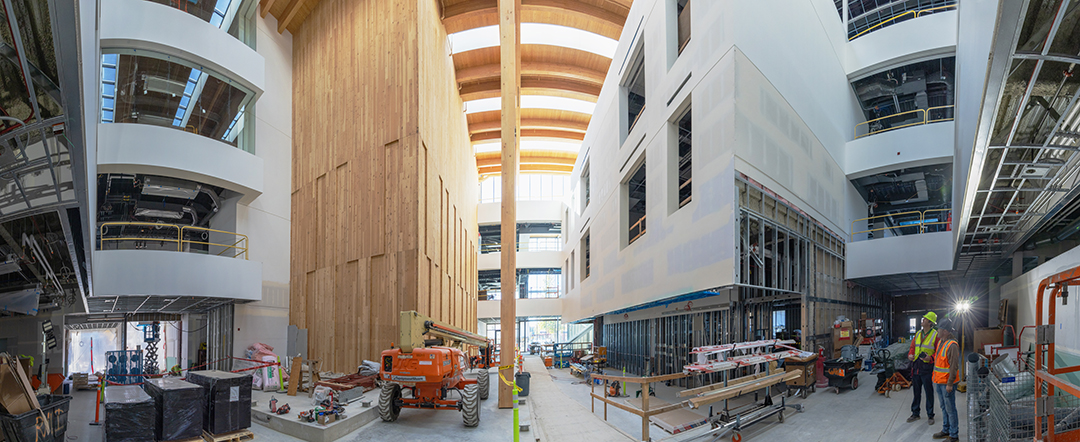
The 106,000-square-foot NAC and GeoEco Plant— funded by the Washington State Legislature in 2023 — is the end result of years of planning and construction. In just a few short months, the $108 million campus centerpiece will begin offering students, faculty, and staff a fresh environment in which to learn, work, and grow together.
The process that kicked off in the fall of 2023 with the demolition of the Language and Literature building has set the stage for decades of arts and humanities work in a space designed from the ground up for interdisciplinary collaboration and study.
NAC Construction Project Coordinator Joe Chanes was hired at CWU specifically to oversee the construction of the building and the GeoEco Plant that will supply it with zero-emission heating and cooling year-round. As he has experienced with other large-scale building projects, this final phase of fleshing out interior spaces brings the whole project into focus.
“We have the atrium built, and we’re starting to work on painting and shaping the space,” Chanes said in August. “Over the course of a big project like this, spaces shrink and grow with each step, as you get new perspective on the thing that’s taking shape. This space is starting to expand again.”
Featuring a 240-seat lecture hall modeled after the widely seen TED Talks series of speeches, as well as timber sourced from Yakama Nation Forest Products, the NAC is destined to become an integral part of CWU students’ lives from the moment it opens for business in fall 2026.
The NAC also features a mock courtroom for the Law and Justice program that features a judge’s bench, witness stand, and jury panel. The two large skylights and ceiling-to-floor window panels will provide ample natural light, while the solar and geothermal energy infrastructure will help the university achieve our goal of reducing greenhouse gas emissions by 45% no later than 2030.
Director of Capital Planning and Projects Delano Palmer has overseen the project since its inception, and he knows the impact that such spaces can have on the student experience. He’s a big fan of showing it off, too.
“I love giving tours of the building at every stage of construction and getting to educate people on how it will serve our campus for years to come,” Palmer said. “Building something that students will have life-defining experiences in, meet friends and loved ones they’ll cherish for the rest of their lives — that’s what gets me excited about the work I do, and about the NAC. We’re not doing this for ourselves but for all the future students who will call this building home.”
Geothermal Pioneers
As impactful as the building itself will be for the campus community, the GeoEco Plant that will heat and cool the NAC has broader implications for the entire state. The largest public geothermal heating and cooling project in Washington State will be capable of maintaining the indoor temperature of approximately 500,000 square feet of building space across campus, utilizing existing HVAC networks to serve up to three buildings, in addition to the NAC.
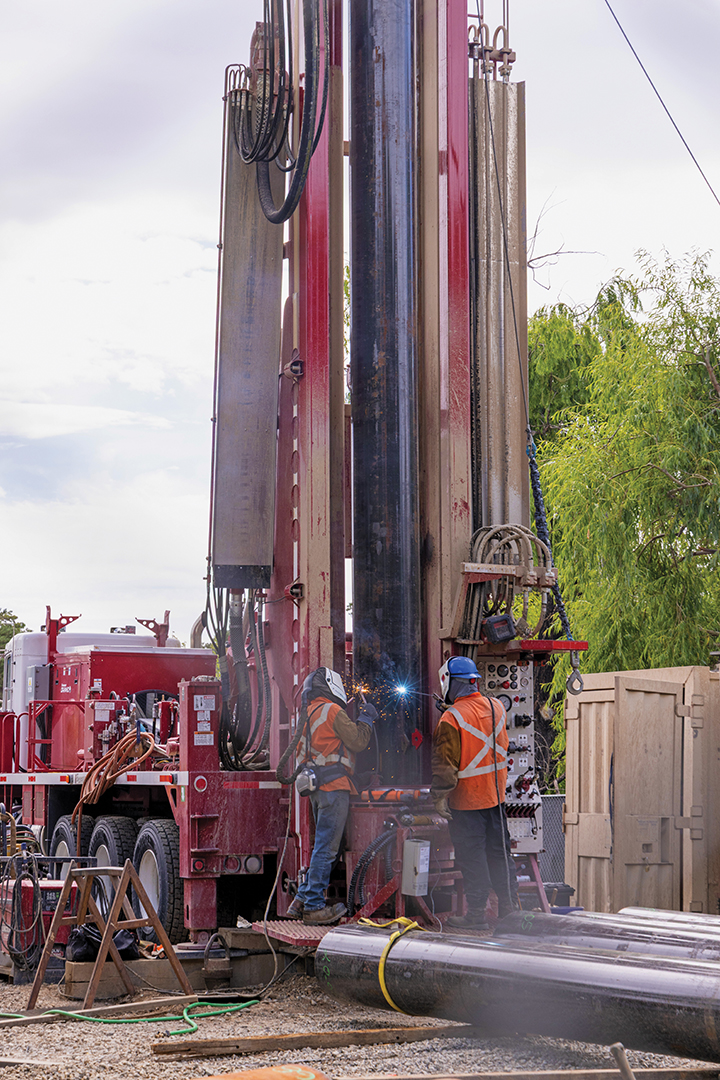
CWU’s Sustainability Director Jeff Bousson sees the effort as an important step forward in realizing CWU’s Climate Action Plan, which was published in July 2024.
“It’s a really exciting project that will enable CWU to reduce our dependence on fossil fuels and support the objectives listed in our Climate Action Plan,” he said. “Hopefully this is the first of many projects to come, all of which will produce significant economic and environmental benefits for our campus and community.”
Those projects include three additional GeoEco Plants spread across campus, along with solar arrays on several existing buildings. The second plant received funding from the state Legislature for the 2025-27 biennium and construction work is already underway across from Black Hall.
Thanks to the construction of the first GeoEco Plant — located across Dean Nicholson Boulevard from the NAC — CWU has become a regional leader in sustainability in higher education. Bousson hopes to spread that success around through continued engagement with other environmentally minded institutions. The first Geothermal Symposium was held last April, and he sees enough opportunities ahead to continue convening the events on a regular basis.
“We aim to continue holding geothermal symposiums and share our experiences with other entities seeking to harness this cutting-edge technology,” Bousson said. “When we open our doors and share our story on how we were able to advance geothermal energy on our campus, we help build a more sustainable future for everyone.”
Once the GeoEco Plant comes online next summer, it will feature an open design, allowing visitors to peek behind the curtain of a truly unique approach to combatting climate change.
Palmer views this aspect of the project as central to CWU’s mission.
“The fact that we’re designing the GeoEco Plant to be a learning lab is a key component for us,” he said. “Whether you’re 2 or 92, you’ll be able to walk up to the building and see the inner workings of the geothermal process. As a university, we try to infuse learning and education into everything we do.”
As Bousson explained, the Climate Action Plan is a living, breathing document that is designed to be implemented over the next 15 years. Each step is vital, and CWU officials are proud to have helped lay the foundation for lasting success as we pursue these climate-critical and cost-saving initiatives.
“It’s imperative that we start on the right foot as it relates to incorporating sustainability into new construction projects on campus,” Bousson said. “This project illustrates that we are committed to starting on the right foot and reducing our environmental footprint for the next several years.”
•••••
This story appears in the Fall 2025 edition of Crimson & Black magazine.
CWU News

Arts and Humanities Month continues to build momentum
October 21, 2026 by David Leder
New position at CWU-Des Moines aimed at improving student experiences
October 21, 2026 by David Leder