CWU researchers seek to learn how much microplastic is in the Yakima River
- March 16, 2026
- Marketing and Communications
Central Washington University Biological Sciences Professor Dr. Clay Arango was recently featured on Northwest Public Broadcasting (NWPB), where he discussed a collaborative research project with former CWU graduate student J Shah into the prevalence of microplastics in the Yakima River.
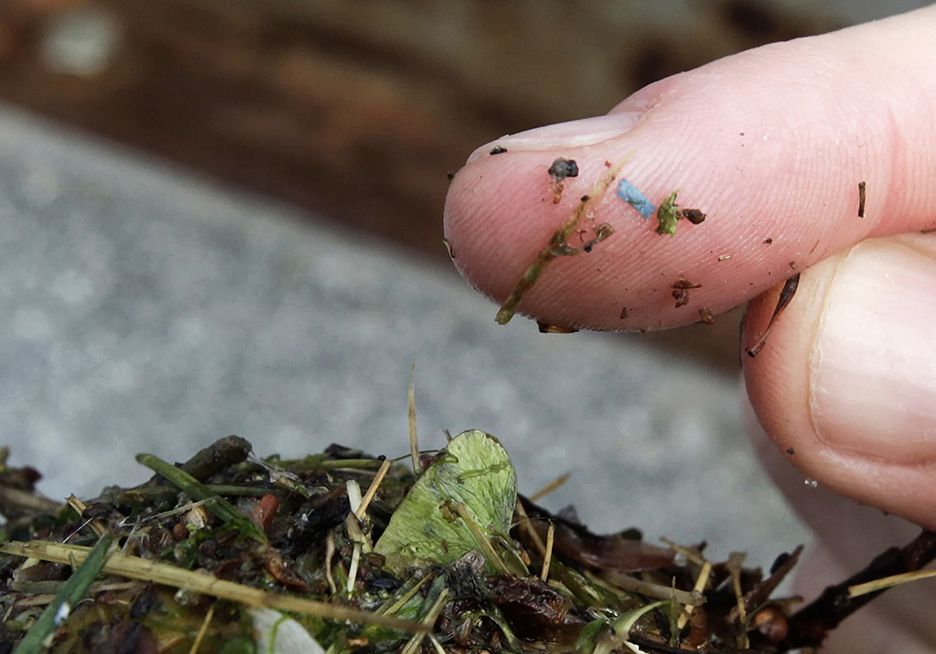
Over the past few years, Arango, Shah, and their colleagues have taken water samples from nine locations on the Yakima River, from Snoqualmie Pass to the Tri-Cities. As Arango explained at a recent presentation in Yakima, each of the samples contained between 2.5 to 5 pieces of plastic fiber per liter — even in water near the river’s headwaters.
“Who would expect plastic up there? There's not much up there. Well, that was one of the higher amounts of plastic,” Arango said at the February presentation at the Cowiche Canyon Conservancy’s Winter 2026 Talk Series, co-hosted by Yakima Valley College.
As the NWPB story explained, Arango, Shah, and the other researchers — including Drs. Paul James and Jason Irwin — used mathematical estimation to detect more than 170,000 pieces of plastic flowing down the river every second.
“So, stand by the side of the river and count 'one Mississippi,' and all the water that flowed past you has 171,000 pieces of plastic in it. Every second, every minute, every hour, every day,” Arango said, adding that the peer-reviewed study was recently accepted for publication, as noted in a March 12 KIMA TV broadcast.

Shah, who now works as an area habitat biologist for the Washington Department of Fish and Wildlife, explored the microplastic problem in her thesis while at Central, where Arango served as her adviser.
Shah’s master’s thesis, which investigated the distribution of microplastics in the Yakima River, was featured in the CWU Museum of Culture and Environment’s Plastic Runs Through It exhibit in 2025. The exhibit was designed to connect a global issue to a local place and to offer a perspective that offered some hope for change.
“I really wanted to look at microplastic distribution in the Yakima River, and I was really interested in how microplastics were entering the aquatic food web,” Shah said in a 2025 CWU News story. “At the time, to the best of our knowledge, there wasn’t a study that did what we did.”
The NWPB article, written by Courtney Flatt, noted that plastics can bioaccumulate, or gradually build up substances, in the food chain. This is of particular concern to Arango and his colleagues.
“If the insects have plastic and the fish eat the insects, it's not too much of a leap of the imagination to think that we've got plastic moving all the way up through this food web into the fish that are really important for recreation and subsistence in our area,” he said.
•••••
Photo at top courtesy of The Associated Press.
CWU News

CWU proud to join national FirstGen Forward Network
October 26, 2026 by Rune Torgersen

Crimson & Black returns to mailboxes and campus news stands
October 26, 2026 by Marketing and Communications