CWU professor helps build national model for cancer rehabilitation
- April 13, 2026
- Rune Torgersen
When CWU Professor of Health Sciences Tim Burnham was preparing to defend his doctoral dissertation at Oregon State University in 1998, he initially thought he was going to be presenting on sport performance.
His focus changed when he realized that precious little work had been done in the field of cancer rehabilitation through exercise.
With a new frontier in his sights, Burnham set about developing a comprehensive framework for helping cancer survivors through their recovery process, a framework that has since evolved into the EASE Cancer Foundation nonprofit organization which he founded alongside his wife, Katie Kemble.
“If you have cancer, you have a physical problem, and if you’re tired and can’t move, it gets worse,” he said. “I also think there’s a big psychological problem, often in the form of stress and anxiety, so in everything I do, I look at it from both of those perspectives.”
Soon after he graduated from OSU in 2000, Burnham was hired to teach at CWU and immediately set about putting his framework into action with group classes held in Yakima and Wenatchee. He had found that a combination of exercise, nutrition, and mental stimulation could help patients both regain their strength and push through a lot of the anxiety and depression that all too often go hand in hand with a cancer diagnosis.
“We know that exercise, omega-3 fatty acids, and focus work together to improve brain function,” Burnham said. “If you can do those three things, you can change your brain, and we incorporate all three into our programming.”
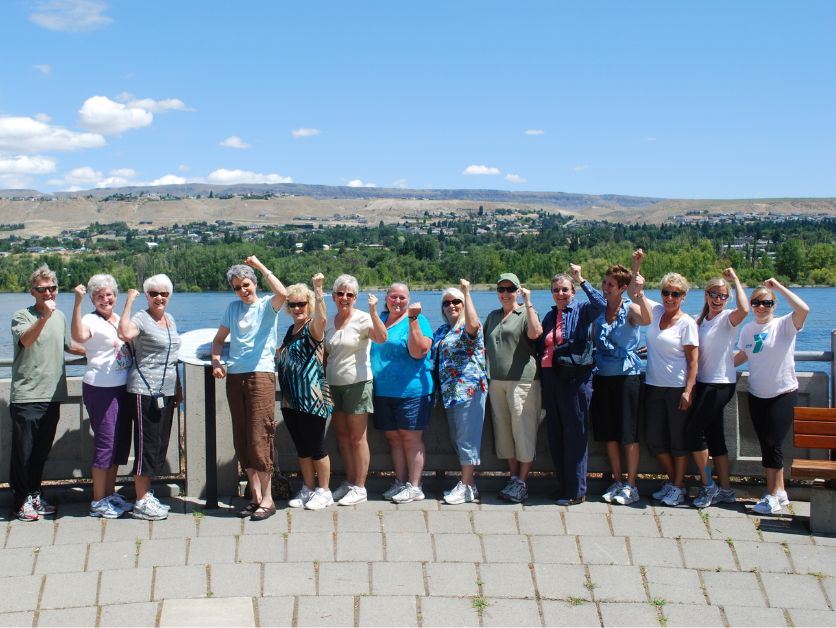
Through an established four-way partnership between CWU, Confluence Health in Wenatchee, the Wenatchee Valley YMCA, and EASE Cancer Foundation, Burnham has been leading classes of 10-15 cancer survivors at a time for more than 18 years, charting their progress and refining his approach according to the data. He is often surprised by what he’s found on the path to a truly comprehensive cancer rehabilitation program.
“Before, we didn’t start on weights until we were about halfway through the program, until we realized just how much benefit the weights were bringing,” Burnham said. “The older ladies in particular, who might never have lifted weights in their life, really like them, I think because they can physically feel themselves getting a bit stronger each time.”
Burnham’s work caught the attention of the American Association of Nurse Practitioners (AANP), who are currently lobbying before Congress to ensure cancer rehabilitation work is covered by insurance companies in Washington, D.C. Their position paper on the matter specifically cites the EASE Cancer Foundation’s work as evidence of the process’ feasibility, scalability, and effectiveness.
Burnham knows that the data he’s able to collect through running the program will help make it clear to insurance companies that this work is worth their time, attention, and support.
“When we asked the insurance companies why this isn’t covered, we were told that we don’t have long-term evidence of a long-term benefit,” he said. “For that, we’re looking at a study that’s 20 or 30 years long.”
As part of the work, Burnham often brings in CWU students to help collect data, in order to provide them with invaluable experience for their future careers. His student assistant for this spring’s EASE class in Wenatchee, Cameron Bickel, is preparing to begin pursuing a doctorate in physical therapy at Whitworth University next year, and he looks forward to building his skillset further prior to graduating from CWU this spring. He plans to present his findings at this year’s SOURCE conference.
“I’m excited to see the outcome, both in person and on paper, because those can be very different things,” Bickel said. “I’m nervous to see what problems come up along the way, but learning how to handle it and move forward will be valuable, too.”
Burnham looks forward to continuing to expand EASE Cancer’s reach and availability. Having seen the results firsthand, he knows how much good it could do for cancer survivors worldwide.
“I looked at those side effects and I saw that exercise could help with a lot of those symptoms if you do it right,” he said. “We’ve charted the fatigue levels, and we’ve found that, on average, they go down for each group we work with through EASE.”CWU News
Arts and Humanities Month continues to build momentum
October 21, 2026 by David Leder
New position at CWU-Des Moines aimed at improving student experiences
October 21, 2026 by David Leder