Wenas Creek Mammoth Project featured on ‘Roots of the Valley’ series
- March 30, 2026
- David Leder
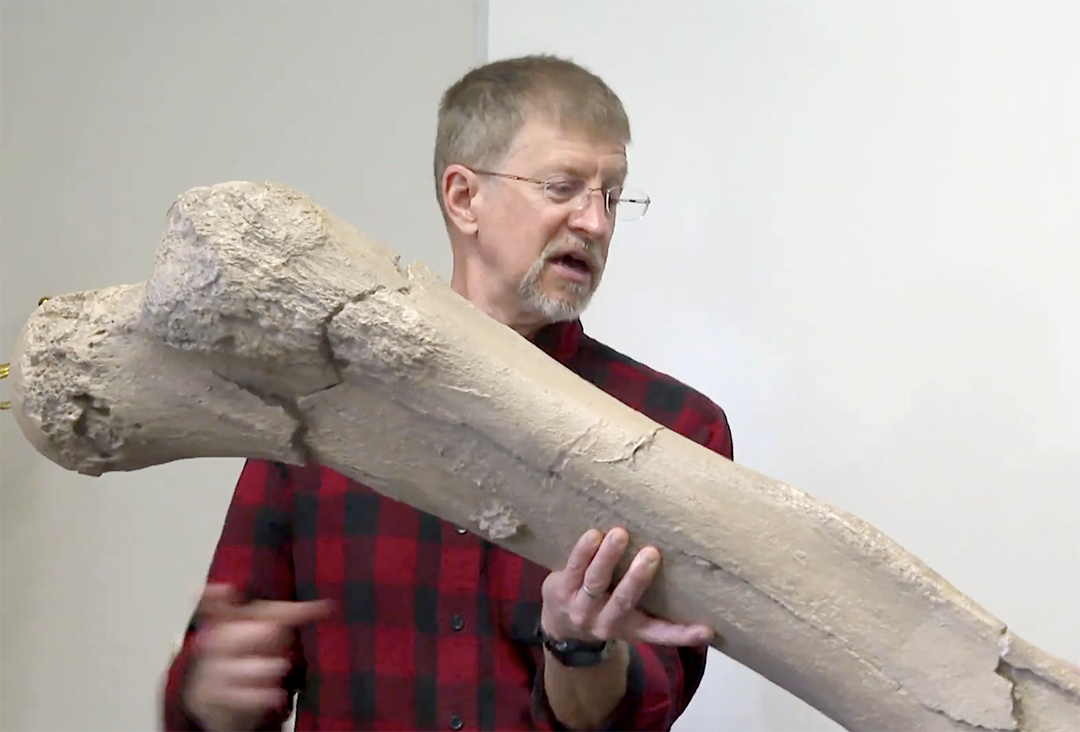
CWU Anthropology Professor Dr. Patrick Lubinski was recently featured on KIMA-TV as part of its “Roots of the Valley” series.
Lubinski was interviewed by reporter John Franklin about the Wenas Creek Mammoth Project, a CWU-led research project near Selah that gained national attention about 15 years ago.
According to a description on the CWU website, the interdisciplinary investigation used methods from paleontology, archaeology, geography, and other fields, with a goal of “careful scientific recovery and analysis of bones and associated artifacts, while placing the finds into context.”
Lubinski led off the KIMA interview by explaining that the archaeological and paleontological dig he and his colleagues conducted in the Wenas Valley from 2005-10 uncovered a collection of mammoth bones from centuries ago. He recalled how CWU hosted 9,000 visitors from across the country to learn about the site and the excavation methods that were used to complete the work.
Lubinski talked about how, during the late Ice Age (approx. 17,000 years ago), the Wenas Valley — located northwest of Selah — provided an ideal environment for mammoths to thrive.
“There was enough good grass around here, in the Ellensburg and Yakima area, to support mammoths, and we think they were eating something like 700 pounds of grass per day,” Lubinski said, noting that the research team also uncovered bison bones that date back to the Ice Age.
Lubinski explained that the remains that were found were of the Columbian Mammoth, not the more commonly known Woolly Mammoth. He said the remains found in the Wenas Valley were “relatively small,” but when taking a closer look at the bone samples, researchers determined that the animals likely stood at least 10 feet tall.
Laboratory work on site materials involved cleaning and identifying bones, looking for bone fragment refits, examining bone surfaces for toothmarks or other damage, photography, mapmaking, submission of samples for dating, genetic analysis, pollen analysis, and more. The work took many years, but most of it was completed by 2022.
Lubinski noted that one of the reasons the Wenas Creek Mammoth Project proved so successful was that the landowners invited the scientists to their property to study the bones.
“All of this wouldn’t have been possible if it wasn’t for the enthusiastic support of the landowners,” he said. “There were no rules that said they had to do anything. If you found mammoth bones on private land, it’s really up to you what happens to them. But they wanted an investigation” and continued to support the work years into the future.
The landowners have created a nonprofit foundation and continue to host events. More information is available on their website.
CWU News

Arts and Humanities Month continues to build momentum
October 21, 2026 by David Leder
New position at CWU-Des Moines aimed at improving student experiences
October 21, 2026 by David Leder