State of the University address highlights successes over challenges
- October 22, 2025
- David Leder

Like all higher education institutions, Central Washington University has weathered a number of challenges in recent years, including state and federal budget woes and enrollment declines.
However, as we rethink, restructure, and reimagine the university — including our policies, procedures, and systems — we have a bright future ahead of us.
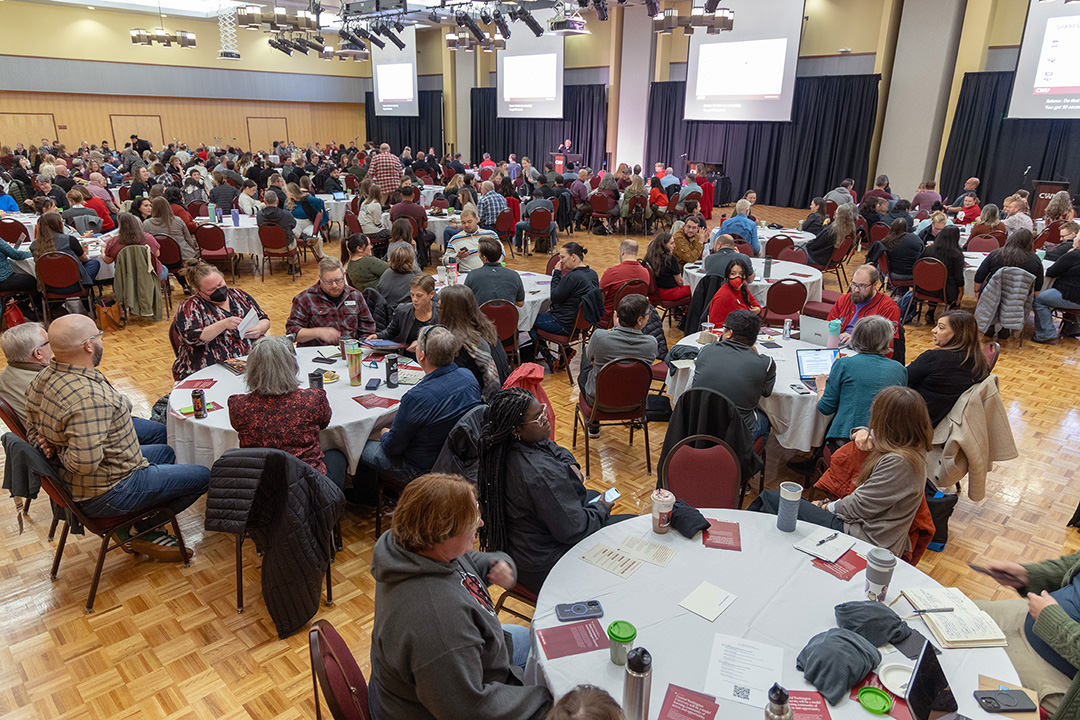
That was the overarching message delivered by CWU President Jim Wohlpart in his annual State of the University address Friday, October 17, on the Ellensburg campus.
“I will not dwell on the challenges in front of us, for the challenges do not define us or our future,” Wohlpart told a crowd of about 300 faculty, staff, and students in the SURC Ballroom. “What does define our future is our vision, mission, values and strategic plan.”

In order for CWU to truly create the future we envision for ourselves, the president made clear that we, as an institution of higher learning, cannot stand still in the face of constant change — some of which is currently unknown due to budgetary challenges at the state and federal levels.
“We must develop our capacity for change, we must be curious and open to new ideas, and we must collaborate and trust each other along the way,” the president continued. “That focus on access and opportunity for all of our students must be our north star, our statement of excellence, the place we aspire to live into in all of our daily work.”
During his nearly 90-minute address, Wohlpart leaned into the university’s Unifying Value of Student Success, which provides a roadmap for how CWU faculty, staff, and administrators approach our work.
“Our Unifying Value of Student Success reminds us why we are doing what we do: to open doors that allow our students to realize their dreams. This should drive everything we do,” he said, noting that it is our responsibility to create pathways into and through the university so our students can achieve their personal and professional goals.
“We do that through the supportive learning environment that we foster, allowing them to become ‘engaged professionals, active citizens, and lifelong learners,’” he added.
The presentation delivered a positive yet realistic view of where CWU is relative to our enrollment peak in the fall of 2019. Enrollment inevitably dipped during the pandemic as students who began before 2020 graduated or moved on.
The pandemic, combined with numerous other factors — such as alternative career pathways and a changing perception about the value of a college education — accelerated a steady drop in enrollment, resulting in 8,509 total students last year and 8,309 this fall. While slightly lower than last year, the fall 2025 enrollment drop represents a relatively modest decline of 2% when compared to some of the state’s other public institutions.

CWU is engaged in a variety of new recruitment initiatives, including an increased emphasis on the Yakima and Wenatchee valleys, although Wohlpart noted that we cannot expect new enrollment alone to turn things around. Improving our retention numbers has taken on an even higher degree of importance over the past year.
“Last year, we involved the whole campus in an effort to improve the retention of our FTIC (First Time In College) students,” Wohlpart said about the initiative led by advisors, faculty, and residence hall assistants, along with staff from Admissions, Financial Aid, Dining Services, Student Billing, and others.
The Institutional Effectiveness, Research and Planning (IERP) team supported the effort by providing weekly enrollment reports to track the initiative’s progress. And, as the president pointed out, “it worked.”
“Our FTIC retention went from 70% last year to 73% this year,” he said. “We will not grow our way out of our current enrollment decline simply by recruiting new students. We must also retain them.”
Wohlpart added that our retention effort must remain a priority, and it must lead to practices and behaviors that become the new normal.
“This is not only a fiscal imperative; it is a moral imperative,” he said.
The president pointed to another encouraging sign, showing that the gap between the retention rate of our total student body compared to our students of color (SOC) has been steadily improving. The retention deficit among SOC has been as high as 6 percentage points, but we have closed the gap, with the 2024-25 deficit at just 3 percentage points.
Wohlpart also shared a related statistic about the retention rate of low-income students — those who receive the Washington College Grant — increased from 67% to 74%.
“Their retention rate is higher than those who did not receive this funding,” he proclaimed. “This is something we should all be proud of.”
The president went on to address other key successes that have resulted from the university community’s commitment to our vision and mission:
- Dual enrollment programs like College in the High School and Running Start continue to be a point of pride for the institution. The percentage of FTIC students enrolled in CWU dual enrollment courses has increased from 10% to 25% over the past six years, placing CWU third in the nation for all public four-year institutions in dual enrollment. What’s more, the retention rate of these students is 80%.
- The Wildcat Pantry served more than 1,000 students last academic year, logging more than 10,000 visits. The student-run service has become a model for other food insecurity programs on campuses around the country.
- CWU has gone a long way toward reducing student debt. Over the past eight years, the amount of debt our students incur has declined from about $25,000 to $20,000, while the percentage of students with debt has decreased from 70% to 55%.
- Since 2022, CWU has been building partnerships and relationships across the region, participating in the development of the Kittitas County Economic Development Strategic Plan and the Ellensburg Creative District. We have also forged strong partnerships with state agencies, school districts, the Chamber of Commerce, nonprofit organizations, and other higher education institutions like Yakima Valley College.
Wohlpart reiterated that there is much work left to be done — and many potentially unknown challenges on the horizon — but he left the audience with an optimistic outlook as we look toward the future.
“I would implore all of us to rethink and reimagine our work, our structures, and our systems to let go of some of the things we have traditionally done,” the president said. “I don’t know at this time what the state budget situation means for Central. What I do know is that we cannot continue to operate in today’s landscape — using yesterday’s policies, structures, and systems — if we want to thrive tomorrow.”
He pointed to two key components of a healthy organization: first, vision and strategy; and, second, implementation and execution. The CWU vision, mission, values, and strategic plan fill that first component, while our shared governance document, “Aligning Priorities to Advance the University’s Vision and Mission,” fulfills the second.
By all accounts, CWU appears to be healthy, with a great deal to look forward to in the years to come.
“We have developed an aspirational vision to be a model learning community of access and opportunity,” Wohlpart said. “And the gap between our current state and our aspirational ideal will be filled through implementing our mission, values and strategic plan.”
CWU News
Arts and Humanities Month continues to build momentum
October 21, 2026 by David Leder
New position at CWU-Des Moines aimed at improving student experiences
October 21, 2026 by David Leder