High-powered telescope a big draw for CWU Physics program
- June 4, 2025
- David Leder

Undergraduate physics students at Central Washington University are benefiting from one-of-a-kind hands-on learning opportunities as part of Professor Cassandra Fallscheer’s Observational Astronomy course.
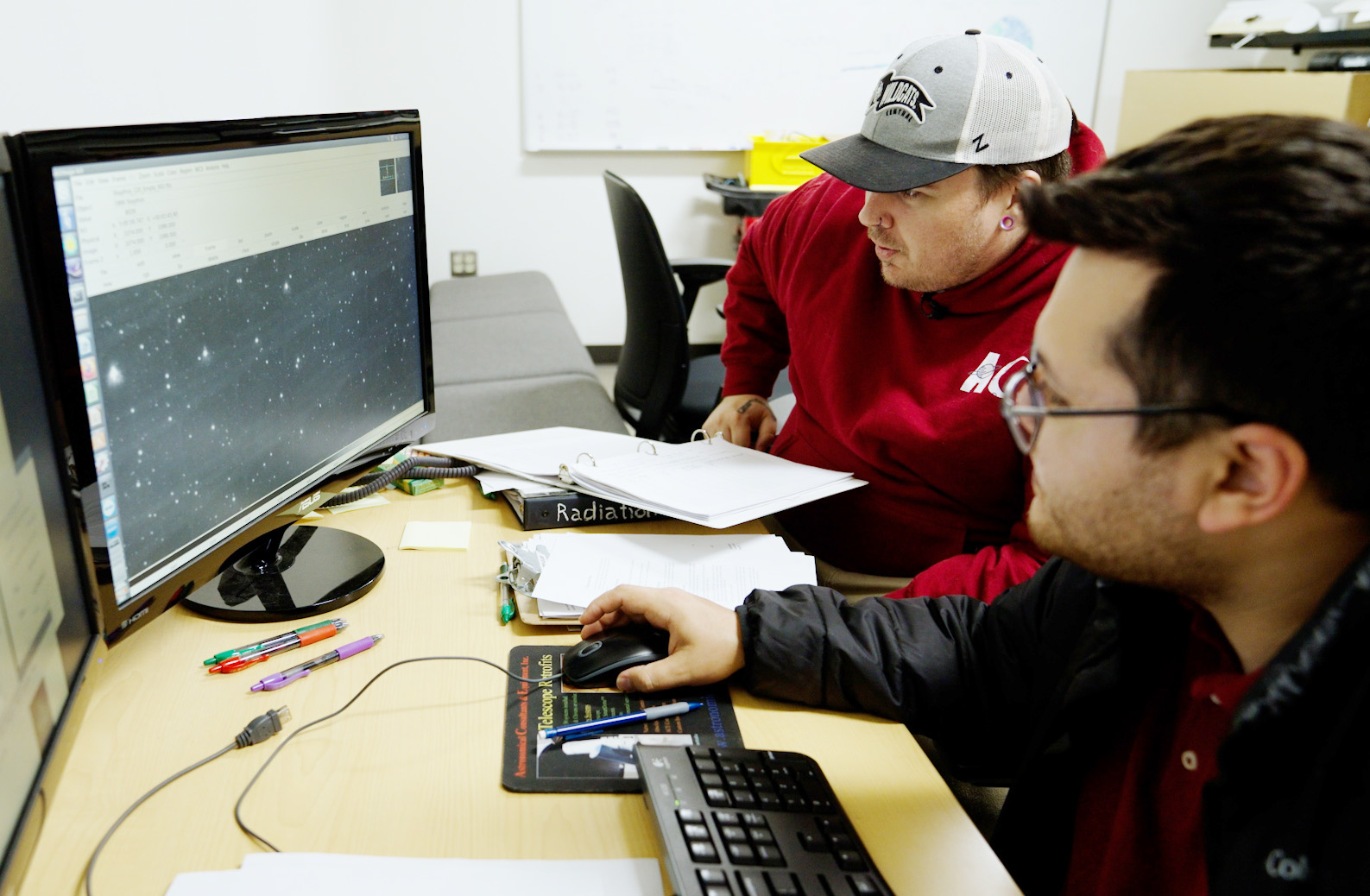
Other state institutions in Washington don't have research-grade equipment like the Astronomical Consultants and Equipment (ACE) 0.6-meter telescope available on campus. And if the institution does have something as advanced as the apparatus that sits on the roof of CWU's Discovery Hall, students typically have to venture off campus to use it.
At Central, students not only get to access the telescope in the same building as their classes; they learn how to operate the equipment and software to create professional-quality research projects that are submitted to international repositories of astronomical data.
“It’s one of the largest telescopes in the state at a university,” Fallscheer said, explaining that the apparatus and its software are controlled remotely from the fourth floor of Discovery Hall. “To have it here, where undergraduate students have priority on that instrument, is very unique.”
Senior physics major Jimmie Krager has been working with the 0.6m telescope since 2022 and now serves as a TA for the Observational Astronomy class.
After spending considerable time working with the telescope over the past three years, he now works alongside his fellow students to teach them how to use the apparatus to capture quality images of distant galaxies, star clusters, and solar systems.
“I have always been into astronomy, and being able to work with advanced equipment like this is a dream come true,” Krager said. “When the other students show me the pictures they’ve taken with the telescope, I feel like a proud dad.”
Krager is currently using the 0.6m telescope to research gamma ray afterglow events, and he continues to be impressed by the instrument’s power and accuracy.
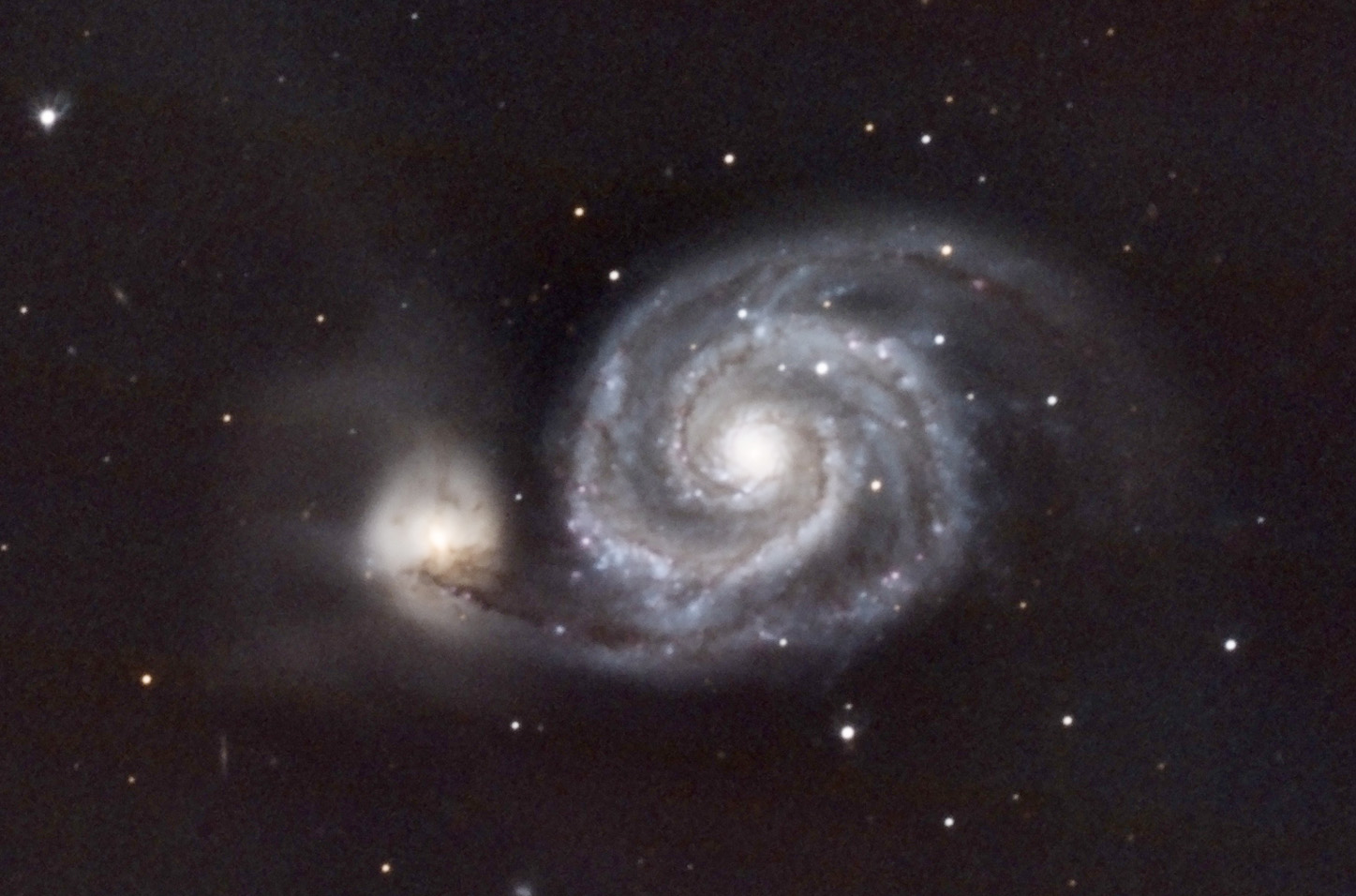
“We can see dim asteroids and watch stars explode in other galaxies — and not just see them, but understand what they’re made of or how fast they rotate,” he said.
Like Krager, senior double major Alison Prekeges has appreciated the one-of-a-kind opportunity she has been given to work so intimately with the 0.6m telescope. She looks back fondly on the first project she worked on in Observational Astronomy class and how she felt when the project was complete.
“We chose a galaxy to take a picture of and used different filters to find areas of light,” Prekeges said of the three-color images she and her classmates created. “Then we combined the three filters into one and adjusted the colors. It was my childhood dream to create a picture like that, and I finally got a chance to do it.”
Prekeges, who is graduating this spring with degrees in physics and dance, added that working with the telescope has given her an entirely new perspective on a possible career in physics.
“It’s so special that we are able to do this — that we have a telescope like this on campus — because most undergrads aren’t exposed to this kind of equipment,” she said. “I’ve benefited so much from this experience, and it’s made me a lot more interested in amateur astronomy. I could see myself getting my own telescope and filters someday and doing this kind of work for fun.”
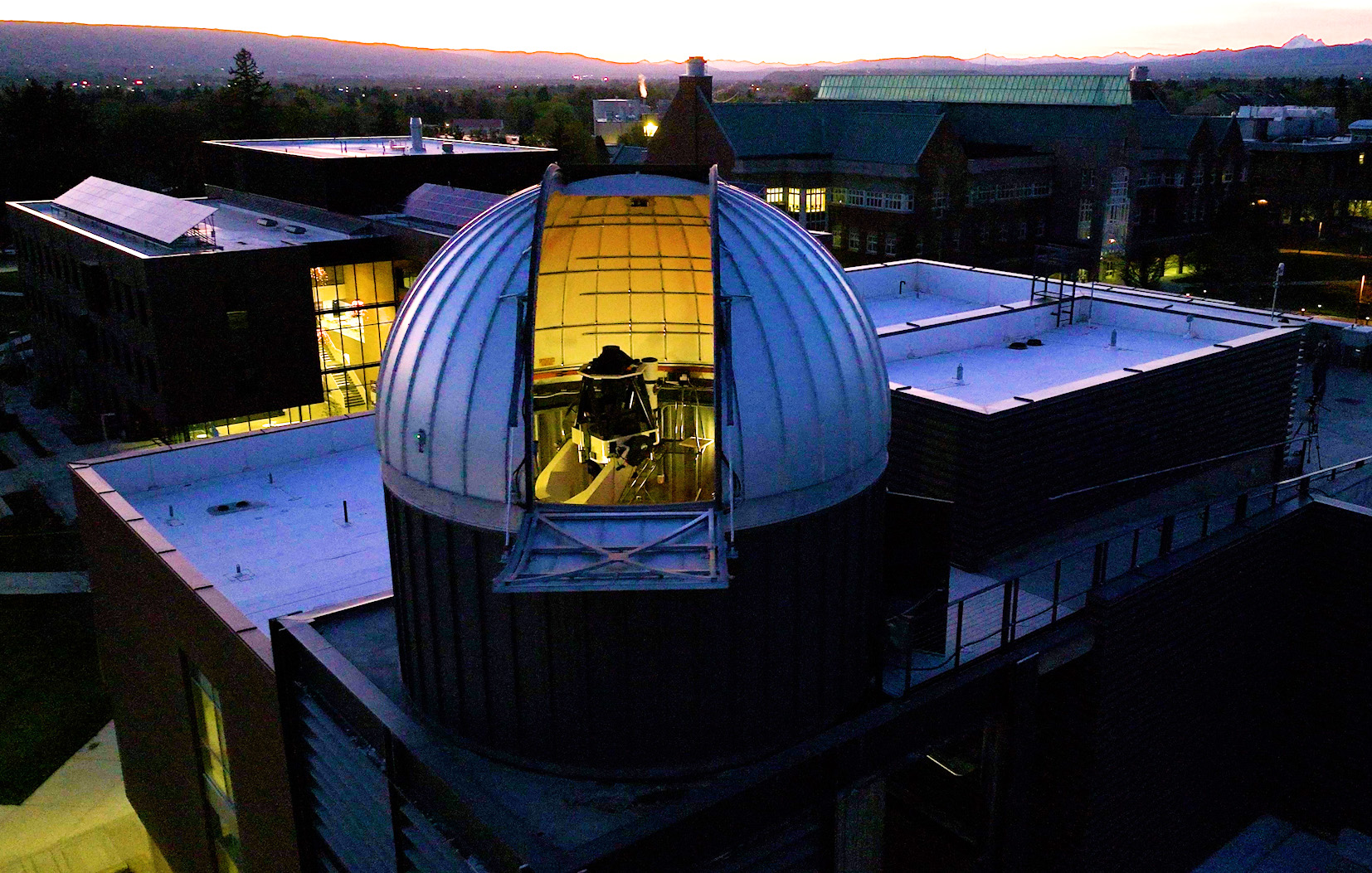
The telescope on the roof of Discovery Hall is a major draw for the Department of Physics, but Krager believes CWU’s program matches up well with its peers around the Northwest. He explained that he couldn’t have imagined a better introduction to graduate-level astronomy concepts than the one he has had at CWU.
“The physics program here is incredible,” said Krager, a non-traditional student who chose Central in large part because of our astronomical research offerings. “I’ve had so many research opportunities as an undergrad, and I feel really well prepared for the next step in my education. When I go to conferences, I’m presenting my research alongside people from large, private schools and I feel like mine is just as good — if not better — than theirs.”
In addition to his TA responsibilities, Krager also serves as president of the CWU Astronomy Club and runs the Lydig Planetarium in Discovery Hall. As he has progressed through the CWU Physics program, he feels like he has built a strong foundation for his future career.
“I would like to be a research professor someday, but I also enjoy teaching,” he said. “I love sharing what I have learned with other people.”

As he prepares to continue on to graduate school, Krager will always appreciate the practical experience he gained working alongside professors like Fallscheer, Michael Braunstein, and Ben White. He has also enjoyed being exposed to the wide variety of equipment, tools, and research methods used in world-class research labs.
“Every class I have taken has been hands-on in some way, and I have gotten so much experience with so many different tools,” Krager said, adding that he has gotten to know most of his professors on a personal and professional level. “I can’t imagine a school where I would have gotten a better physics education than I did here.”
Prekeges is planning to pursue a career in dance, but she would also be happy if she ended up going the physics route. She is planning to pursue a master’s degree someday, with a goal of working in electronics or optics.
“I originally came to CWU for the dance program, but the astronomy program was also a big draw,” she said. “I took a couple classes early on, and I’m so glad I discovered everything physics has to offer. I have grown to really love it, and I’m glad I will have an alternate career path to fall back on.”
Out-of-this-world opportunity
CWU students gain hands-on experience with 0.6M telescope
CWU News
CWU builds statewide profile with unveiling of North Academic Commons
October 12, 2026 by David Leder
International student finds growth, connection and new direction at CWU
October 7, 2026 by Tran Nha Pham