New books place CWU faculty at center of medical ethics conversation
- May 19, 2025
- David Leder

Four faculty members in the CWU Department of Philosophy and Comparative Religion have assumed a prominent role in advancing the conversation about the changing landscape of medical ethics in the 21st century.
Professors Matt Altman and Cindy Coe and Senior Lecturers Lauren Nuckols and David Schwan each made significant contributions to two separate medical ethics publications over the past year, helping them earn recognition and praise from their colleagues at CWU and across the country.
Altman’s name appears on the cover of both publications — one as a co-author, the other as a co-editor. He believes the work he and his colleagues are engaged in will prove to be highly influential in the medical ethics field for years to come.
“All four of us have studied medical ethics for a long time, and our interests started to converge over the past couple of years,” said Altman, who serves as department chair. “We were all doing our own individual research, but the more we talked about it, we decided that we could bring all of our ideas together and provide some valuable new insight into the study of medical ethics. It was rather fortuitous how everything came together.”
Medical ethics is defined as the disciplined study of morality in medicine and concerns the obligations of physicians and health care organizations to patients, along with the obligations of patients. Medical ethics delivers a framework for healthcare providers to navigate complex situations, prioritize patient well-being, and uphold professional responsibility.
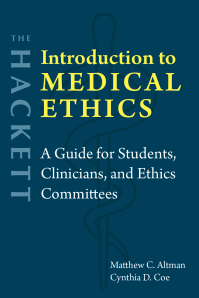
The first publication, co-authored by Altman and Coe, is a textbook titled The Hackett Introduction to Medical Ethics (Hackett). The second project is a collection of specialized essays, co-edited by Altman and Schwan, titled Ethics and Medical Technology: Essays on Artificial Intelligence, Enhancement, Privacy, and Justice (Springer). Altman and Schwan also wrote their own chapters in the book, along with Nuckols and a dozen other authors from around the world.
“It has been very gratifying to work with my colleagues and other experts on a subject we all feel very strongly about,” Altman said. “We are breaking some new ground with these books, and we hope others in the field will find them useful in their own work.”
The introductory textbook is unusual in that it is targeted not only at undergraduate students but also medical students, medical professionals, and hospital ethics committees. It is intended to be used in college and medical school classrooms, including some at CWU. Likewise, the compendium of research papers is unlike other publications currently in circulation in that it features the work of established scholars from around the world writing about recent breakthroughs in medical technology.
As Schwan explained, he and his colleagues didn’t choose to embark on these projects for fame and fortune; they genuinely care about how medical ethics is affecting the world around them, both now and in the future. These projects gave them an opportunity to shine a light on issues that are having a profound effect on the medical field and society in general.
“Our hope is that these books will help address the fundamental problems associated with medical ethics in the 21st century and benefit people who are struggling to make sense of these issues,” Schwan said. “What I find most valuable isn’t that my name is on the cover; it’s that I’m contributing to a wider discussion that may lead to finding solutions for people.”
What Does the Future Hold?
Schwan said what sets Ethics and Medical Technology apart is that it provides a unique perspective that incorporates the research of international scholars from a variety of backgrounds, including sociology, philosophy, law, and interdisciplinary studies.
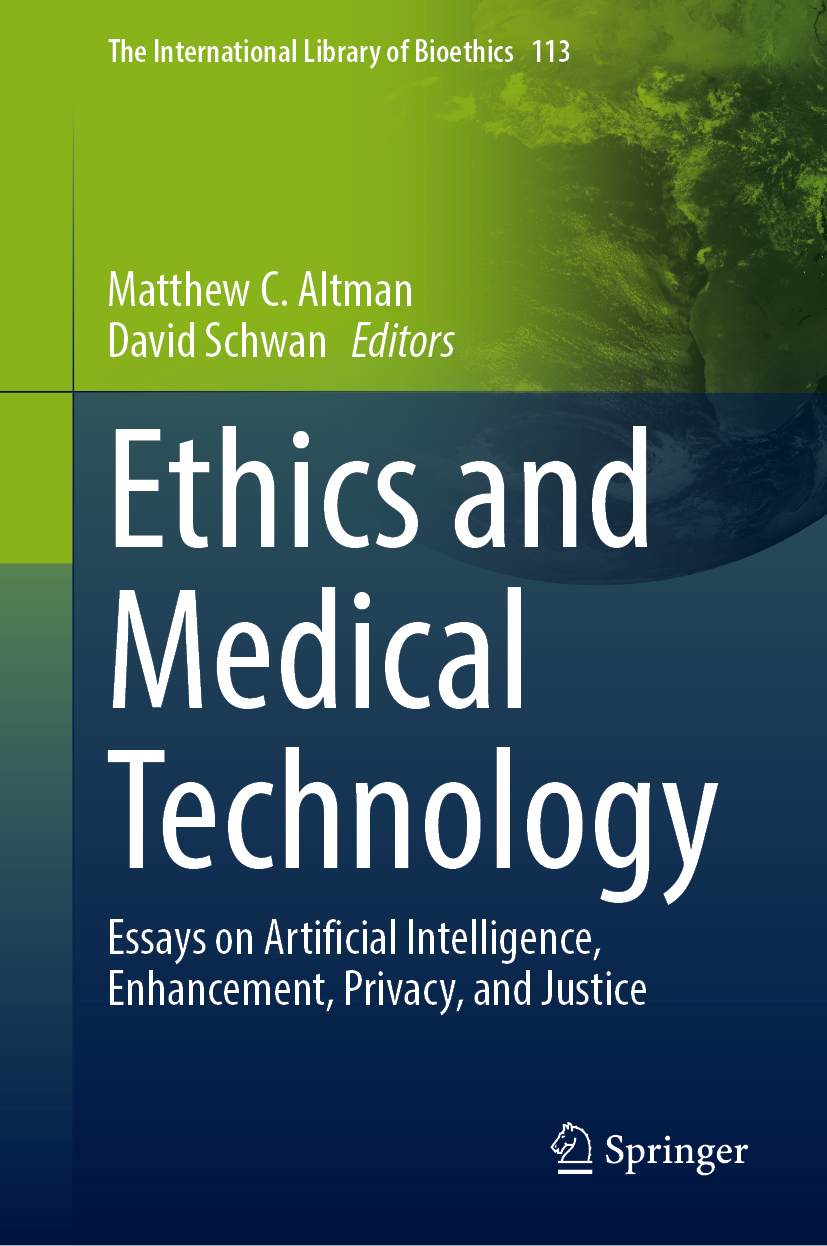
“There have been similar books written, but this one covers a wide range of topics and represents some recent, cutting-edge work that’s being done,” Schwan said, noting that what interests him most are the theoretical problems that could arise in the future.
“What are things going to look like in the future? How are these issues going to affect policy-making and certain medical practices?” he continued. “Machines can already diagnose health conditions better than humans in some cases, but we need to figure out where to draw the line. What’s the patient experience going to be like if it’s driven entirely by technology?”
As Nuckols explained, one of the more pressing issues today is the increasing use of technology, including AI, in the medical field. She wrote her chapter on big data and surveillance, focusing on medical privacy issues associated with the collection and commodification of personal medical data outside of HIPAA-protected contexts.
For example, sensitive medical information (including mental health information) can be collected or inferred from web browsing activity, social media interactions, location history, health tracking apps and devices, and even non-health-related technologies such as cars and smart home devices. Nuckols examined the medical privacy issues associated with these and other surveillance practices.
“I hope readers will gain increased understanding of the meaning and moral significance of medical privacy, and an increased awareness of data collection practices and their ethical implications,” she said. “More generally, I hope our research can inspire readers to explore these issues and debates further.”
Nuckols added that she is proud to have been involved in such an influential project that shines a positive light on the Department of Philosophy and Comparative Religion and, more broadly, CWU.
“This work is practical and concretely applicable, and I think it can help us work through some of the medical ethics issues related to newer technologies,” she said.
Advancing Their Profession
Likewise, Altman and Coe are hoping their new textbook will be well-received in the medical ethics community, including their colleagues in the CWU Department of Health Sciences. Medical ethics training is required for students enrolled in the pre-medicine, nursing, and emergency medical technician (EMT) programs, and there is also crossover appeal for law and justice, sociology, and philosophy majors.
“We want people on hospital ethics boards to use it, as well as compliance personnel who review ethics proposals,” Coe said. “There are so many questions that need to be answered, and this book covers a wide variety of topics that apply to many different areas of study.”
Among the topics she and Altman explored in the book include: the regulation of medical research involving children; medical racism; conscientious objection; reproductive rights; autonomy for both physicians and patients; and doctor-patient confidentiality.
“One of the things we grapple with in the book is that there are many legal regulations around healthcare, but we also need to consider the moral questions,” Coe said. “Those tend to be somewhat different, but they are just as important.”
The Hackett Introduction to Medical Ethics contains 14 chapters and will be released this fall. Coe and Altman — a married couple who co-authored another book about 10 years ago — said the concept for their new book grew out of their shared love for teaching, including the past 22 years at CWU.
“This is intended as a teaching textbook, and we thought very carefully about how we get information across to our students,” Coe said. “We have found that we are most effective when we examine real-world examples and encourage small-group discussions. Our goal was to translate what we do in the classroom into a resource that other teachers can use, and we are very pleased with how it turned out.”
CWU News
Arts and Humanities Month continues to build momentum
October 21, 2026 by David Leder

New position at CWU-Des Moines aimed at improving student experiences
October 21, 2026 by David Leder