CWU Primatology alumni gather to remember Washoe the chimpanzee
- May 28, 2025
- Rune Torgersen

For almost two decades, the Chimpanzee Human Communication Institute (CHCI) at Central Washington University was the site of ground-breaking research into primate behavior and ecology, fueled by Washoe the chimpanzee and her adopted children, Loulis, Moja, Tatu, and Dar — all of whom could communicate with researchers through American Sign Language.
On Friday, May 16, more than 150 alumni of the world-renowned Primatology program these special chimpanzees helped create gathered at CWU once more to honor the outsized legacy of the program, and to dedicate a new art installation to the memory of the first-of-its-kind work enabled by the CHCI.

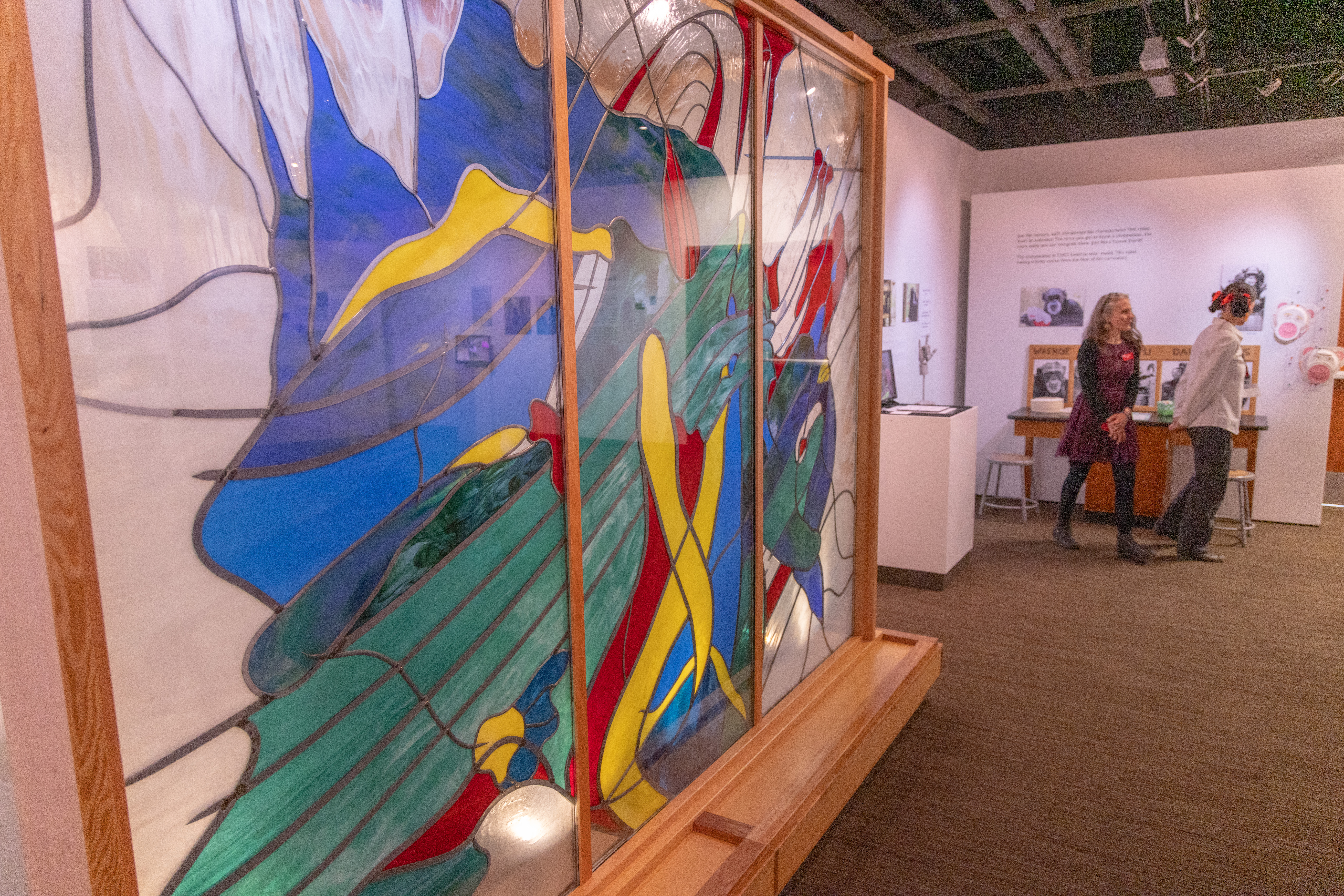
The day began with an interactive panel on the legacy of the Primate Behavior program, along with the opening of a special exhibit at the Museum of Culture and Environment in Dean Hall, centered around the lives the chimpanzees lived on the CWU campus. The exhibit, which is now open to the public, features a large stained-glass window by artist Julie Prather, which is based on one of Washoe’s paintings, titled “Bug Flower.”
The dedication ceremony for the new monument outside of Dugmore Hall featured speeches by CWU President Jim Wohlpart, former Board of Trustees member Ron Dotzauer, Primatology alumna Crickette Sanz, and Primate Behavior program founders Roger and Debbie Fouts.
Debbie Fouts was overcome with joy at seeing so many familiar faces all in one place, celebrating the program they had built together.
“We’re just so grateful that you all are here and can be with us — I mean, it’s just amazing,” she shared with the attendees. “Thank you, thank you, thank you for all the things you have given to us for so many years. There are so many friends here, from CHCI, with their families, that we’re just so grateful.”
Her husband, Roger, expressed more mixed emotions, acknowledging the hurt that had been inflicted on Washoe’s original family in Africa in order to bring her to the U.S.

“It’s remarkable that Washoe did choose us,” he told the crowd. “I hurt sometimes when I think of what role she might have played for her family had the Air Force left her in Africa. All that she could have offered to her community and to her children, where she belonged. Her unwilling sacrifice does have something good that comes out of it, but there’s also that part of the loss, because she was remarkable.”
Sanz, who has spent more than 25 years researching great apes in Africa with her husband, fondly recalled the time she spent with Washoe during her bachelor’s and master’s degree programs at CWU.
“It’s still quite difficult for me to believe that Washoe has passed, as she really always seemed larger than life,” Sanz said. “She was the type of individual who made not only a mark on the world, but on each person who knew her.”
Wohlpart, who has been fascinated by the story of Washoe since childhood, delivered an emotional speech about her legacy and that of CWU’s Primatology program. He made a point of inviting the dozens of gathered alumni to the University House for a reception following the event so they could continue reconnecting with one another.
“Today is dedicated to the generations of primatology professionals who have been educated through the programs that Washoe helped found,” Wohlpart said. “Even after the closure of the CHCI in 2013, Central’s important role in the field of primatology continues, thanks to all of you. We are here for a very short time. Take every moment, and be fully present, because what you are doing in this moment will have an impact on the future.”
At the conclusion of the ceremony, the attendees erupted in a cheer, imitating the sounds of celebration often heard across campus on joyous occasions that took place in the CHCI. The hooting of happy chimpanzees returned to Ellensburg for a brief but deeply significant moment.
Washoe was the world’s first, and so far only, example of a non-human learning and teaching a human language. CWU remains the only institution in the world to obtain a bachelor’s degree in Primate Behavior and Ecology, and the only university in the country that offers a master’s degree in Primatology.
Media contact: Rune Torgersen, Marketing and Communications, 509-963-1264.

CWU News
Arts and Humanities Month continues to build momentum
October 21, 2026 by David Leder
New position at CWU-Des Moines aimed at improving student experiences
October 21, 2026 by David Leder