Geothermal Technology FAQs
'The Heat Beneath Your Feet'
A Guide to Geothermal Technology at CWU
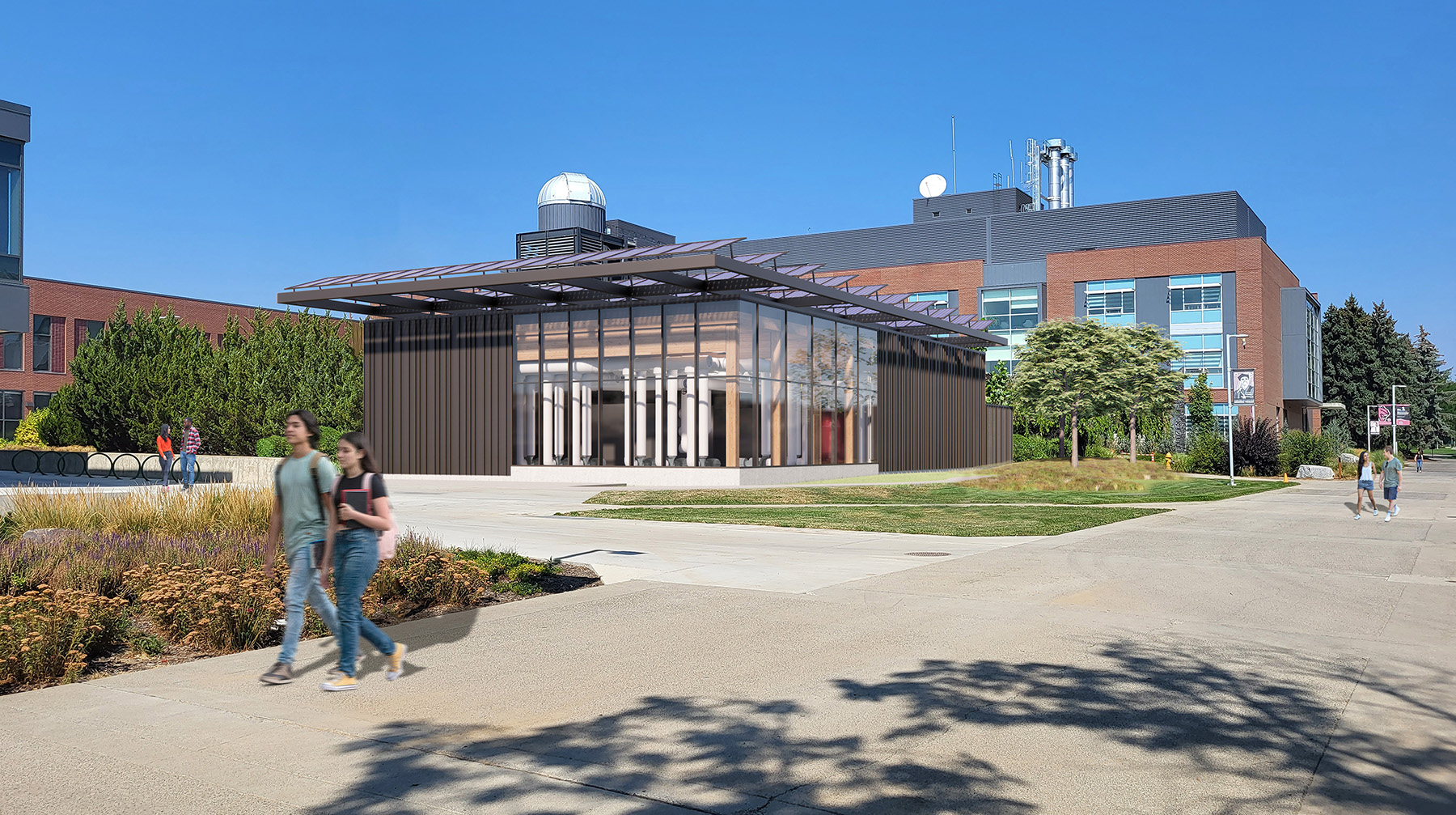
Central Washington University is building a Geo Eco Plant on the north end of campus that will heat and cool the North Academic Complex, scheduled to open in spring 2026. The Geo Eco Plant contains a well that accesses water contained in the Ellensburg Aquifer, which lies directly beneath the CWU campus.
The use of geothermal power is expected to greatly reduce the university's reliance on fossil fuels. An additional geothermal power project is in the planning stages as part of our 25-year Climate Action Plan. The following FAQs provide additional details about how geothermal power will help CWU reach our long-term objective of becoming a carbon-neutral campus.
-
What is a geothermal well?
A geothermal well uses an open loop pump system to extract water from the ground to condition the temperature of any connected building for a fraction of the energy cost of a traditional HVAC system. Then the water is put back into the ground, where it is heated or cooled by the earth. Rather than consuming any groundwater, the system acts as an energy exchanger, avoiding contaminating our environment. CWU’s GeoEco Plant, when completed in early 2026, will feature the largest geothermal well in Washington state, along with a 50-kilowatt solar panel array to help offset the electricity demands of this renewable energy system.
-
What kind of technology exchanges energy with the aquifer?
A six-pipe water-to-water heat pump exchanges energy with the aquifer by transferring heat between the groundwater and building systems. Using refrigeration cycles, the system moves thermal energy, either by extracting heat from the aquifer to warm buildings or rejecting heat when cooling buildings. The refrigerant in the system undergoes phase changes (liquid to gas and vice versa, similar to boiling water into steam) to facilitate this energy transfer. Since heat pumps move energy instead of generating it, they are significantly more efficient than systems that rely on fossil fuels or electric resistance heating.
-
Why is CWU uniquely suited to use a geothermal system?
Ellensburg sits on top of a large underground aquifer, with water that stays at a consistent temperature (approximately 55-65 degrees Fahrenheit) all year long. In the summer, this aquifer will function as a heat sink, enabling us to cool the air in connected buildings. In the winter, the aquifer will warm up the cold surface air, which will allow CWU to heat buildings without the need to burn fuel.
-
Why is CWU turning to geothermal technology to help decarbonize campus?
CWU’s Climate Action Plan commits the university to becoming a zero-carbon campus no later than 2050. Approximately 60% of CWU’s greenhouse gas emissions (GHG) can be attributed to using natural gas for heating buildings across campus. Human activities such as burning fossil fuels (e.g., natural gas, oil, and coal) produce powerful GHGs, which blanket the Earth and trap the sun’s heat, therefore causing climate change impacts.
In May 2023, House Bill 1390 was signed into law, which requires public institutions (e.g., CWU) to submit decarbonization plans for their respective campus district energy systems. As a result, CWU will be submitting a 15-year Decarbonization Plan to the State of Washington no later than June 2025. CWU’s first GeoEco Plant exemplifies CWU’s commitment to significantly reducing greenhouse gas emissions and serves as a critical step forward as CWU begins to transform its campus district energy system over the next 15 years.
Utilizing the Ellensburg aquifer through emission-free geothermal technology will enable us to scale back the use of our current steam plant and water-cooled chillers, which will significantly reduce the university’s GHG footprint and, in conjunction with our other decarbonization efforts, position us to become a carbon-neutral campus no later than 2050. The GeoEco Plant, along with the demolition of two aging and inefficient buildings, will support CWU’s goal of reducing our greenhouse gas footprint by 33,000 metric tons over the next 50 years.
-
How far along is the project, and when will the well be operational?
The GeoEco Plant is currently under construction, across the street from the site of the new North Academic Complex. CWU anticipates the geothermal well to be in operation in the fall of 2026.
-
How many buildings will be served by the geothermal well?
The first GeoEco Plant will be capable of heating and cooling approximately 500,000 square feet of CWU’s buildings. The first GeoEco Plant will initially provide emission-free heating and cooling to the new 106,000-square-foot North Academic Complex. However, the GeoEco Plant will also provide renewable heating and cooling to additional buildings in close proximity to the plant as the buildings are upgraded to support the geothermal infrastructure.
-
How will students benefit from the installation of a geothermal well?
The GeoEco Plant will feature an educational dashboard for students, faculty, and staff to learn more about the mechanics and benefits of renewable geothermal technology, including how this project will help support CWU achieve its climate pollution reduction goals. As sustainability becomes a more prominent component of many college degrees and professions in response to the ongoing climate crisis, having the opportunity to work with cutting-edge technology like the GeoEco Plant will equip our students and others in the region with the experience, resources, and skillsets they need to make a positive difference in their fields.
-
How does this project benefit Ellensburg, Kittitas County and the surrounding region?
CWU seeks to build collaborative relationships that not only develop top-tier graduates, but also help to spur economic growth throughout Kittitas County and the surrounding region. A campus-wide conversion to geothermal power will generate interest across various sectors, including the private sector, to learn more about this system in addition to creating opportunities for tourism, student recruitment, and local business growth.
Additionally, the state Department of Ecology identified Ellensburg as one of the 16 communities in Washington that are overburdened, vulnerable, and highly impacted by criteria air pollution. CWU is the City of Ellensburg’s largest natural gas customer and a large user of No. 2 fuel for our Central Heating and Cooling Plant. Both fossil fuel sources emit large amounts of PM2.5. By continuing to complete these types of projects, CWU is progressing towards achieving our decarbonization goals, resulting in the reduction of PM2.5, which over time will begin to positively impact the health of community members, including those most vulnerable to poor air quality.
-
What’s next for implementing geothermal technology at CWU?
CWU received additional funding from the Washington State Legislature earlier this year to install and construct a second geothermal injection and extraction well, but these funds are contingent upon the state’s Climate Commitment Act (CCA) surviving a potential repeal during the November election. If the CCA is repealed, CWU will experience significant barriers to achieving its near-term climate action goals and the university will lose roughly $20 million in funding for climate change mitigation efforts, including funding for a second geothermal plant.