
Little did he know that these experiences planted the seeds that would eventually grow into a career as a Blue Angels pilot.
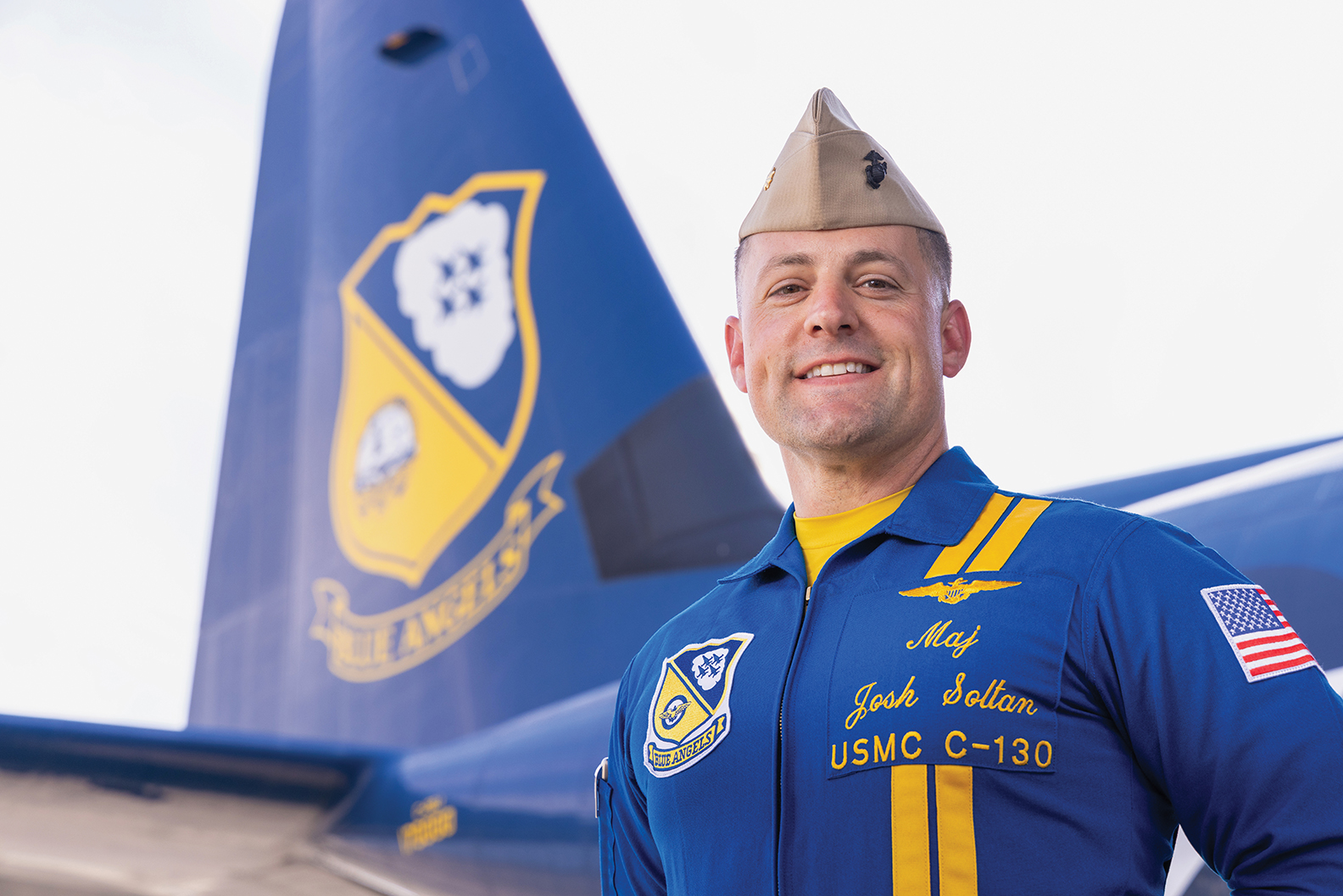
For the past three years, Soltan has been the lead pilot of the beloved C-130J “Fat Albert” and just completed his final year flying with the U.S. Navy’s elite air performance squadron.
As he reflects back on his time in this role, he is reminded of the hard work he put in over the last two decades to get where he is today.

“I was always interested in aviation but didn’t have a lot of outlets to go back to it,” says Soltan, a native of Spokane who serves as a pilot instructor in the U.S. Marine Corps. “When the door to my baseball career closed, I found another door in Central’s aviation program. I looked into it and thought it might be the avenue for me, so I applied and got accepted.”
After earning his degree from CWU in 2010, Soltan’s career took off rapidly. By the summer of 2011, he had completed The Basic School in Quantico, Virginia, and began his flight training in Pensacola, starting his journey in the same place he is today.
His aviation career has led him through various stages of training, from primary flight training in Corpus Christi, Texas, in 2011, to earning his Wings of Gold as a Naval Aviator in 2013.
By 2014, Soltan was flying with VMGR-152 “Sumos” in Okinawa and Iwakuni, Japan, where he honed his skills across the vast Pacific region.
“I spent three years out there flying all across the Pacific,” Soltan says. “That squadron’s call sign is the ‘Sumos’ because we are a large aircraft that carries a lot of things all around the different island chains. They have us working anywhere between South Korea to Alaska—all the way to Australia, and pretty much everywhere in between until you get to India.”
Since his time at CWU, Soltan’s dedication and passion have never waned. His experiences were not just about flying; they were about understanding the broader implications of his work.
“We carried aid for typhoons that devastated the Philippines, and we would fly down a lot of water and supplies and personnel to help clean up and get them back up and running again,” he recounts.
Soltan’s missions—from providing humanitarian aid in Nepal after a devastating earthquake to conducting joint exercises with allies in South Korea and Australia—showcased the global impact of his role.
All of Soltan’s hard work culminated in the biggest opportunity of his life in July 2021, when he was selected as a Blue Angels C-130J demonstration pilot, a role that would significantly advance his aviation career.
The C-130J, nicknamed “Fat Albert,” carries the team’s maintenance and support equipment to air shows across the country. The plane also performs aerobatic maneuvers at every air show, with Major Soltan serving as the lead pilot.
For Soltan, the Blue Angels are more than just a team of elite pilots; they represent the heart and soul of the Navy and Marine Corps.
“Representing over 800,000 active-duty, reserve, and civilian men and women currently serving worldwide in the Navy and Marine Corps is quite the task to take on,” he says. “It is my job now to represent them, and I can’t let them down.”
Soltan is the second Central alumnus to have been selected for the Blue Angels, joining Lt. Cmdr. Craig Olson (’91), who flew two separate tours with the Navy Flight Demonstration Squadron in 2002 and 2007.
Continuous Improvement
The transition to the Blue Angels required a level of precision and self-awareness that pushed Soltan to new heights as a pilot and as a leader. But the Blue Angels are not just about precision; they are about teamwork and personal growth.
“Pilots make mistakes all the time, whether they are willing to admit it or not,” Soltan explains. “The process to correct those mistakes is what matters.”
This concept is discussed in the exhaustive Blue Angels debriefs, which can last for over an hour. The debrief sessions focus on identifying errors of all magnitudes, from stuttering in standard briefs, being off a flight track, missing a proper verbal call or response, omitting a procedural checklist item, heading, airspeed, altitude, and more.
This accountability exercise fosters an environment of honesty and continuous improvement.
“These errors are human, and being truly honest with yourself about making an error in front of each other can be a freeing but very unnerving endeavor,” Soltan says. “But we are also encouraging of the things we do right. This makes for an honest and forthcoming environment which facilities our precise, practiced, and risk-mitigated flying.”
He adds that the ability for pilots to be hyper-critical of their own performance is a learned process, but once they have adopted the Blue Angels way of doing these things, “it becomes a part of who you are and makes you better at noticing the smallest of details.”
Through this rigorous process, Soltan has learned valuable leadership traits, including the importance of accepting criticism and finding creative ways to ensure mistakes are not repeated.
“Acceptance of the smallest critique from my fellow teammates and finding a creative way to ensure it doesn’t happen again is a leadership trait I have tried to adopt,” he says. “From a scuff on my boot to poor attitude during the day, I have learned a great deal about myself and others on how to become a better human being and an even more supportive teammate.”
From advancing his aviation skills to accelerating his own personal growth, the last three years have shaped Soltan into the pilot and person he is today.
This fall, he finished his final air show performances with the Blue Angels. In November, Soltan flew over Pensacola for the last time in his blue suit that he will never put on again—a ritual the Blue Angels call a “Drop Salute.”
“We have one show that we call our End of Season Show, our Homecoming show, and it’s the last time the 2024 Blue Angels fly and the last time I will stand in front of a crowd and do anything show-related,” Soltan said last summer when he was in Seattle for the annual Seafair celebration.
Now, it’s time for Soltan to pass the baton to the next team, confident that he has done his best to uphold the legacy of the Blue Angels.
“Our names on the planes are taken off, and by the time you land, the 2025 team is taking over,” he says. “Then you can kind of take a breath and think ‘OK, I’ve done the best I could and now it’s on to the next thing to continue that legacy.’”
Flying Into the Future
Most Blue Angels pilots hold their role for two years, but two pilots fill three-year terms; Soltan’s role as the lead C-130J pilot and the narrator on the F18 side, who is the number five pilot.
While his term with the Blue Angels is now complete, his service with the Marines will continue. He already has his new assignment, and he will soon be heading back out to the Pacific to join a C-130J squadron in Hawaii.
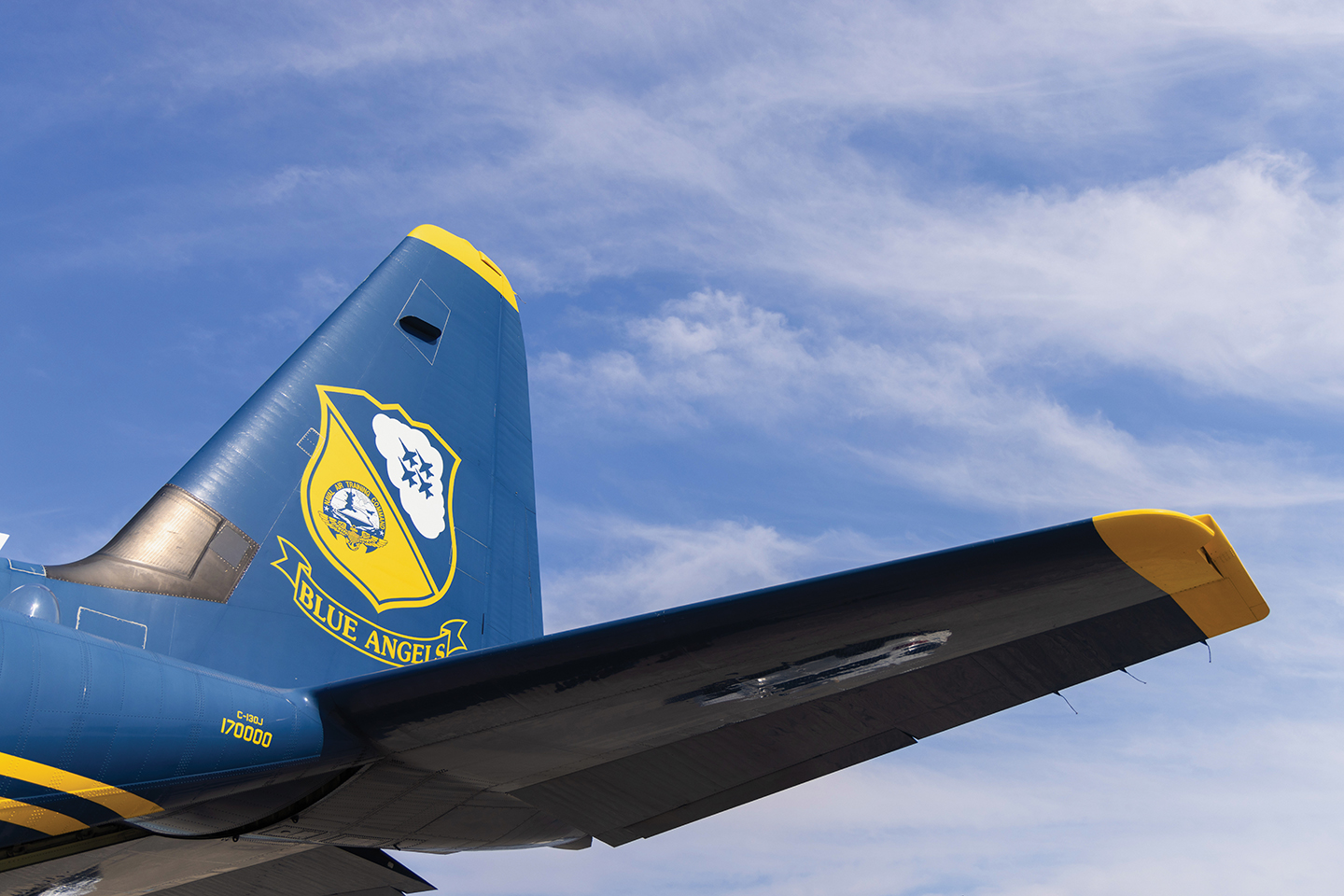
“I am going to go back out to do the same stuff that we were doing in Japan a few years back, so it’s kind of coming full circle,” Soltan says. “I am pretty excited to be an instructor pilot back with the fleet and working with new co-pilots coming through and getting them all worked up so that they can replace me.”
Although one of the most rewarding chapters of his career has come to an end, Soltan’s future aspirations continue to soar.
“I try not to limit myself and say I am only going to do one thing because there are so many opportunities out there,” he says. “I realize after doing this job that you really can broaden yourself by keeping an open mind with what’s coming at you.”
Whether it’s continuing in the Marine Corps, transitioning to the airline industry, or pursuing something entirely new, Soltan knows one thing for sure: his journey is far from over, and the sky is not the limit.
And through it all, his connection to his alma mater remains strong, as evidenced by his decision to donate his Blue Angels gear to the CWU Aviation department at the end of the 2024 season.
Soltan wants to help inspire the next generation of aviators and push students to reach for the stars when they are planning their futures.
“It would be great if a future CWU graduate achieves a commission and becomes a naval aviator and Blue Angel one day again,” Soltan says. “Maybe they could go beyond that and aspire to become an astronaut and go back to the moon or even beyond that to piloting/commanding a shuttle to space.”