
Captured by the U.S. Air Force for use in the space program, she was named after Washoe County, Nevada, where she was raised and taught to use American Sign Language (ASL). Her caretakers, R. Allen and Beatrix Gardner, realized that, since previous attempts to teach chimpanzees to use vocal speech had failed, it might be possible to pass on a different means of communicating using the primate’s natural talent for complex gestures and socialization.
It worked, and Washoe became the first non-human to ever learn and teach a human language.
Project Washoe formed around the signing chimpanzee, and in 1980, she and her family arrived at Central Washington University, in the care of Professor of Psychology Roger Fouts and other faculty. In 1993, CWU built the Chimpanzee Human Communication Institute (CHCI), a specialized building to house the chimpanzees and allow for educational programs. The interdisciplinary Primate Behavior program Fouts helped found would evolve into one of CWU’s most unique fields of study.
Washoe’s influence guides the program to this day, infusing the work and research being conducted with a deep understanding of the rich inner lives of primates.
Senior Lecturer of Primate Behavior Mary Lee Jensvold joined the Experimental Psychology program in 1986, and has watched as Primate Behavior at CWU became the force of nature it’s known as today.
“I call the students who come out of our program ‘shooting stars,’” she said. “They go out and do great things at sanctuaries and research sites all over the world. They’re unique, and they take an incredibly compassionate, individualistic approach to caring for these intelligent, social animals.”
Jensvold served as director of the CHCI until it closed in 2013, and she continues her work with Washoe’s remaining family members, Tatu and Loulis, at the Fauna Foundation in Carignan, Quebec, Canada. As a consultant for the Friends of Washoe, she helps ensure Tatu and Loulis are well cared for in their old age, and that all of the valuable data gathered from Project Washoe is put to use in educating the next generation of primatologists.
“One of the things we’ve always emphasized in the program is that primate research needs to be as non-invasive as it possibly can be,” Jensvold said. “It needs to be humane, with consideration for the primate you’re studying.”
Washoe passed away in Ellensburg on October 30, 2007, at the age of 42. Her legacy includes the formation of the CWU Primate Behavior program, a wholly unique and interdisciplinary approach to the field that is revered and respected around the world for helping advance our understanding of primates.
Unmatched Expertise
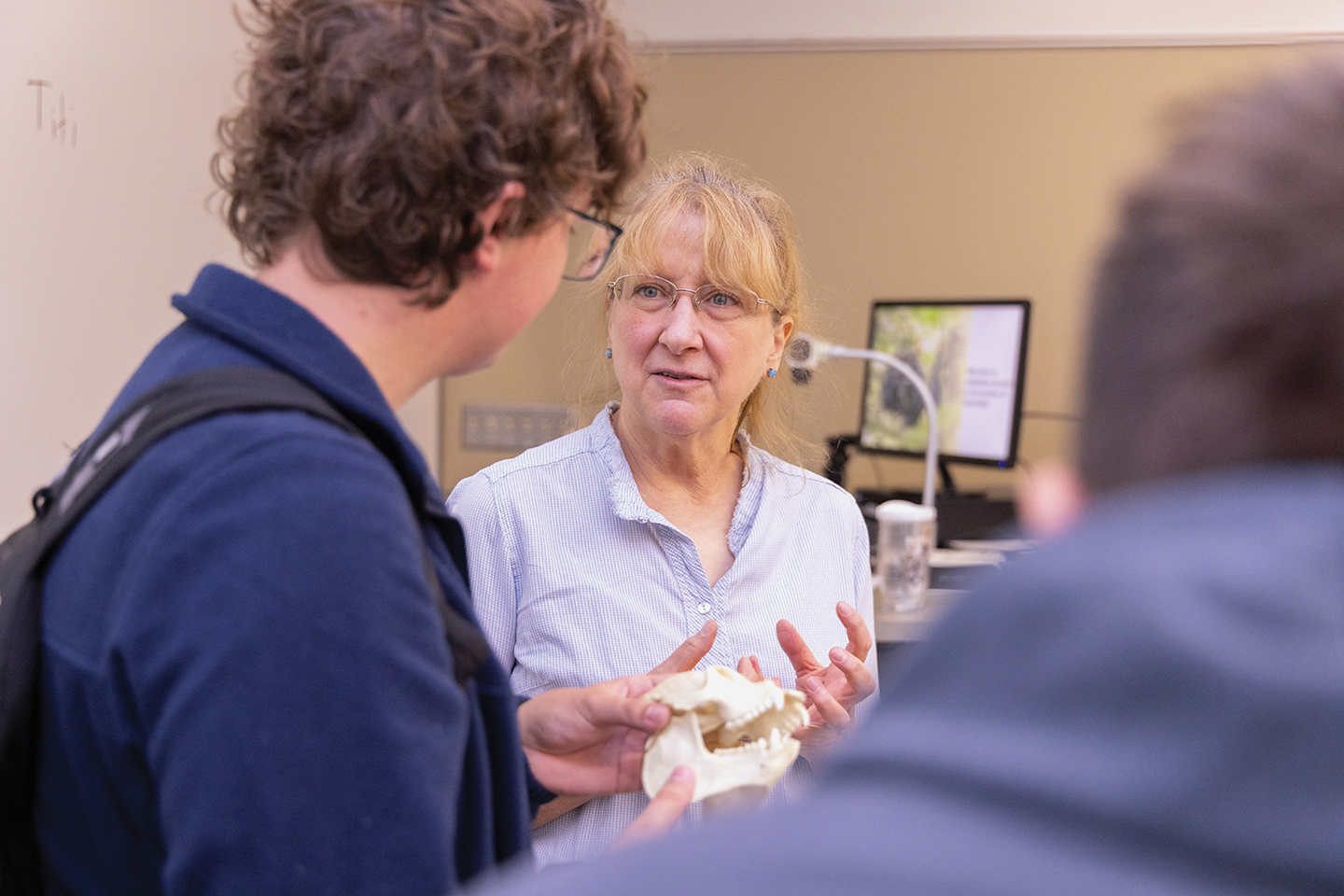
The Primate Behavior program at CWU is split into a Bachelor of Science in Primate Behavior and Ecology, and a Master of Science in Primate Behavior. The BS degree is a double major, requiring classes from anthropology, biology, and psychology, and it remains the only program in the western hemisphere where undergraduate students can earn a degree in primate behavior.
“The sheer amount of primatology-specific classes offered at CWU is part of what makes the program unique,” Jensvold said. “When I was an undergrad, and I knew I wanted to work with primates, I ended up having to do an anthropology minor to get there.”
This approach to the field extends to the MS program, where students have broadly varied fields of study, yet share the camaraderie that comes with common purpose. Katie Seymour, who’s working on her master’s thesis, came to CWU because of Project Washoe’s history, and she stayed for the connections she has forged with her classmates.
“We’re a very tight-knit cohort, and we all get along super well,” she said. “The program does a great job of bringing together all the different disciplines within primatology, and working alongside people with different focuses gives us all a broader perspective on the field.”
Seymour spent last summer interning with Fauna Foundation, working alongside Jensvold, Tatu, and Loulis. This was the first time she had seen chimpanzees sign with one another in person.
“The work that I’d done up until that point was all based on recorded footage from the CHCI,” Seymour said. “Seeing chimps signing to themselves and with each other for the first time in person was a very interesting and humbling experience. It was super reaffirming for someone like me, who came into primatology from a psychology background.”
Seymour’s thesis centers on how signing chimpanzees experience and express familiarity through signing behaviors.
“I’m looking at the speed and reiteration of their signs when directed at different humans,” she said. “Humans change how they express themselves depending on their relationship with the person they’re talking to, so I want to see if the same is true in chimpanzee-human interactions in sign language.”
While some students go into research after graduation, others choose to pursue conservation and sanctuary work. Kailie Dombrausky (’18) works at Project Chimps in Georgia as a caregiver for a group of 95 chimpanzees. She says her time at CWU has helped her give the primates the kind of care they deserve.
“I’m applying everything I learned in grad school here,” she said. “I provide our chimps with enrichment and get to see them interact with each other and build the strong relationships they need to thrive.”
Jensvold remarked that primate sanctuaries saw a surge in demand after the U.S. Fish and Wildlife Service classified all chimpanzees in the country as endangered in 2015, ending all biomedical studies on them and leaving thousands in need of a home.
“It used to be that being a caregiver at a chimpanzee sanctuary was a dream at best,” she said. “Now, caregivers have their pick, and can walk onto a job anywhere.”
Dombrausky believes taking care of this population of chimpanzees is a moral obligation following their release.
“What’s important to understand is that chimpanzees are our closest relatives, and all of our research suggests that they are intelligent beings with complex inner lives,” she said. “They have emotions, and chimps that have spent long periods of time in less humane forms of captivity begin to show signs of PTSD and depression. They are with us because they were raised in captivity and wouldn’t be able to reacclimatize to a life in the wild. It’s up to us to not write them off as animals, and give them the care and attention we owe them after their years of trauma.”
Students from CWU’s Primate Behavior program are uniquely suited to this task, thanks to the opportunity they have to practice on the chimpanzees living just 20 miles down the road in Cle Elum.
Common Cause
Opened by Keith Lachappelle in 2008, Chimpanzee Sanctuary Northwest (CSNW) provides care to 15 chimpanzees.
Sanctuary directors JB Mulcahy and Diana Goodrich both graduated from CWU’s Primate Behavior MS program in 2001, and continue to give back to the school by offering internships to aspiring primatologists.
“We’re in the unique position of being very closely aligned with CWU, both ideologically and geographically,” JB Mulcahy said. “For students looking to get hands-on experience in an academic environment, we’re really the best option nationally. We’re really excited that this came about, and even more so about all the places it can go from here.”
Interns at CSNW prepare meals and daily enrichment activities for the chimpanzees, and some even receive special training that allows them to work directly with the animals. Mulcahy explained that the internship program benefits both parties, as CSNW grows and learns through the constant influx of new perspectives.
“While the students act as extra staff members, they also bring new ideas to the table that keep the sanctuary evolving,” he said. “They take what we’ve taught them about high-level care guided by compassion and implement it at sanctuaries and care facilities all over the world.”
The experience working with, and caring for, chimpanzees is often a pivotal moment in students’ careers, leading them down a road they might not have otherwise considered.
“Chimpanzee Sanctuary Northwest was really how I got my foot in the door for chimpanzee caregiving,” Dombrausky said. “Getting that experience early on was crucial when I was applying for jobs after I graduated, and ultimately led me to my role at Project Chimps.”
As Primate Behavior and CSNW work in tandem to produce field-defining professionals, a lot of those professionals find ways to contribute to the program that gave them their start. One such alum is Jake Funkhouser (’18).
“We can reach out to people like Jake and ask him questions about his research as it applies to our sanctuary, in order to stretch our own research further,” Mulcahy said. “Having that personal connection means that we get better, more tailored advice, and are able to help our friends out in kind.”
Worldwide Visibility
Funkhouser jumped into volunteering with CSNW as early in his college career as he could.
“Before I had even declared my major, I was spending as much time at Chimpanzee Sanctuary Northwest as possible,” he said. “That experience provided the foundation for my career, ignited my love for primates, and even led me to other opportunities like time in Panama.”
In addition to CSNW, the primate behavior program offers field placements all over the world, in order to help students put their education into vivid context. During his junior year of undergraduate studies in Primate Behavior and Ecology, Funkhauser found himself heading to Panama to help rehabilitate primates confiscated from the illegal pet trade.
“We were brought a spider monkey that had been rescued from a pet trader, and were immediately faced with the challenge of providing the right kind of environment to help her learn the fundamental skills she needed to succeed in life as a spider monkey,” he said. “I knew from my classes that spider monkeys have a really distinct way of moving through the trees, so I was able to apply that in designing a forest enclosure, ensuring she learned what she needed to.”
Following his graduation from CWU, Funkhouser earned his PhD at Washington University in St. Louis, and is currently a postdoctoral fellow at the University of Zurich, Switzerland. He regularly works with CWU students to continue the culture of collaboration that makes the program possible.
“At this point, it is a multi-generational network of highly skilled primatologists, helping each other grow and learn even long after our time at Central is over,” Funkhouser said. “My PhD advisor, Crickette Sanz, studied at the CHCI, so from the very beginning we had this shared background, and she was able to help me tailor my degree to suit those needs. We’re all in it together, and wherever I go, I always run into at least one other Central alum in the room with me, helping to build that cumulative body of knowledge and bringing it back to Central to advise the next generation of scholars focused on primate conservation and well-being.”
Current Primate Behavior MS student Jianna Terranova has completed research programs in Uganda and Costa Rica, and she concurs that the opportunities students have to apply the knowledge they glean from the program before graduation are everywhere.
“Wherever you go in Dean Hall, there are always posters for field schools and research experiences hanging on the walls,” she said. “Those opportunities are the best, because they take what you’ve learned in the classroom and show you how it fits into the real world. It’s just amazing how it all comes together. My future really clicked into place when I first saw the opportunity to go to Africa for field school.”
Lifelong Connections

When Washoe passed away in 2007, she left behind a flourishing family transcending the boundaries of species to shed new light on the study of primates as a whole. Her adopted son, Loulis, continues to use the sign language she taught him, much like the students of CWU’s Primate Behavior program continue to benefit from the culture she left behind.
Each student who goes out into the world to research and care for our closest genetic relatives in the animal kingdom brings the knowledge they gain back to CWU to start that cycle anew, and continue growing what has become a keystone program for the study of primate behavior.
“The program is successful because of the incredible people who support it,” Funkhouser said. “University leadership, faculty, teachers, research partners, graduate students—everyone plays a part in continuing the incredible international legacy of this program. We know that it’s a fairly niche area of study, and nobody’s expecting thousands of students to show up for it, but the dozens of students who do come, they will become the world’s experts in this field, without a doubt.”
Learn more about the history of the Chimpanzee Human Communication Institute at CWU.
Read about the accomplishments of a distinguished CWU primatology program graduate.