
As Professor David Bieloh explains, graphic design isn’t just about creating a compelling logo or dynamic poster design. Developing into a professional graphic designer relies just as much on a student’s art and design foundation: understanding composition, visual experience, effective use of color and typography, and dozens of other core competencies.
“We’re not just trying to teach our students how to design the next commercial product package,” Bieloh said. “We have a much more human-centered philosophy. We’re more concerned with teaching them concepts and strategies that they can use to solve problems, both in the industry and in society.”

Associate Professor Justin Beckman and his colleagues aim to help his students enter their professional careers as “better citizens, thinkers, and problem-solvers.”
Bieloh and his colleagues, Associate Professor Justin Beckman and Senior Lecturer Matthew Wenz, take a holistic approach to teaching that ensures their students are prepared to tackle any challenge they are presented with in their careers.
At its core, the CWU Graphic Design program is just as much about developing people as it is about graduating talented designers (about 40 per year, on average).
“You can build a good portfolio at a lot of places, but for us, it’s about the full process,” Bieloh said. “It’s so hard to keep up with everything that’s happening in the design industry today. I focus on what’s going to make them better citizens, thinkers, and problem-solvers.”
Likewise, Beckman and Wenz try to give their students a well-rounded view of how the industry works and how they can chart their own path in an ever-changing landscape.
Beckman believes it’s his responsibility to help students understand the many potential directions they can go with a degree in graphic design.
“We give our students an overarching experience that includes a wide array of possibilities,” he said. “It’s not just logos and branding; it’s not just building websites. You can work for a large company or a small company. You can work for an ad agency, an in-house design agency, or start your own product line.
“You might work for a newspaper or magazine, or a nonprofit,” he continued. “Or you might decide to freelance. We have graduates doing all of those things and more, and we feel like it’s important to show them everything that’s out there.”
All three faculty members have built extensive professional networks over the years, and they have helped connect graduates with companies as far away as New York, Texas, and Ohio.
CWU Graphic Design alumni can currently be found working at places like John Paul Mitchell Systems, Gap Inc., the Seattle Mariners, Alaska Airlines, Xbox, Fred Hutchinson Cancer Research Center, Pearlfisher, and many other top brands and marketing agencies.
More often than not, program alumni end up working in the Puget Sound area or other Northwest locales, including Ellensburg. They may even find a job with their alma mater.
In Bieloh’s experience, CWU is unique because of the many on-campus graphic design opportunities available to students and recent graduates.
“I’ve worked at other higher ed institutions, and I’ve never had such a strong connection with all of the different design areas across campus,” he said. “We have students and alumni working in the Publicity Center, Auxiliary Enterprises, the Office of Marketing and Communications, student media, and various other departments. Most of those job opportunities are competitive, which is good experience for them. They also get paid while receiving good creative direction that they can take with them to their next job.”
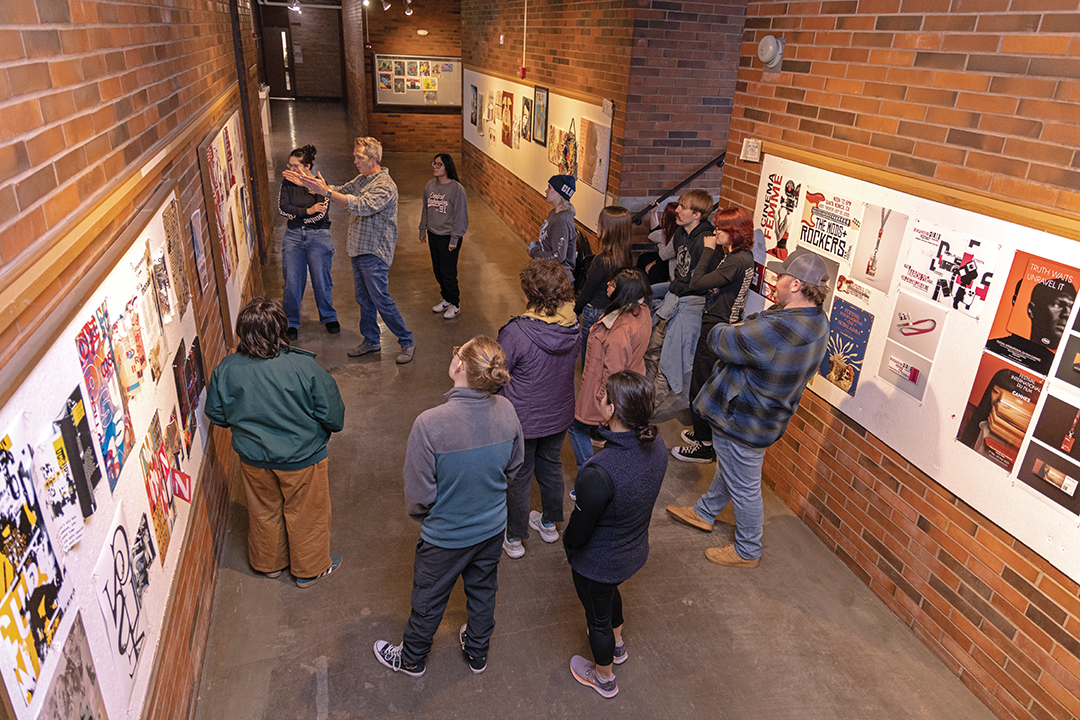
Wide Range of Experience
Not all graphic design majors at CWU join the program with an extensive art background. In fact, most of them start out not knowing much at all.
But, as Bieloh explained, that lack of experience can be to their advantage.
“Sometimes it’s better to work with them from the very beginning,” he said. “A lot of work goes into teaching them what good design is and what it is not.”
Beckman and Wenz teach most of the entry-level graphic design classes, and they see students from a wide range of creative backgrounds. Some come in with an innate understanding of the subject matter, while others have no artistic training.
“Most of them are very green, but we also have students who have grown up in an artistic household and already have amazing drawing skills, a great sense of composition, and an instinctual approach to color,” Beckman said. “Those students definitely come in with an advantage, but having an art background isn’t required. We’re here to help them build their artistic foundation, and everything else eventually comes together.”
That’s why CWU stresses the importance of the creative process, he added. The end product matters, but there’s so much that happens before you can arrive at the finish line.
“We want our students to fully understand what it means to be engaged in a thoughtful artistic process,” Beckman said. “That includes everything from doing research in the initial stages to thinking about the end user, to talking to clients and identifying the objective of a specific project.”
During his 12 years at Central, Bieloh has found that a “systems approach” is the most effective way to show students how all of the pieces fit together across different mediums and campaigns.
“We want them to understand how their designs fit into a larger whole,” he said. “Design does not exist in a vacuum. We don’t teach students to focus on single, stand-alone artifacts when they solve design problems. Rather, we focus on systems thinking, where each project they work on involves whole families of designed artifacts—all parts of a much larger system within each brand. It’s about designing in a way where you are always thinking bigger and deeper than just the single product or artifact.”
In the end, Bieloh and his colleagues feel like they have done their jobs when their students leave CWU understanding the importance of good ideas, and how they can employ conceptual solutions to address real-world design problems.
Based on the feedback the faculty members receive from their industry colleagues and alumni, they know they are doing something right.
“We just want them to leave here knowing what’s truly important: foundational systems, a people-centered approach, conceptual problem-solving, and a focus on the user,” Bieloh said. “If they are able to grasp those core concepts and learn to create beautiful work—which they inevitably do—they will be well-positioned to enter the workforce. That’s our ultimate goal.”