
“I was that classic kid who wanted to be an astronaut,” the CWU Geological Sciences professor said. “I loved the stars, and whenever there was a book fair at school, I’d always pick up books about spaceships and NASA. Once I went to school for astrophysics, I realized that what I was actually interested in was rocky planets, and then just by accident, I took a geology 101 class. That changed everything, and while it took me longer to finish my bachelor’s degree, it was completely worth it.”
Following this newfound passion, Shamloo earned her PhD in Geological Sciences from Arizona State University in 2020, and began pursuing a professorship that would allow her to share that passion with others.
“I’ve always loved teaching,” she said. “I see it as a form of science communication, and a way to connect with the geologists of tomorrow. One of the things that attracted me to CWU was the heavy emphasis on teaching.”
In addition to teaching, Shamloo serves as primary investigator for the Center for High-Temperature, Volcanic, and Experimental Studies (CHIVES), a CWU research group dedicated to exploring the conditions that make volcanoes erupt, through the lens of Washington’s Cascade mountain range.
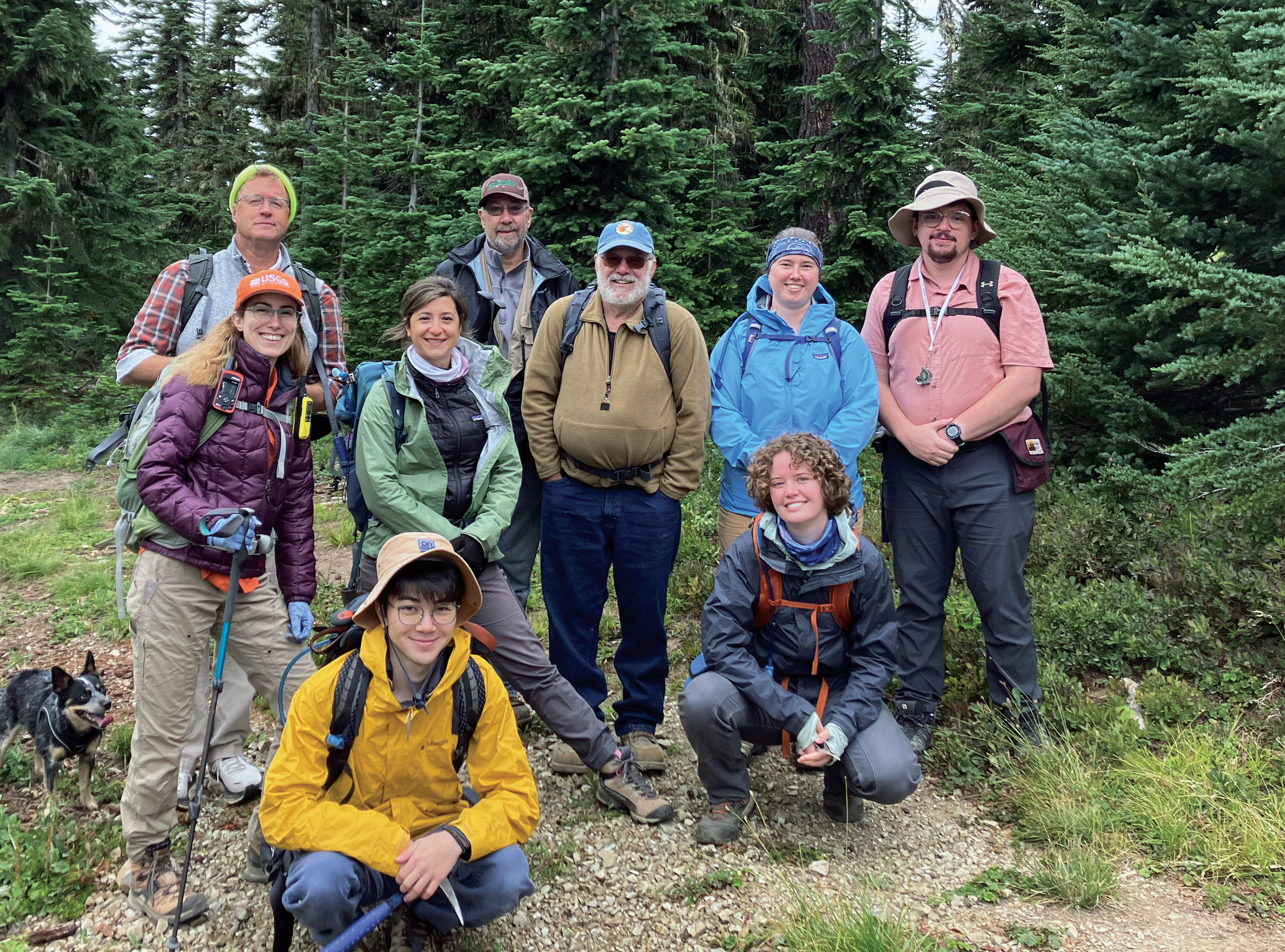
The group is currently examining the early history of Goat Rocks, a cluster of volcanoes in the north Cascades featuring unique properties that leave their past visible to the naked eye.
“Goat Rocks is very understudied, and in fact we only just recently classified the ages of some of these erupted units. So, to me, it’s a treasure trove just sitting there waiting for us,” she said. “It’s a unique place because the entire life history of a Cascades volcanic system is exposed from erosion and glaciation there, which just doesn’t happen all that often. This is a huge opportunity for us, so we’re looking to explore what fueled the volcanoes in this era of time for the Cascades.”
The group’s research into Goat Rocks is funded by a four-year, $495,196 grant from the National Science Foundation. Shamloo knows that while the day-to-day work of sifting through magmatic crystals hunting for clues to their origin might not seem like earth-shattering science, it is that very dedica-tion to incremental exploration that may eventually help com-munities prepare for future volcanic eruptions.
“Sometimes what we do can feel very esoteric,” she said. “We’re studying chemical signatures in tiny crystals to under-stand the massive systems that power volcanoes. Every part of the puzzle is important for the broader picture, so I’m an advocate for that ‘no small parts’ mentality.”
With her research plucking away at the big questions underpinning volcanic activity, and her classes reaching more future geologists every year, Shamloo reflects on the road that led her to the career of her dreams.
“I was curious, and I was okay with failure,” she said. “If there’s anything I try to instill in my students, it’s that you don’t have to be a Stephen-Hawking-type to be a scientist; you just have to be curious and willing to chase that curiosity. Don’t be afraid to ask questions; those questions are what drive us to improve our understanding of the world.”