
CWU Geology Lecturer Nick Zentner is one such rock hound who has made a name for himself sharing his enthusiasm for geological phenomena with people around the world.
Following a hiatus in the wake of the pandemic, Zentner’s Emmy Award-winning TV show Nick on the Rocks was picked up by Seattle’s Cascade PBS in 2024. With two seasons of the revival in circulation and more on the way, the intimate, welcoming exploration of Pacific Northwest geology continues to attract a global audience.
Viewers are drawn to the show’s stunning videography, informative content, and Zentner’s genuine passion for the subject. His approach comes from a lifetime of fascination with the ground beneath his feet, and a knack for finding collaborators within the community he has built.
“I feel like this is all part of my job, taking what I’m interested in and sharing it with the world,” said Zentner, whose own geology journey started when he was 21, in the mountains of Montana. “People just show up out of the woodwork, and offer their talents to the production, which I’m of course always happy to accept. The community is an important part of everything I do.”
Nick on the Rocks began as a partnership between CWU and Seattle-based KCTS-9, the local Public Broadcasting Service (PBS) affiliate, in 2016. New episodes of the program appeared on PBS through 2020 and continued to gain traction on YouTube, attracting millions of viewers over the years.
The program returned to the airwaves last year after Cascade PBS assumed full ownership rights, and just completed its second season under its new iteration. With an expanded reach, the show is reaching new and old fans alike.
“There are a lot of loyal viewers, but we also get a lot of newcomers who are excited to see their local landmark on the show,” Zentner said. “For them, it’s almost like having a neighbor be interviewed about an arson case, you know?”
Lifelong Passion
After dropping out of a cartography program at the University of Wisconsin in 1983, Zentner thought he was done with school, and retreated to the wilderness to try to find his next step. As luck would have it, his next step found him first.
“I quit school because I’d run out of money, and I worked for a summer in Glacier National Park in Montana,” Zentner said. “My bunkmate there was a geology student, and thanks to the things he showed me on our hikes together, so was I, soon enough.”
Once he had earned his master’s degree in geology, Zentner went looking for a place to teach so he could share his passion with students who, like him, might not otherwise have considered a career that involved the study of rocks. Following a brief teaching stint in Ohio, he felt called back to the Pacific Northwest, and settled in Ellensburg as a geology lecturer at CWU, where he has now taught for over 30 years.
“I purposely stopped at my master’s degree because I knew that full-time academia wasn’t really my scene,” Zentner said. “I thought if I could make my day job all about my students, and my night job all about spreading the geology gospel to anyone else who might be interested, I’d be able to help bridge the divide between academic interest and the enthusiasm of the general public.”

Zentner received a Silver Creator Award from YouTube for hitting over 100,000 subscribers on his channel, @GeologyNick.
Zentner began uploading geology videos to his YouTube channel in 2012, filming himself delivering lectures while out and about in the picturesque Central Washington landscape. Once his growing following made it clear that there was a real appetite for his approachable brand of educational content, former CWU Chief of Staff Linda Schactler had the idea to broaden the scope of the production and pitch it to local cable TV stations.
With former CWU videographer Chris Smart on board to handle the cinematography, Nick on the Rocks aired its first season in 2016 to an enthusiastic audience and awards buzz. After four successful eight-episode seasons, production came to a halt, along with the rest of the world, in 2020.
“It was fun working on the first four seasons just the three of us at Central, until the pandemic hit and we had to put it on pause,” Zentner said. “During that time, I found a large audience through my YouTube series, which helped scratch the itch a bit, so I wasn’t too interested in starting a bigger production again until the Seattle people came knocking.”
A New Beginning
In 2023, Cascade PBS reached out to Zentner to express interest in continuing Nick on the Rocks, and, in the process, taking over the show’s production from CWU. He hesitated at the idea, unsure if PBS had a videographer capable of capturing the same wonder the first four seasons had created.
“I told them that I wouldn’t do it unless they found this magic person who’s young and talented and hardworking and willing to hike a fair amount with a bunch of camera gear on his back so we can get the shots we need,” Zentner said. “They found that person in Brady Lawrence.”
Lawrence’s background as a Seattle-area freelance videographer put him in a perfect position to deliver what Zentner was looking for.
“Nick was looking for someone who could do it all, and also be willing to go on longer hikes to hard-to-reach places,” Lawrence said. “That’s sort of my specialty, so we hit it off right away.”
The partnership has proven to be a perfect fit, with Lawrence’s experience in capturing international cross-country bike races complementing the need for longer excursions into the Washington wilderness.
“Honestly, it was great from the start,” he said. “The first four seasons had this very specific energy and feel to them, so we had a lot of conversations about how to honor that and carry it forward, while also changing it up and making it a bit more dynamic. Nick was really receptive to that right off the bat.”
Growing up in North Carolina, Lawrence had always envisioned himself producing narrative films in Los Angeles, until he, like Zentner, stumbled upon the great outdoors along the way.
His skill in capturing scale and intimacy in one continuous shot has elevated the show’s visual vocabulary, Zentner said. But, as the team has discovered, you’re not always going to be able to please everyone.
Following an unenthusiastic comment on Zentner’s YouTube channel, Lawrence has been finding creative ways to position him within his surroundings, to show the audience he’s really there on location.
“Someone in a comment section thought a particular section was green screen, which really took (Zentner) aback,” Lawrence said. “Since then, we’ve tried to work in more segments of walking and talking, to really show off the surroundings. I’ve been working those into bigger reveals as Nick walks around a curve to a stunning vista or something along those lines, which has been working great. I don’t know if there’s a technical term for them, but Nick has taken to calling them ‘do-si-dos,’ and we try to find an opportunity for them in every episode now.”
Zentner explained that the shot starts out normally, and then the camera keeps zooming out until the music swells and suddenly he’s just a dot on a small cliff inside a massive gorge, all in one take.
“Those moments are quite effective, and rather than upstage what I’m doing, they really add to the sense of awe and wonder we’re trying to convey,” Zentner said.
Along with the new drone-enabled camera tricks, Lawrence’s experience in documentary filmmaking has brought new planning elements to the team’s workflow, leading to more concise storytelling to fit the show’s seven-minute format.
Zentner develops talking points to pair with specific points of interest ahead of time, letting sight and sound synchronize better along the way.
“It’s a nice way to have a really polished, concise story, with great visuals to match,” Lawrence said. “We’ve since been able to add a few talking points so we know what to film ahead of time, which has served to tighten up our workflow while still letting Nick do some of the improvising that the fans like.”
Engaged Community
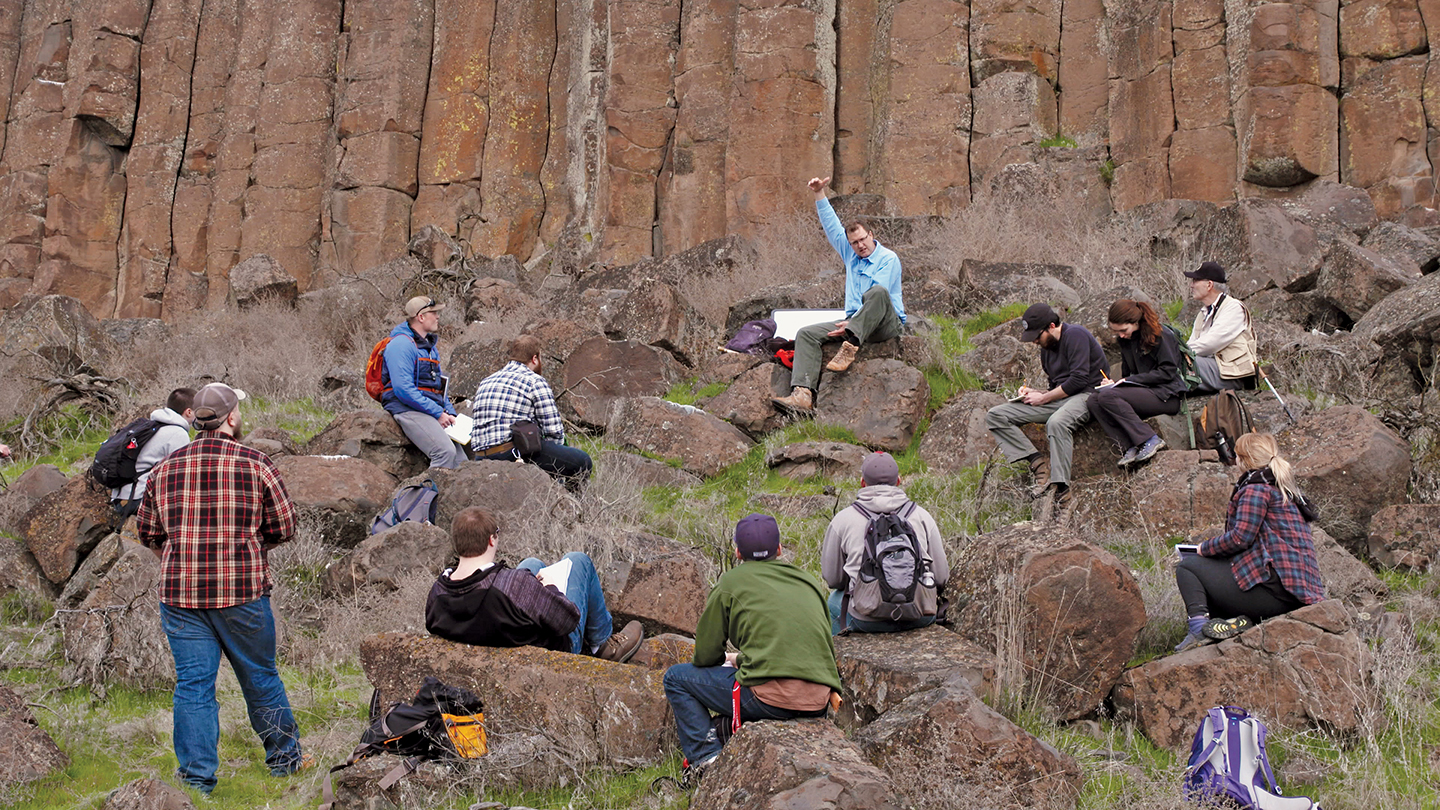
Zentner’s classes frequently take place in the midst of the very geology being discussed.
In addition to Zentner and Lawrence, the Nick on the Rocks team features field producer Gary Paull, who first discovered Zentner’s work on YouTube during the pandemic. His @GeologyNick channel currently features 75 live-streamed lectures, plus an extensive collection of footage taken in the field.
“I’ve got a real fascination with the landscapes that are around me, and the more you learn, the more you want to know,” Paull said. “The stories out there are endless, and Nick’s great at telling them.”
After seeing some of Paull’s annotated photos online, Zentner reached out to him on the Nick on the Rocks community Facebook page, asking him if he would be interested in using the photos in his video lectures. Paull was happy to oblige.
“I’d been working on those for a long time, so it was pretty cool to see Nick use them in his lectures,” Paull said. “Being able to combine my pretty pictures with my experiences walking through the landscapes they depict has been a real joy.”
In the summer of 2024, Paull started joining the hikes to film Nick on the Rocks season 6 as a field producer, offering insight and advice along the way. Paull’s own background as a geology major at the University of Washington in the 1970s, along with his career in the U.S. Forest Service, has made him a great fit for the team.
“When we’re out there together, I’m talking geology with Gary, Gary’s talking film stuff with Brady, and that way we’re all speaking the same language,” Zentner said. “Gary and I like to go out and scout locations for the YouTube channel when we’re not filming for Nick on the Rocks, and it’s great to be able to brainstorm specific shots right there on site.”
The community around Nick on the Rocks has grown to include members across the globe, with viewers traveling from as far away as the Netherlands to engage with fellow rock hounds at Zentner’s annual free lecture series in downtown Ellensburg.
During that time, hundreds of geological hobbyists and professionals alike descend upon Central Washington, planning field trips and forging connections with one another based on their shared love for the field — and for the way Zentner presents it.
“Real friendships have developed within the community,” Paull said. “It goes beyond the geology itself, too, with people meeting up in different parts of the country and going on their own field trips independently of the show. It’s a really wholesome thing to be a part of.”
Zentner is grateful for the opportunity to share his love of geology with such a large audience — an honor he does not take for granted.
“There’s been some broad recognition that this isn’t just some pet project of mine, but rather something that resonates with people,” he said. “I’m so grateful to CWU for helping to create this program, and to my new partners in Seattle for bringing it back to life. There’s so much to see here in the Pacific Northwest, so it has been pretty intentionally focused on this region. Even with all the money in the world, this is where I’d want to be, and what I want to film.”