
However, after renting a cottage close to the rural settings that inspired poet Gerard Manley Hopkins and Lewis Carroll — author of children’s classic Alice’s Adventures in Wonderland — Zeller found her mind pulled in unexpected directions.
In addition to writing new passages for her novel and connecting with other fellows at Oxford’s St. Edmund Hall, Zeller became inspired to revise her upcoming memoir-in-essays, Raised by Ferns, which will be published by Porphyry Press next year.
“I ended up taking a lot of notes toward sections of my memoir that were about parenting and whimsy and play,” she said. “Being on location there and close to that ancestry of texts just took me in that direction.”
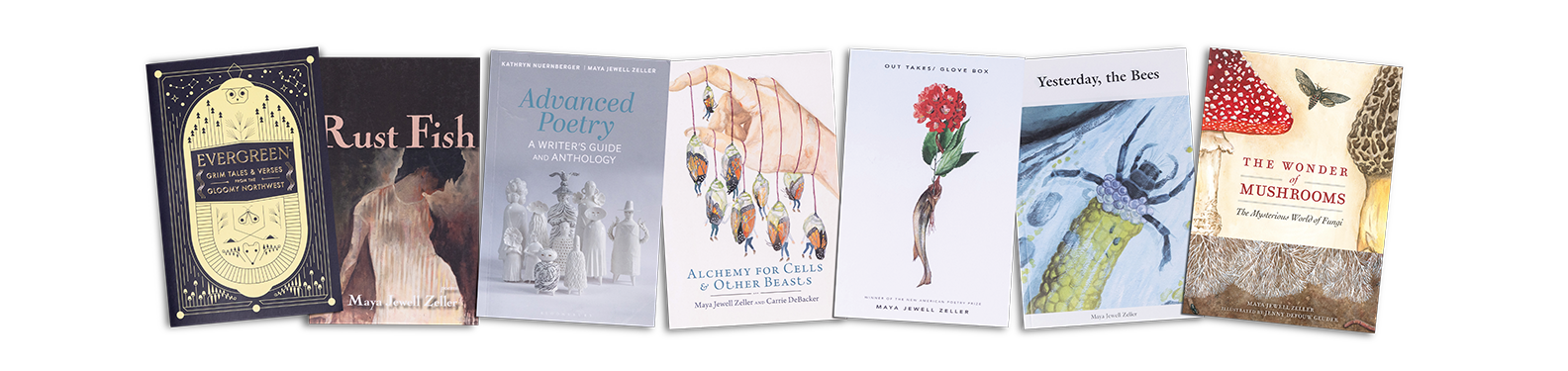
Zeller explained that the freedom to follow creative diversions is one of the primary benefits for artists in academia who are afforded opportunities like the Oxford Fellowship.
“When you bring together scholars from various institutions in a place where none of them are bound to their home institutions’ daily schedules, the conversations that can happen are pretty incredible,” she said. “I was able to take off all those parameters and just let myself follow wherever my creative mind went.”
Zeller considers poetry to be her primary genre, but at this point in her career, she doesn’t let genre expectations constrain her. While teaching high school English prior to earning her Master of Fine Arts in creative writing/poetry from Eastern Washington University in 2007, she discovered a passion for experimental and hybrid forms that has stayed with her.
“I found myself drawn to teaching all genres, and I also found myself really drawn to those genres that are the weirdos,” she said. “These hybrid genres that don’t have categories are where I found myself the most excited.”
After becoming a mother, Zeller found that the concentration of language, music, and image that drew her to poetry were no longer enough to say everything she wanted to say, so she began writing prose poems, micro-essays, and longer fiction and nonfiction.
She also learned to be flexible with her writing process, working whenever and wherever she could. Many of the essays in Raised by Ferns started as voice recordings made during the long drives that became part of her life when she began teaching at CWU in 2016.
More recently, Zeller has reserved occasional Fridays to focus on her creative and scholarly projects, such as her co-authored textbook, Advanced Poetry: A Writer’s Guide and Anthology (Bloomsbury, 2024), and her upcoming lyrical field guide, The Wonder of Mushrooms (AdventureKEEN, 2025).
“What will inevitably happen during that session is that I will inspire myself to do something else,” she said. “I will depart from the process that I told myself I’m working on and then come back to that process. I don’t usually write new things by making space for them; they kind of have to happen.”
As a memoir-in-essays, Raised by Ferns contains a complete narrative arc, while also touching on topics including the environment, motherhood, childhood, academia, the limitations of the American educational system, and more.
In writing the book, one of her goals was to “be more capacious about a human life,” showing the many aspects it can contain. She hopes to help her students be their full selves in their writing, too, especially those who might struggle to have their voices heard beyond the page.
“As an extreme introvert, I know that writing is a specific discipline in which introverts can actually express a lot,” she said. “If I can help a student feel validated and have permission to be the exact weird creature that they are, then I will have achieved all of my teaching goals.”
Even outside the creative writing classroom, Zeller believes it’s important for people to be able to encounter diverse voices and find new ways to express themselves.
“We really need public libraries, and we need to not ban books,” she said. “Access to weirdos, right? If you don’t find your weirdos, then you just keep it to yourself.”