
After spending the previous 14 years as the lead archaeologist and ethnographer for the Yakama Nation, the 2004 CWU anthropology alumnus had already invested countless hours and resources into learning more about his ancestral history in the Yakima Valley.
As a descendant of boarding school survivors, Shellenberger — an enrolled Yakama tribal member — had developed a deep personal interest in piecing together the checkered history of Native American boarding schools in the U.S. and Canada. But something about the revelations from Kamloops, B.C., “lit a fire” underneath him that has only grown brighter in the two years since.
“When that news came out, it made me want to use my background and training for a bigger cause,” said Shellenberger, who served as the director of CWU’s American Indian Studies program from 2021-22 and now works as the Cultural Resources Department Director for the Cowlitz Indian Tribe.
“This boarding school issue is international, and no one knows the full story of what happened. I’m just trying to get some answers by piecing together the history, as painful and depressing as it is.”
In May 2022, almost exactly one year after the Kamloops atrocities were revealed, Shellenberger’s quest became that much more personal when the U.S. government disclosed that it had discovered more than 50 burial sites where Native American boarding schools once stood. Some of these unmarked graves were uncovered at Fort Simcoe, near his parents’ hometown of White Swan (about 30 miles southwest of Yakima), and he began to feel as though he was being personally called to do this work.
Fort Simcoe was home to one of the earliest on-reservation boarding schools in the U.S., operating from 1861 to 1922 before a church-run mission was established there. During those six decades, a military fort and Native American boarding school were located on the grounds, yet there is no evidence of a designated cemetery.
“It’s just grass, which seemed very strange to me,” Shellenberger said.
Naturally, he and other tribal historians have a lot of unanswered questions about where their ancestors were laid to rest. Where did their bodies end up? Were they moved to another location? Are there any records of their deaths or the transfer of their remains? Where were the Indians who were hung as ‘war criminals’ buried? Were they even buried at all?
“These are just a few of the questions we’re trying to find answers to,” Shellenberger said. “But so far, the records searches have been very challenging. They weren’t very well kept by the BIA (Bureau of Indian Affairs) or the other federal agencies involved, which makes it extremely difficult to account for everyone.”
Painful Past
Shellenberger, 44, explained that most people aren’t aware of this painful era in Native American history, and those who do know about it don’t realize that it happened right here in Central Washington, as a result of the Indian Removal Act of 1830.
Even as an enrolled tribal member, Shellenberger didn’t comprehend what occurred at the boarding schools until he was an adult. Even though he knew many family members and friends who were survivors, it wasn’t something that was widely talked about.
That has since changed, and many survivors are willing to share their stories with him. Their accounts are heavy with physical and sexual abuse, and several survivors speak of the suspected foul play that took place at boarding schools they attended.
“We were taught that no one knows what happened to these people, and the perception is that they disappeared or that they just left,” he said. “But we now know that wasn’t true, and it’s going to be up to me and my fellow researchers to figure out what happened.”
Shellenberger recounted a story about his great-great-grandfather, Alexander Blodgett, who was sent to San Quentin Prison in the late 1800s for trying to prevent Oregon state officials from sending his children to a boarding school. Blodgett eventually lost his family and his livelihood because of a federal law that was rooted in intolerance and bigotry.
“That era shaped my family’s history, and it’s a trauma that has persisted through generations,” he said. “There are still remnants of that in how our family functions. Kids today have no idea what was done to try to move Natives out of the way.”
Hidden History
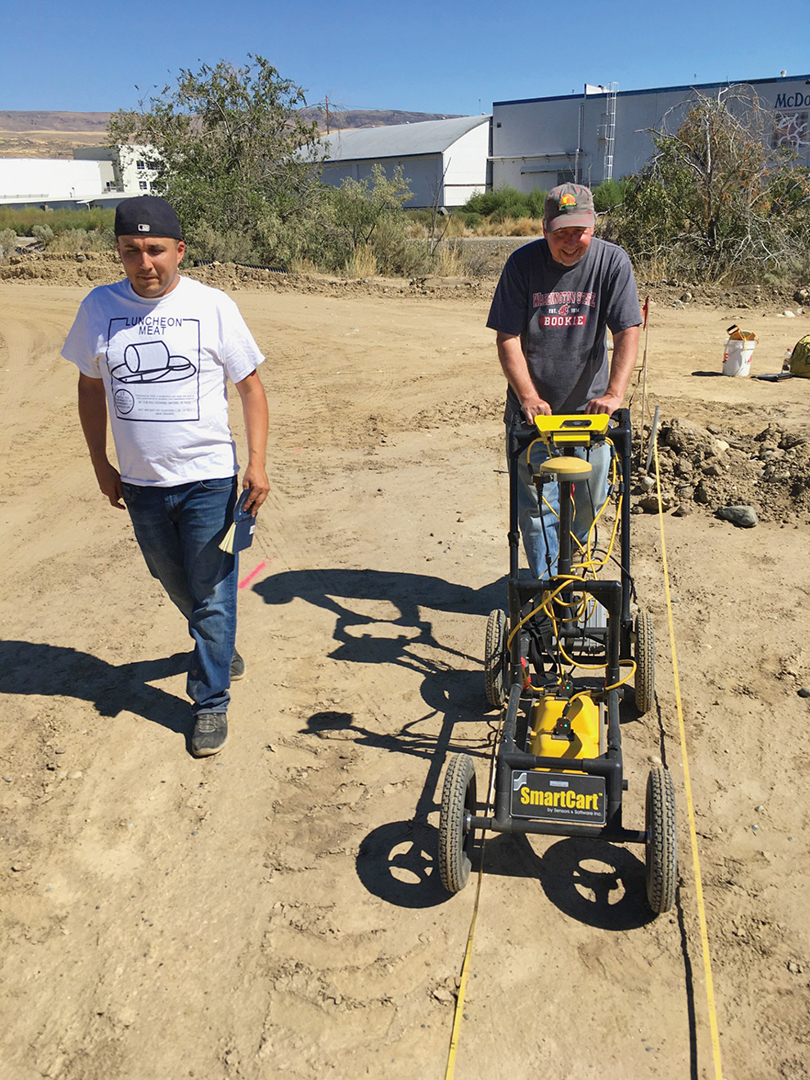
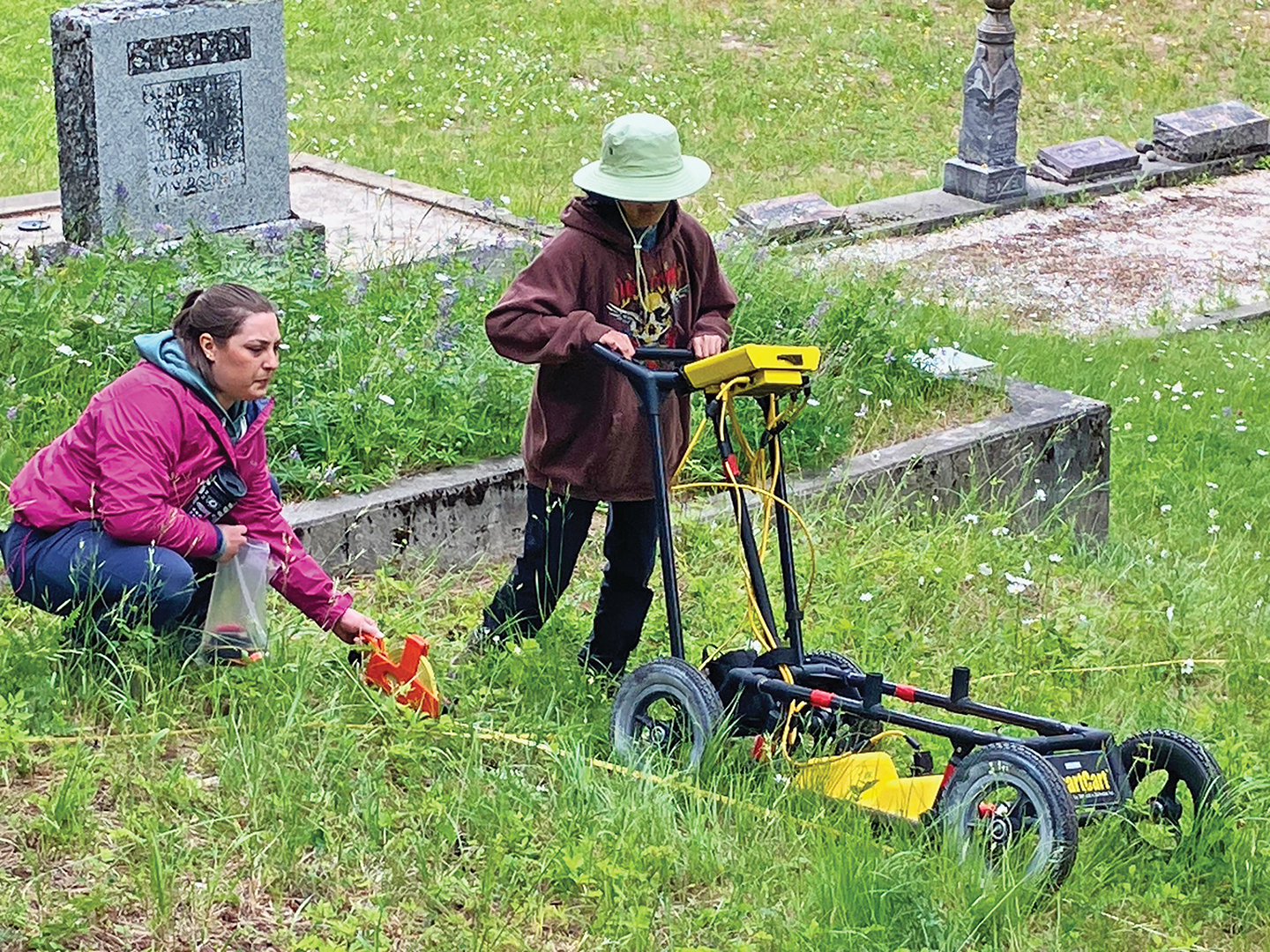
Aside from trying to connect sporadic historical records and talking to the boarding school survivors who are still living, Shellenberger and his former CWU colleagues have been using ground-penetrating radar (GPR) technology to identify unmarked burial sites at Fort Simcoe and other non-tribal locations, including Roslyn, Lacey, Camano Island, and Hermiston, Oregon.

Making good on his commitment to uncover as much information as possible about unmarked burials in the region, Shellenberger purchased his own GPR equipment in 2021 and began using it for volunteer field research. He later put the equipment to use during a summer field school outing to Fort Simcoe with CWU faculty members Karisa Terry and Steve Hackenberger and their students.
“I’m a concerned tribal member, and I view this work as essential to preserving our past,” said Shellenberger, who also earned a master’s degree in resource management from Central in 2006. “But it’s also very interesting, and I love that I can do this important work with help from my former CWU colleagues and their students.”
In fact, he invites anyone interested in using GPR technology and preserving history to join him for a field session. And although his initial focus was to learn everything he could about what became of his ancestors during the late 19th and early 20th centuries, he makes clear that his ongoing unmarked burial research is not limited to Native American lands.
“We’re also doing this work in Roslyn to find unmarked burials for Whites, Blacks, and Italians to make sure they are protected,” Shellenberger said. “The perception is that we’re just trying to find our own kids, but that’s not true. We are trying to identify all unmarked graves.”
That altruistic approach has put Shellenberger in touch with several boarding school researchers in the U.S. and Canada, including sites in Kansas, Oklahoma, Pennsylvania, and British Columbia. He notes that he is just one of many scientists around North America digging into this unfortunate — and mostly hidden — past.
But given the size of this undertaking, he believes researchers from across the country must combine their resources while also soliciting volunteer help.
“This work cannot be accomplished by only a few people; it has to be all hands on deck,” Shellenberger said. “That’s my call to action for everyone. If you want to help, then please do. We would be happy to train anyone who is interested.”
Ongoing Partnership
Although Shellenberger left the university in 2022 for a job with the Department of Fish and Wildlife, he continues to work closely with the CWU Department of Anthropology to ensure this essential project remains at the forefront.
Shellenberger’s tribal heritage, and the fact that he worked for the Yakama Nation for more than a dozen years, has lent even more credibility to the anthropology department’s cultural resources management efforts.
“It’s just invaluable to have someone like Jon leading this work,” said Hackenberger, a CWU anthropology professor who taught Shellenberger nearly 20 years ago. “He has such deep roots and so many connections within the tribal communities. To have him working alongside us and representing us is just a dream.”
Longtime CWU Anthropology Professor Patrick McCutcheon concurred, noting that Shellenberger’s personal experiences, combined with his elite professional acumen, continue to benefit CWU students and faculty even though he no longer works on campus.
“Jon has been an inspiration to me as I try to improve my teaching and research,” he said. “I’m an anthropologist, and he’s teaching me about anthropology. It’s just been amazing to work with him.”
McCutcheon pointed to Shellenberger’s deep appreciation for the oral traditions passed down from his tribal ancestors.
“We underestimate the importance of our communication traditions,” he said. “We just don’t appreciate in our culture how central that oral history is to native cultures. Through his own experiences, Jon has been able to convey to his colleagues and students just how important it actually is.”
At the Forefront
Aside from his contributions to CWU Anthropology and American Indian Studies (AIS) over the years, Shellenberger’s GPR work at Fort Simcoe and other unmarked burial sites in the Northwest has the potential to be earth-shattering.
His background and expertise have put him at the forefront of an international fact-finding mission that could deliver some long-awaited resolution for native and nontribal communities across the country.
“CWU already had a lot of expertise in this area, but with Jon’s new instrumentation and first-hand knowledge, we have become an expert,” Hackenberger said. “Ever since the Canada discovery, we’ve been attracting national interest. Now, whenever someone thinks they may have discovered something underground, they contact us.”
Hackenberger believes that with the many shocking revela-tions of the past few years, CWU must continue working closely with Shellenberger and other partners to carefully investigate the boarding-school locations and uncover what mysteries still remain underground.
“So many atrocious things happened to those Native American communities, and we are just now waking up to a horror story,” he said. “But now we have the knowledge and expertise where we can actually do something about it.”
For Shellenberger, the GPR work he has been engaged in over the past four years is just the beginning of a long journey to uncover the truth. He is driven by his anthropology and resource management roots, but most of all, he feels like he owes it to his people to help them find answers about their tortured past.
“If we ignore our history, we are destined to make the same mistakes,” Shellenberger said. “The truth is, American history isn’t friendly to many people. But that doesn’t mean we should ignore it. The way I see it, if you don’t recognize history for what it is, then what good are you doing? We need to face the truth, and I’m going to do everything I can to shed some light on that painful chapter in our history.”