
What he didn’t have was a college degree.
“I had young kids, and I wanted to set an example,” Berry said. “I saw how important school was, how it important it is to get that education, and how it really helps in your career.”
So he went back to school, completing an associate’s degree at South Seattle College. The academic schedule of firm deadlines and regular testing was a challenge to balance with his three young children and a job that required a lot of travel. He knew he wanted to complete his bachelor’s, but how?
“I knew that to get to the next level, a bachelor’s degree was required, but I didn’t know how to do that,” he said.
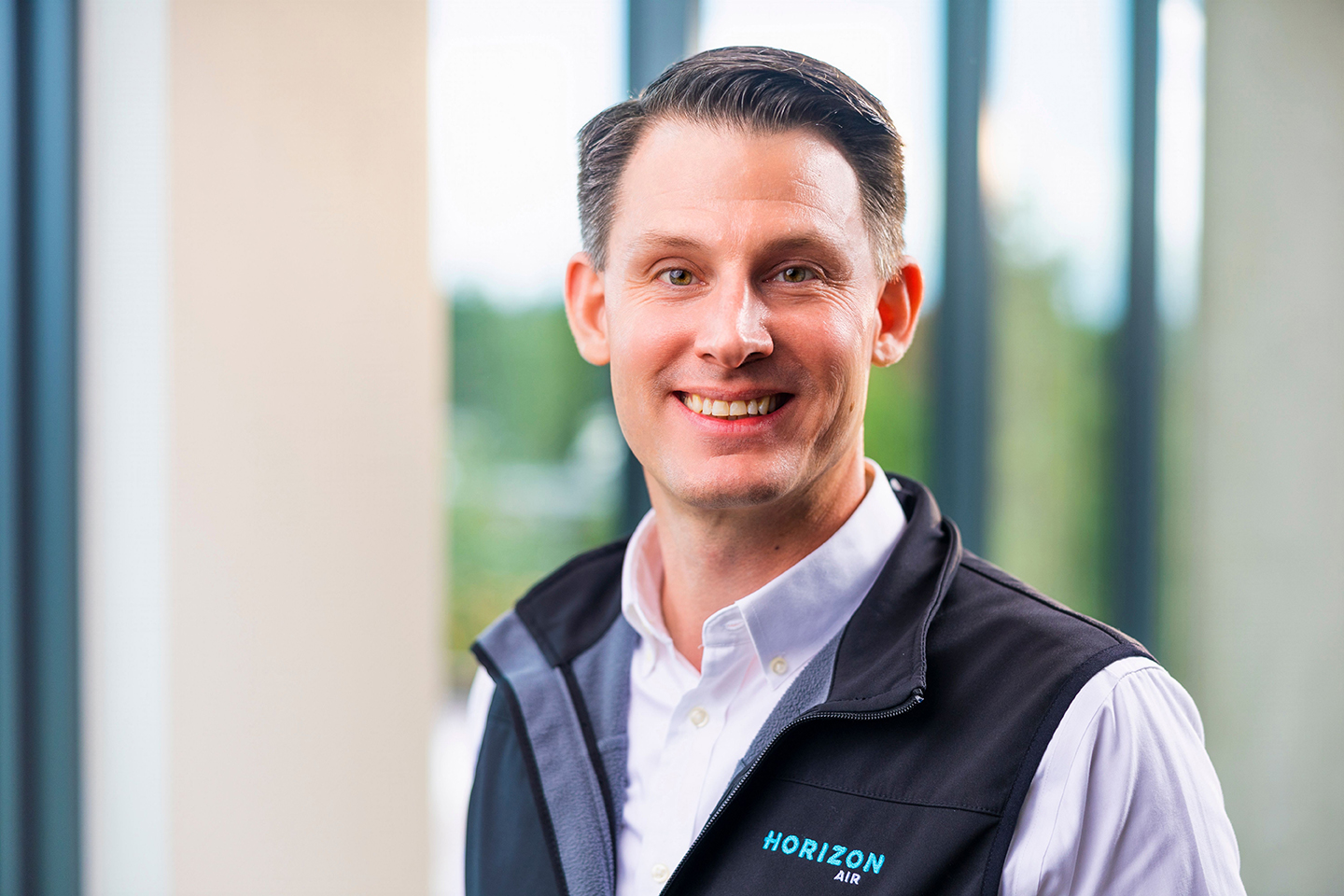
CWU FlexIT alumnus Jason Berry is now the president of Horizon Air. He credits the program for helping him take the next step in his career. Photo courtesy of Horizon Air.
That’s when Berry (’15) met Senior Lecturer Liz Fountain and learned about CWU’s FlexIT program, a unique, competency-based program built to help students just like Berry finish their degrees while balancing the demands of careers and family.
In just six months, Berry finished his bachelor’s in information technology administration and management, an accomplishment that proved to be a game-changer for his academic and professional life.
Today, Berry is executive vice president of cargo for Alaska Airlines and president of Horizon Air. After graduating from CWU, he went on to earn a Master of Business Administration.
“It’s hard to believe that I started as a ramp agent in the 1990s and, now, here I am,” he said. “But that unlocking of my potential wouldn’t have happened without the FlexIT program and CWU.”
Learning While Working
Berry was one of the first students to go through FlexIT, which is celebrating its 10th anniversary this year.
Fountain was among the faculty who launched the program, which is the first of its kind in Washington state-supported institutions.
“At that time, competency-based education was really just in the for-profit academic sector, and a lot of the programs focused on certifications,” Fountain said. “But we need a way to help people who have some college, but no degree, to finish. These students have been working in the industry, they have great skillsets, they know what they’re doing. And then they come into higher education and have to sit in class for 10 weeks at a time. That doesn’t take their competencies into consideration.”
FlexIT began with just a bachelor’s degree, and after four years expanded to include a master’s track in two specializations: retail and administrative management.
Just as Fountain and her colleagues had hoped 10 years ago, the program is now filling a major gap across the industry. According to the National Student Clearinghouse Research Center, the number of students who have “some college, no credential” increased to 41.9 million in 2022. These students have valuable work and life experience but, like Berry, require more flexibility than a traditional four-year program offers.
“There’s a huge need in upskilling and reskilling the workforce, but these students can’t stop working to go to school, and their organizations don’t want them to. The companies can’t afford for people to take two to four years to go to school,” Fountain said. “Online education has matured so much, and we understand now that you can learn without seat time. We’re learning how we can support students in showing what they already know and moving them from that to the finish line of where they need to be.”
Set Your Own Pace
Since FlexIT launched in 2015, just over 400 students have graduated from the program: 165 undergrads and 241 graduate students. There are typically about 100 students enrolled at any time, but the flexibility of the format means some may be dipping in and out each quarter depending on life’s demands.
FlexIT is especially popular with active-duty military members, who are able to take time off when they are called overseas, and then pick back up when they return.
Another benefit is that the program is entirely online and self-paced. Students pay a flat rate for either half-time or full-time enrollment, and can complete as many courses each quarter as they want. Rather than individual course instructors, students are assigned a faculty content coach who meets with them
regularly to track their progress.
Rather than the faceless, mass-produced method created by some for-profit institutions, FlexIT is highly personalized.
“You get a very intimate experience, a lot of one-on-one time with your advisor,” Berry said. “It’s so different than courses with a basic knowledge and skill assessment.”
In each class, the student works with the content coach to create papers and projects that demonstrate competence in the subject. Students with a lot of professional background can get through a course in a few weeks. On a subject they aren’t as familiar with, they can go slower to absorb the information.
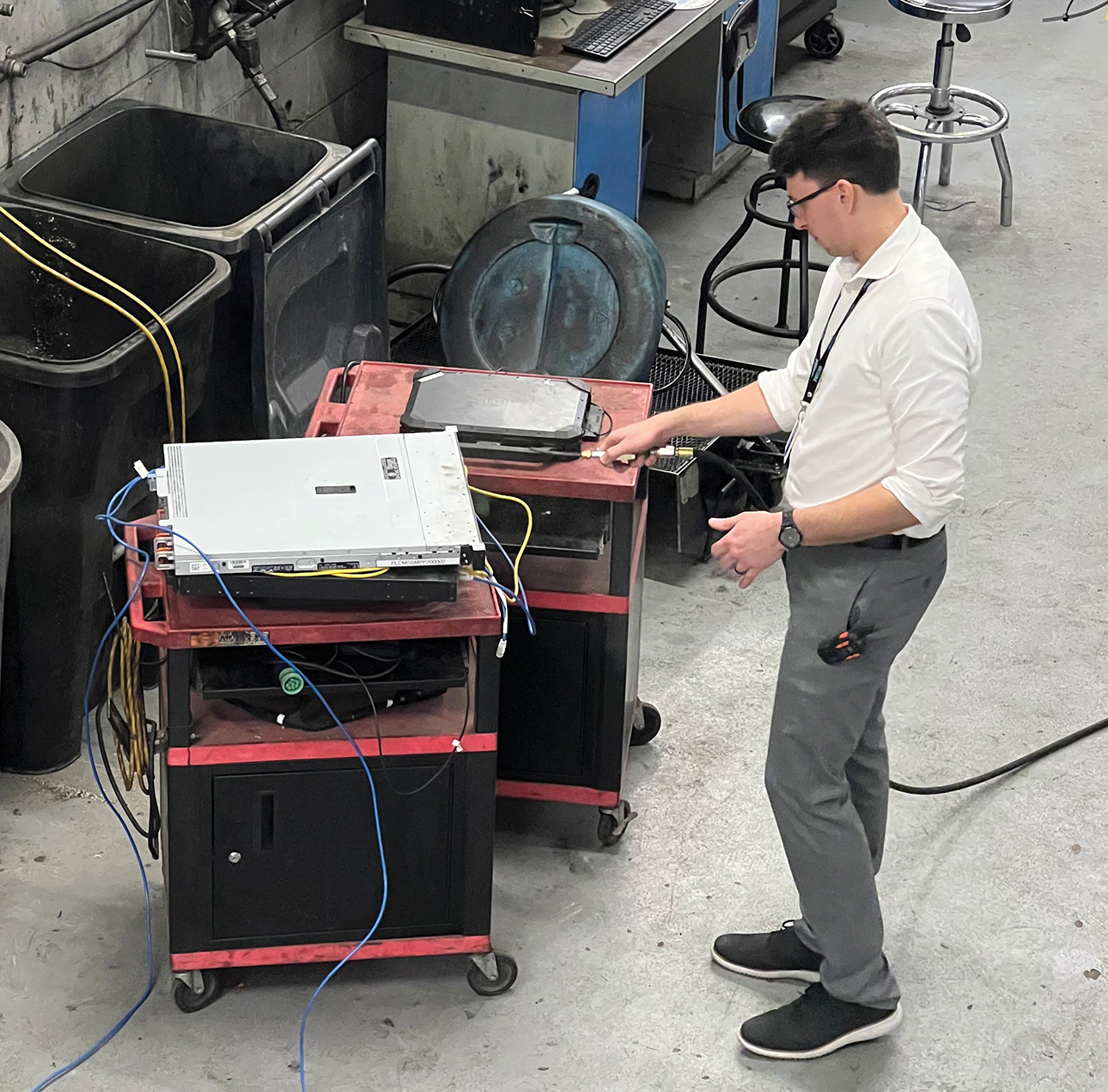
Austin Faith completed his CWU degree this spring and is already working as an IT operations manager for PACCAR Inc. in Bellevue. Photo courtesy of Austin Faith.
Austin Faith (’25) finished his master’s degree in IT management through FlexIT this spring. He is now working in Bellevue as the corporate IT operations manager at PACCAR Inc., a global heavy-duty truck manufacturer.
He knew a master’s degree would open up new career opportunities, but he needed a program that would allow him to balance his demanding job and two young children.
“It’s not for the weak-hearted. It takes a lot of self-discipline,” Faith said. “I maintain a busy day-to-day schedule, which is what’s perfect about FlexIT — it’s extremely flexible. I can neglect it for a couple days if I need to and then step right back in.”
As a part-time student in the program, Faith was able to manage one to two classes per quarter, and it took him two years to get through the program at that speed. Other students take advantage of the flexibility to stack up classes during slow times.
Kevin Lomax (’24) finished his master’s in cybersecurity management while working for CWU’s Network Infrastructure Services as a residential network student apprentice. Now he works in the Computer Support Services department as a student tech liaison and teaches in the IT Management department.
Lomax said he appreciated how the FlexIT program allowed him to juggle work and school at the same time. He explained that students like him will get as much out of the program as they’re willing to put in.
“When work is slow, I could go through classes much quicker, which is a good cost savings if you’re willing to put in the extra effort,” Lomax said.
Meeting Market Demands
As FlexIT begins its second decade, the future is all about scaling up and adjusting to market needs and changing technology. The program already offers specializations in data analytics and cybersecurity and is building out its coursework in artificial intelligence.
“Every organization is an IT organization. It doesn’t really matter if you’re in education, corporate, biotech, health care — you have an IT infrastructure that supports your organization, and you need people who know how to manage it,” Fountain said. “You used to need people to manage hardware and check the cabling, but now what you need are people who understand how AI is being used to develop organizational capacities, or potential threats to cybersecurity.”
While the faculty adjust the curriculum to meet the changing IT landscape, Elizabeth Henry, academic program manager for IT Management, and Luke Williams, competency-based education program coordinator, are looking for ways to expand FlexIT’s learning modality across the university.
One need is to deliver all of the general education program requirements via the FlexIT model. This would allow undergraduate students who haven’t finished required coursework — such as English 101 — to complete it in the flex format. Students currently have to complete that coursework through traditional online or in-person classes.
Henry and her colleagues are also looking to grow their partnerships with major industries in Washington, especially those which offer tuition reimbursement programs.
“That would be a win-win for us,” Henry said. “We’re providing an educational program that allows employees to gain an undergraduate or graduate degree, and the employees get to use the tuition reimbursement benefit.”
Of course, the flex model isn’t for everyone. Students who excel in the program are those who are self-driven and don’t require the social interaction of a traditional classroom. With that in mind, the FlexIT staff conducts a thorough assessment of all applicants to verify they will be successful in the format.
“We just want to see students succeed,” Williams said. “It’s a labor of love — helping these students, figuring out how we can get more of the benefit from this program. That’s our mission.”