Mammoth
About the Mammoth Project
Introduction
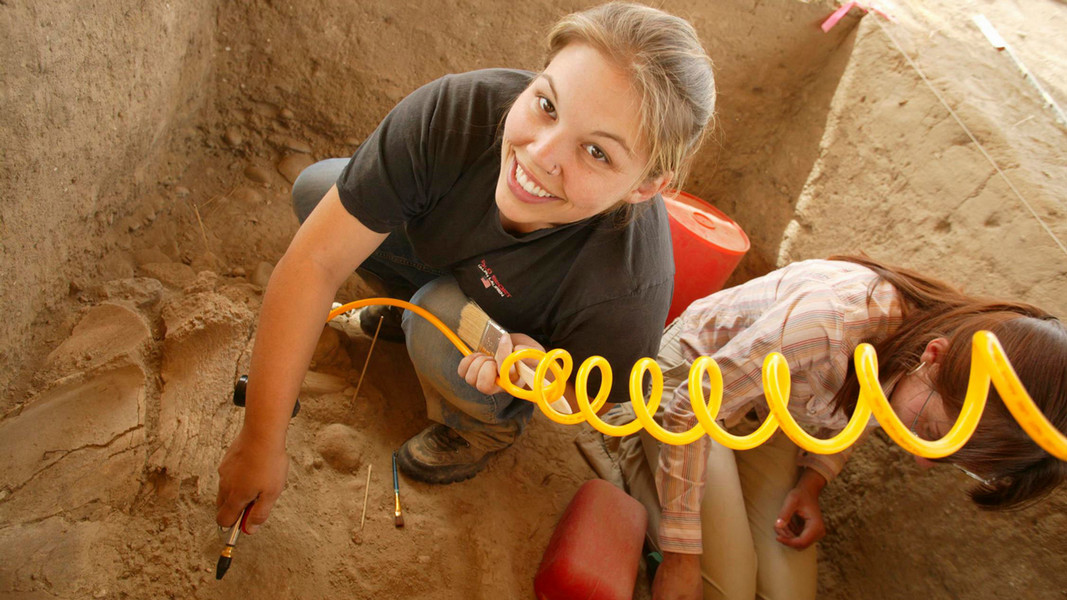
The Wenas Creek Mammoth Project was a Central Washington University (CWU) scientific investigation of mammoth bones found on private land in the Wenas Creek Valley near Selah, Washington. The investigation was interdisciplinary, using methods from paleontology, archaeology, and geography. The goal of the project was careful scientific recovery of the bones and any associated materials, while placing the finds into appropriate geological context.
The project was made possible by the interest and generosity of the landowners of the find location, Haywire Outfit. Financial support was provided by the CWU Office of Graduate Studies and Research, and Office of Continuing Education. Corporate sponsors included Fairpoint Communications (Web space for the Mammoth Cam), Basic American Foods (2009 scholarships), Ranch and Home (complimentary hoses), Luft Trailer Sales (complimentary trailer for summer 2005), Solutia (complimentary bone consolidant), L & S Fencing (discounted fence rental), and Jerrols Book and Supply (complimentary paintbrushes).
Significant financial support was also provided by private donors, including Cynthia and Davie Alporque, Sharon Balding, and others who wish to remain anonymous. We thank them all.
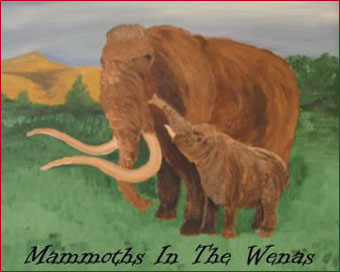
Artist depiction of mammoths by landowner Bronwyn Mayo (2006)
The project team included CWU faculty and students, outside experts, and volunteers, for all phases of the project. This included excavations, on-site exhibits and public dig tours, cataloging, laboratory cleaning and refitting of bones, age estimation, bone analysis, and other activities. The team leader was Dr. Pat Lubinski, an archaeologist with the CWU Department of Anthropology & Museum Studies. With completion of scientific publications on the mammoth and bison bones, artifacts, dating, and pollen record, the project is largely concluded.
History of Investigation
In February, 2005, GFI Construction was building a road on a hillside owned by Haywire Outfit (formerly Mayo Ranches) near Selah, Washington. They had already completed the road grade and were smoothing the embankment when they hit a large bone with the trackhoe. The bone was found on a slope of the bluffs overlooking the Wenas Creek Valley.
Owner Doug Mayo was intrigued by the bone, and wanted to know more, so he contacted Morris Uebelacker at Central Washington University. Dr. Uebelacker, a professor of Geography, came out to the find location and collected the large bone fragments exposed there. He brought them back to the CWU laboratory of Dr. Pat Lubinski, a professor of Anthropology who specialized in zooarchaeology (the study of animal bones from archaeological sites). The bone was tentatively identified as a mammoth left humerus (upper arm bone).
The initial CWU Wenas Creek Mammoth Investigation Field School was conducted June 27 through August 5, 2005. The faculty research team was Dr. Lubinski, Dr. Karl Lillquist (CWU Geography), Dr. Morris Uebelacker (CWU Geography), and Mr. Bax Barton (paleontology). In addition to the faculty research team and student assistant Jake Shapley, nine students were enrolled as field school students. The students were Lorin Davidson, Ben Hanson, Ryan Murphy, Miles Muscato, Andrew Pruitt, Angela Reese, Mark Steinkraus, Jayne-Leigh Thomas, and James White. Several additional people volunteered their time to the effort.
A second season of the CWU Field School was conducted June 19 through August 11, 2006. In addition to the faculty research team and student assistants Jake Shapley and Jayne-Leigh Thomas, 15 students were enrolled as field school students. The students were Nikki Boneham, Agnes Castronuevo, Stacie Cearley, Sarah Davis, Serena Ford, Beth Gilmore, Adam Gordon, Ian Gould, Tim Held, Melissa Hogrefe, Dayne Kinder, Lynne McCreight, Minori Muramoto, Hannah Spool, and Stacy Stanley.
A third season of the CWU Field School was conducted June 25 through August 17, 2007. In addition to the faculty research team and student assistants Jake Shapley and Christie Weitzel, nine students were enrolled in the field school: Becky Arnold, Jenny Eakins, Ian Gould, Brittney Gregory, Sarah Huntington, Stephanie Kirpach, Kim McDaniels, Minori Muramoto, and Kayla Snider.
A fourth season of the CWU Field School was conducted June 23 through August 15, 2008. In addition to the faculty research team and student assistants Jake Shapley and James McCurdy, 16 students were enrolled in the field school: Rob Bennett, John Claggett, Robert Eikenbary, Sarah Hallstrom, Morgan Harris, Tristan Hirtle, Alfred Keller, Katelyn McCarty, Gregg McNutt, Sarah Nauman, Dan Pikkat-Ecklund, Andrea Rutledge, Laura Sisson, Mai Son, Kyle Waller, and Mike Wray.
A fifth season of the CWU Field School was conducted June 29 through August 20, 2009. In addition to faculty instructor Pat Lubinski and student assistants Robert Eikenbary and Alfred Keller, 21 students were enrolled in the field school: Molly Allison, Fernando Calderon, Jason Cathcart, Jim Cook, Eric Crook, Scott Ditsworth, Allie Duda, Rose Frederics, Raul Gaitan, Jocelyn Goldschmidt, John Hartman, John Hughes, Katherine Krieger, Mallory Lopez, Kiera Murphy, Mike O'Brien, Barbara Parsons, Janna Parsons, Eric Prendergast, Kaitlynn Simmonds, and Katrina White.
A sixth and final season of the CWU Field School was conducted June 28 through August 20, 2010. In addition to faculty instructor Pat Lubinski and student assistants Robert Eikenbary and Alfred Keller, 20 students were enrolled in the field school: Ashli Anderson, Melanie Bell, Eric Brouwer, Annie Coburn, Tommy Garnica, Michell Gilman, Kelly Goodner, Rowan Kaufman, Jessica Lally, Daniel Medina, Steven Linden, Megan Paulson, Helen Shuttleworth, Rachael Sweetman, Emily Tompkins, Tim Troemel, M.J. Vacha, Christie Vogler, Gerard Wanechek, and Erin Wyrick.
Bone Identification and Age
The original find by the backhoe was a left humerus, a good match for a mammoth (Mammuthus sp.). It was similar to but shaped a bit differently than the humerus of another elephant-like extinct animal in Washington, the American mastodon (Mammut americanum).
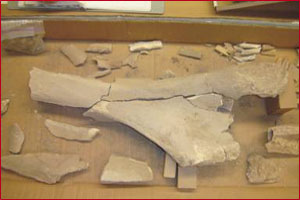
Partially reassembled bone in laboratory, March 2005
There have been two species of mammoth identified in Washington: the Imperial mammoth (Mammuthus imperator) and Columbian mammoth (Mammuthus columbi). Woolly mammoths (Mammuthus primigenius) have not been positively identified in the state. Mammoths in North America generally date between 1.7 million years ago and 10,000 years ago. The age of the Wenas Creek mammoth and bison have been estimated at about 17,000 years old, based on radiocarbon dates of the mammoth and bison bones. These bone dates are consistent with dates on sediment above and below the mammoth using a method called infrared-stimulated luminescence dating.
There were many small fragments of bone recovered, and a smaller number of identifiable pieces. These included 122 mammoth bones or bone fragments and 21 bison bones. In an ancient DNA study, the Wenas Creek mammoth was found to belong in the Columbian mammoth group. DNA studies of the bison bones were not successful, but the bison is likely to be an extinct species called Bison antiquus.
2005 Field Investigation
To give you and idea how this started, we will talk about the initial (2005) field season. The principal goals of the summer field school were to: (1) gain geological information to put the humerus find into its proper context, (2) search for additional bone at the location, and (3) provide an interdisciplinary hands-on learning experience for the students.
The first goal was gaining geological context for the bone find. This was important because the find was made during construction and the relationship of the bone and surrounding sediment was unclear. Unfortunately, this has often been the case for bone finds in Washington. With an understanding of the sediment surrounding the bone find, we can better interpret how the bone came to be there, and what else can be said about this mammoth and its environment. The geological context investigation was directed by Dr. Karl Lillquist. We had GFI Construction excavate a backhoe trench into the hill to reveal the local stratigraphy, then hand excavated a trench to link the backhoe trench to the bone find. The trench walls were mapped and described in terms of sediment color, texture, sorting, structures, etc., and a particle-size analysis was performed in the laboratory.
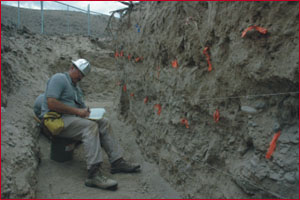
Dr. Karl Lillquist mapping stratigraphy in trench
To look for additional bone, we first hired Dr. Brian Whiting to perform a ground-penetrating radar (GPR) survey of the area around the initial find. He completed two grids at the site, one north of the find and one to the south. This method will result in a map showing locations with higher-than-average radar returns and lower-than-average radar returns, both called "anomalies". Anomalies indicate some change in the sediments under the surface, possibly including mammoth bone. A number of anomalies were found, but none were clearly indicators of mammoth bones. A sample of the results is provided below.
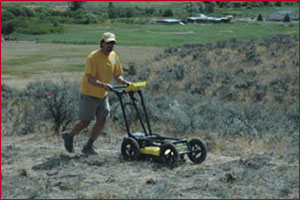
Dr. Brian Whiting operating GPR unit on site
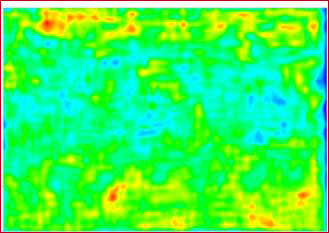
Sample GPR results. (Anomalies in red and blue)
We set up 2 x 2 meter (about 6 x 6 feet) squares for hand excavation surrounding the original find location and also on some GPR anomalies. Each of these squares was excavated with trowels and/or flat shovels in 10 cm levels, and all of the dirt was shaken through 1/8" screens. While this might sound unnecessary when looking for mammoth bones, we wanted to be very careful with our excavations in order to find any smaller animal bones or artifacts that might be associated with the mammoth bones. Additionally, we wanted to record the orientations of any bones we found in order to better interpret how they came to be there and their relationship to each other.
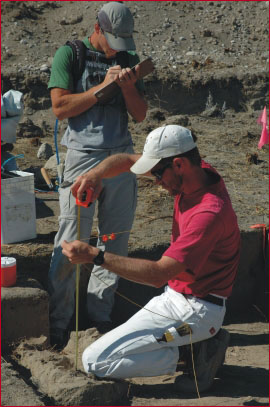
Student Miles Muscato and Dr. Patrick Lubinski measuring depths
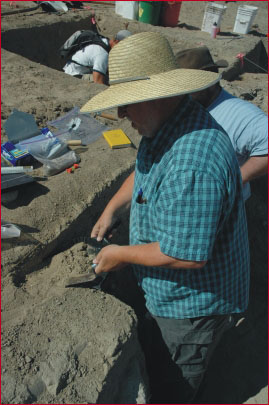
Bax Barton collecting bulk sediment samples for water screening
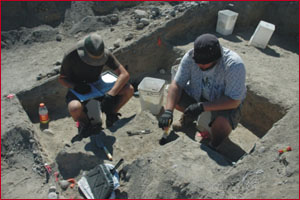
Students Mark Steinkraus and Lorin Davidson excavating Unit 9
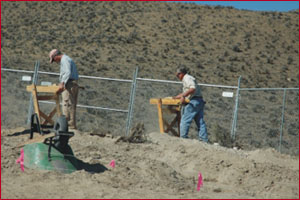
Screening excavated sediment through 1/8" hardware cloth
In order to keep track of all of the location information and tie the backhoe trench, excavation units, and current landscape together, we made a map of the area with a laser surveying instrument called a "total station" theodolite, supplemented by use of a Global Positioning System (GPS) unit.
Current Findings
Our current interpretation of the geologic context is that the bones lie in a colluvial deposit derived from downhill movement of loess (from the Pleistocene) and gravels (from the Ellensburg Formation). Loess is a wind-blown, dusty sediment often found in thick layers downwind of glaciers. The Ellensburg Formation consists of gravels and sands from the predecessors of the Cascades and was deposited at about the same time as the Columbia River Basalt flows. The colluvial deposit is underlain by bedded alluvial (water-deposited) sediments from the ancient Pleistocene Wenas Creek.
The bone find is well above the elevation of the highest known level of the outburst floods from Glacial Lake Missoula, which happened repeatedly during the Pleistocene and account for a number of other mammoth finds in the state. These floods carried boulders and icebergs well into the Yakima Valley, and are thought to be responsible for the Moxee mammoth tusk found in 2001. The outburst floods occurred when the ice dam across the Clark's Fork River catastrophically failed, emptying a lake about the size of Lake Erie in about two days and sending water across eastern Washington into the Columbia River drainage.
As of the end of the 2010 field season, we had discovered bones from mammoth, bison, and small rodents. The mammoth and bison are shown in the skeleton graphics below, where bones we found are indicated in red.
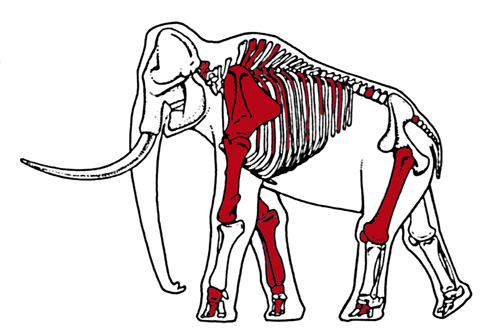
Mammoth skeleton with bones found shaded in red
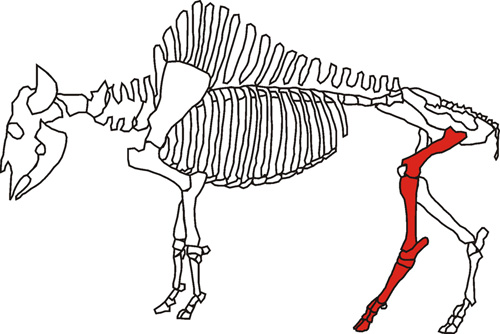
Bison skeleton with bones found shaded in red
In addition to the bones, we also found two human artifacts, both chipped stone waste flakes. With these flake finds, the project is both paleontology (focused on the fossil record) and archaeology (focused on the human past). One of these flakes was found in situ (in place) about 15 cm (6 inches) above a mammoth toe bone, and the other was found in the screen, apparently above the mammoth bone in another unit. Since the bones and flakes are from the same geological layer, they could be the same age.
Since the flakes cannot be dated directly, we tried getting age estimates for dirt samples collected surrounding the in situ flake using infrared-stimulated luminescence dating. This method estimates how long a grain of dirt has been buried. Of 94 single grains, 80% were consistent with a 17,000 year old burial but 20% were consistent with a 5,000 year old burial. This means that the flake could be 17,000 years old, or it could have been deposited about 5,000 years ago, which could happen if it fell down a 5,000-year old rodent burrow.
We also looked for signs that people killed or butchered the mammoth or bison, but there was no unambiguous human-caused damage on the bones (such as butchery cutmarks).
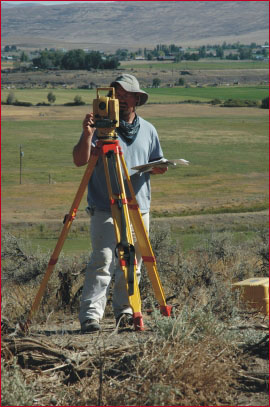
Student Ryan Murphy operating total station theodolite in 2005
Documentation
In addition to the scientific documentation of the project (notes, maps, photographs, scientific articles, etc.), the project has been recorded for several documentaries. About 15 minutes of footage on the dig was included in the History Channel's "Journey to 10,000 BC" which first aired nationally March, 2008. A 7-minute documentary was completed by CWU's Chris Smart in 2009, and is available for viewing on the videos page. There is also trailer for a documentary by Dr. Michael Ogden and his students (CWU Department of Communications) on the videos page.
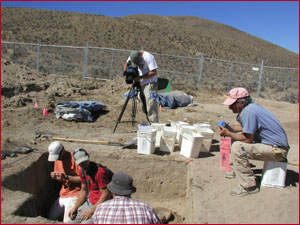
Student Andy Hanson films excavation in Unit 1 while Dr. Morris Uebelacker observes.
Revised March 24, 2026
CWU News

Arts and Humanities Month continues to build momentum
October 21, 2026 by David Leder
New position at CWU-Des Moines aimed at improving student experiences
October 21, 2026 by David Leder
Questions? Contact Us.
Department of Anthropology and Museum Studies
357A Dean Hall