
CWU Sustainability
Waste Diversion
CWU is committed to promoting sustainable practices and reducing the amount of waste generated on campus. Check out the latest updates and resources below as we work to divert over 25% of the waste generated on campus from entering the landfill by 2030.
Composting on Campus
-
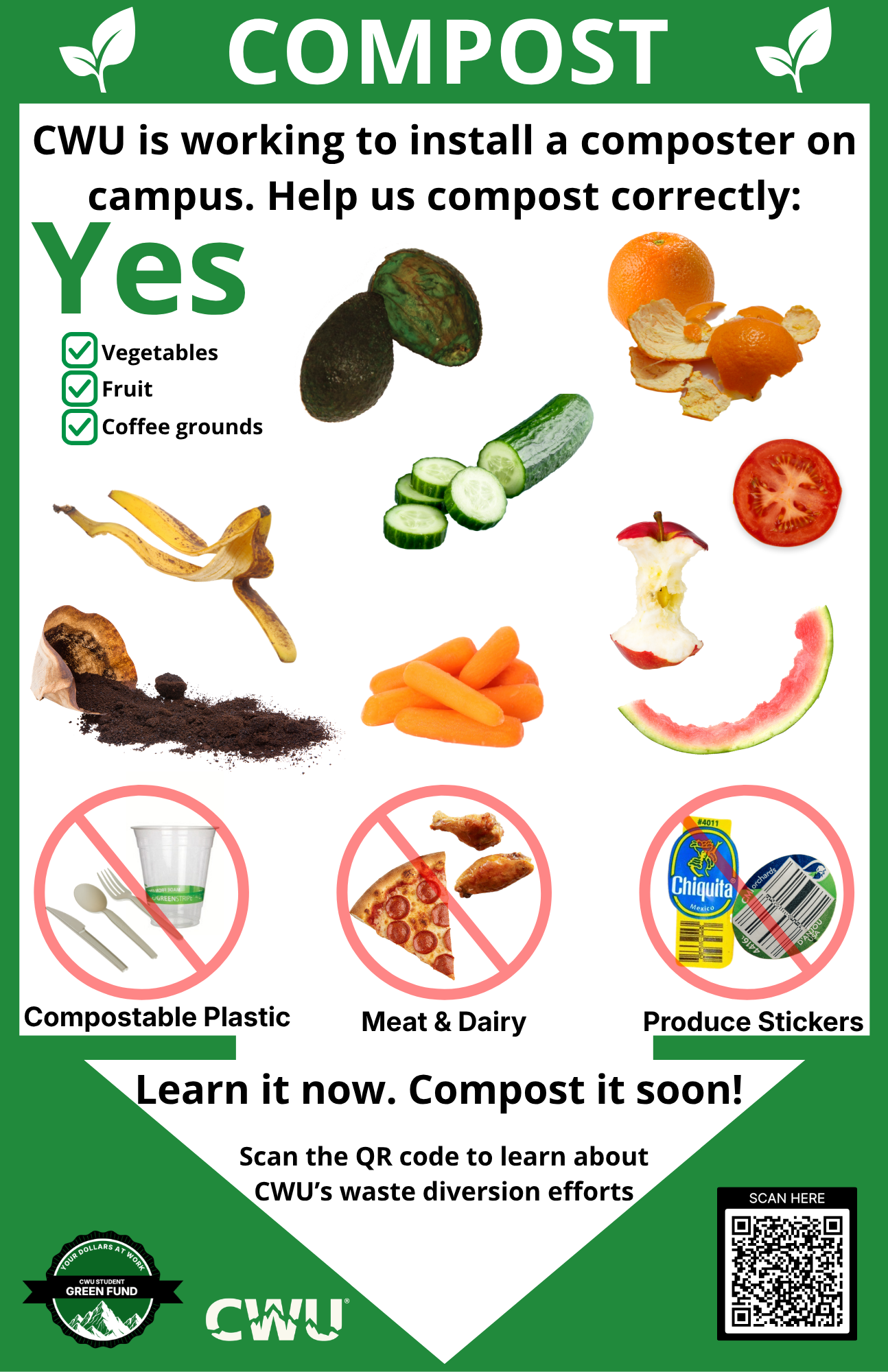
What Can Be Composted?
Accepted Items:
-
Fruits
-
Vegetables
-
Coffee ground
Please remove produce stickers before composting.
Not Accepted:
-
Meat products
-
Dairy products
-
Compostable plastics
-
Coffee cups
-
Plastic bags
-
Napkins
-
Pizza boxes
-
Trash or recycling
Accepted materials may expand as composting infrastructure develops at CWU.
-
-
Why Should We Care?
- Every year, approximately 220 tons of waste, including pre- and post-consumer food waste, is produced at the SURC and then sent to the local landfill. The SURC spends roughly $60,000 per year to haul this amount of waste to the landfill.
- Landfills in the United States are emitting significant amounts of methane emissions, a very potent greenhouse gas, roughly 30 times more effective at trapping heat in the atmosphere than carbon dioxide.
- In short, instituting a waste diversion program at CWU will help the university:
- Save money
- Reduce its impact on the climate and environment
- Generate compost to support the expansion of local food production
- Help address food insecurity in campus and in our community
- Create a circular economy and help the next generation of professionals learn how to compost and grow food!
-
Our Vision
- Dining Services and the campus community place pre- and post-consumer food waste (and other compostable waste) into clearly labeled composting bins at the SURC.
- The organic waste collected is transported to a large composter unit on campus, where roughly 500 pounds of organic waste can be loaded into the composting unit each and every day.
- Once the high-quality compost has cured and is ready to be used (4 or so weeks), the Wildcat Farm will use the compost to improve soil quality and expand food production, for the purpose of distributing more healthy and nutritious food to Dining Services at the SURC as well as local food banks. The food produced at the Farm that is not consumed and is discarded in the composting bins will be sent back to CWU’s composter, therefore building a circular approach to managing food waste and increasing food production.
-
Are We Composting at CWU?
CWU is not currently composting post-consumer food waste campus-wide. While coffee grounds from campus dining cafés are composted at the Wildcat Farm, most food waste generated at the SURC still goes to the landfill due to limited composting infrastructure.
The new compost bins are a first step focused on education and reducing contamination. By building correct sorting habits now, CWU will be better prepared when large-scale composting becomes available.
-
Latest Updates
- In May 2025, two CWU students were awarded funding through the CWU Student Green Fund to replace and standardize waste collection containers at the SURC.
- The intent of this project is to help support the eventual rollout of a composting program on campus while reducing confusion around which items to recycle, compost, or throw in the garbage bin.
- Recycling and composting standards differ by county in Washington. This Student Green Fund project includes the installation of educational signs to help raise awareness among SURC visitors on which items to discard in the landfill, recycling, or composting bins. This project aims to help reduce contamination of recycling and composting bins.
- The CWU Sustainability Office is currently seeking funding to support the acquisition and installation of a commercial composter. We will continue to seek grant funding, potential donors, and other funding opportunities to support an eventual organic waste diversion program on campus.
Recycling on Campus
-
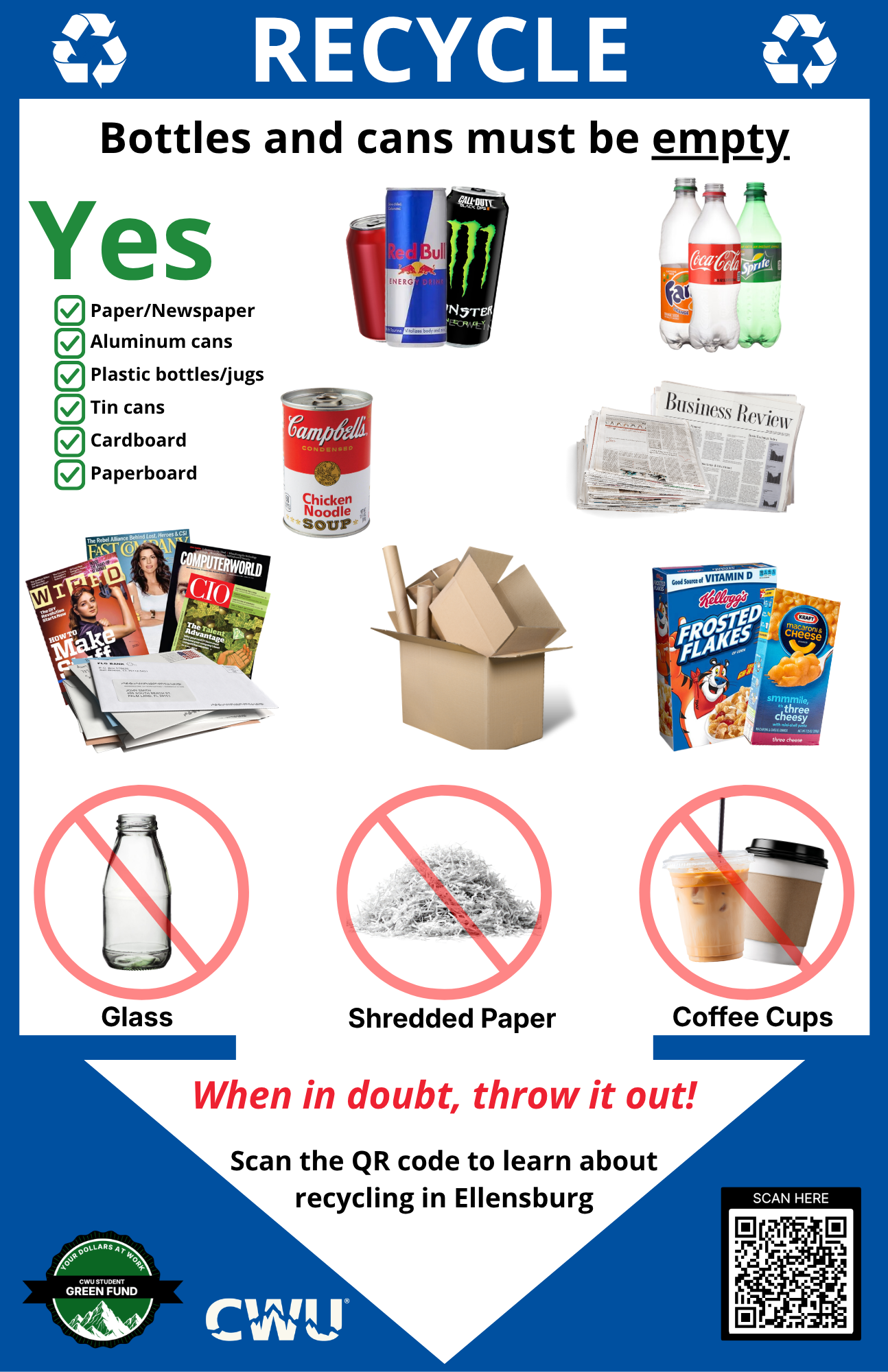
What Can Be Recycled?
Accepted Items:
- Paper/Newspaper
- Aluminum cans
- Plastic bottles/jugs (No caps)
- Tin cans
- Cardboard
- Paperboard
Recycling should be clean, dry & empty.
Not Accepted:
- Liquids or food
- Glass
- Compostable plastic
- Coffee cups
- Plastic bags
- Napkins
- Pizza boxes
- Shredded paper
- Trash
-
Where Do Recyclables Go?
Here is the overview of where your recyclables go from Ellensburg:
1. COLLECTION: WM collects material from customers.
2. TRANSFER STATION: Due to the distance between Ellensburg and the
Spokane Materials and Recycling Technology Center (SMaRT), recyclables go to a local sorting facility, part of our local hub and spoke network. Here, some materials, like cardboard
and plastics, are segregated to get ready to be shipped off to their next
stage. Once enough recyclables are collected, they’re loaded into a transfer
trailer and taken to a recycling facility.
3. RECYCLE FACILITY: WM operates a network of sophisticated recycling
facilities where people and technology work together to sort recyclable
materials by type (i.e. paper, cardboard, plastic bottles and jugs, etc.). After
sorting, materials are baled and ready for the next leg of their journey.
4. END MARKETS: Baled recyclables go to “end markets” for reintegration into
the supply chain. Here, recyclables are transformed into something new by
secondary processors and/or manufacturers. Watch how plastic bottles
transform into fiber: https://www.youtube.com/watch?v=swN29A4fyXo
5. THE IMPACT: This process recovers valuable resources, reduces greenhouse
gas emissions, and contributes to the circular economy. -
Recycling Special Items
Batteries
Kittitas County Solid Waste now participates in the OneDrum™ program. OneDrum™ is a turnkey all-in-one battery recycling solution that allows the safe and efficient placement and transportation of large volumes of consumer single-use AND rechargeable batteries in one drum. No more sorting by chemistry or individually bagging or tapping any battery terminals (including coin cell batteries).
You can now just drop your batteries at one of the battery drop off locations in the County.
Kittitas County Solid Waste Office - 925 Industrial Way Ellensburg WA 98926
Jerrol’s – 111 E University Way Ellensburg WA 98926
Cle Elum Transfer Station – 50 #5 Mine Rd Cle Elum WA 98922
-
Off-Campus Recycling
If you live in off-campus housing, your apartment complex may or may not offer recycling to its residents. When you're searching for housing in Ellensburg, call the property manager and ask if recycling is provided for the community.
If recycling is not available at your apartment complex, collect your recyclables and take them to the Ellensburg Transfer Station. The following recyclable items are accepted at each of the Kittitas County Transfer Stations in Ellensburg:
- Newspaper
- Cardboard
- Magazines
- Tin Cans
- Aluminum Cans
- Plastic Pop Bottles
- Plastic Milk Jugs
To keep in mind whenever you recycle:
- Make sure items are clean and dry
- Don’t recycle items in plastic bags
- Make sure you are recycling items in the right bins
- Recycle Flyer (PDF)
-
Can We Recycle Shredded Paper?
No, shredded paper is NOT accepted in the City of Ellensburg recycling program.
Why? Shredded paper is too small to be sorted and recycled. Any paper item smaller than a postcard is not recyclable because it falls through the sorting equipment.
Luckily, there are alternatives for shredded paper. Shredded paper is a great addition to your compost pit if it does not contain cellulose material (like windowed envelopes). Alternatively, it may be bagged and disposed of in your trash.
Waste on Campus
-
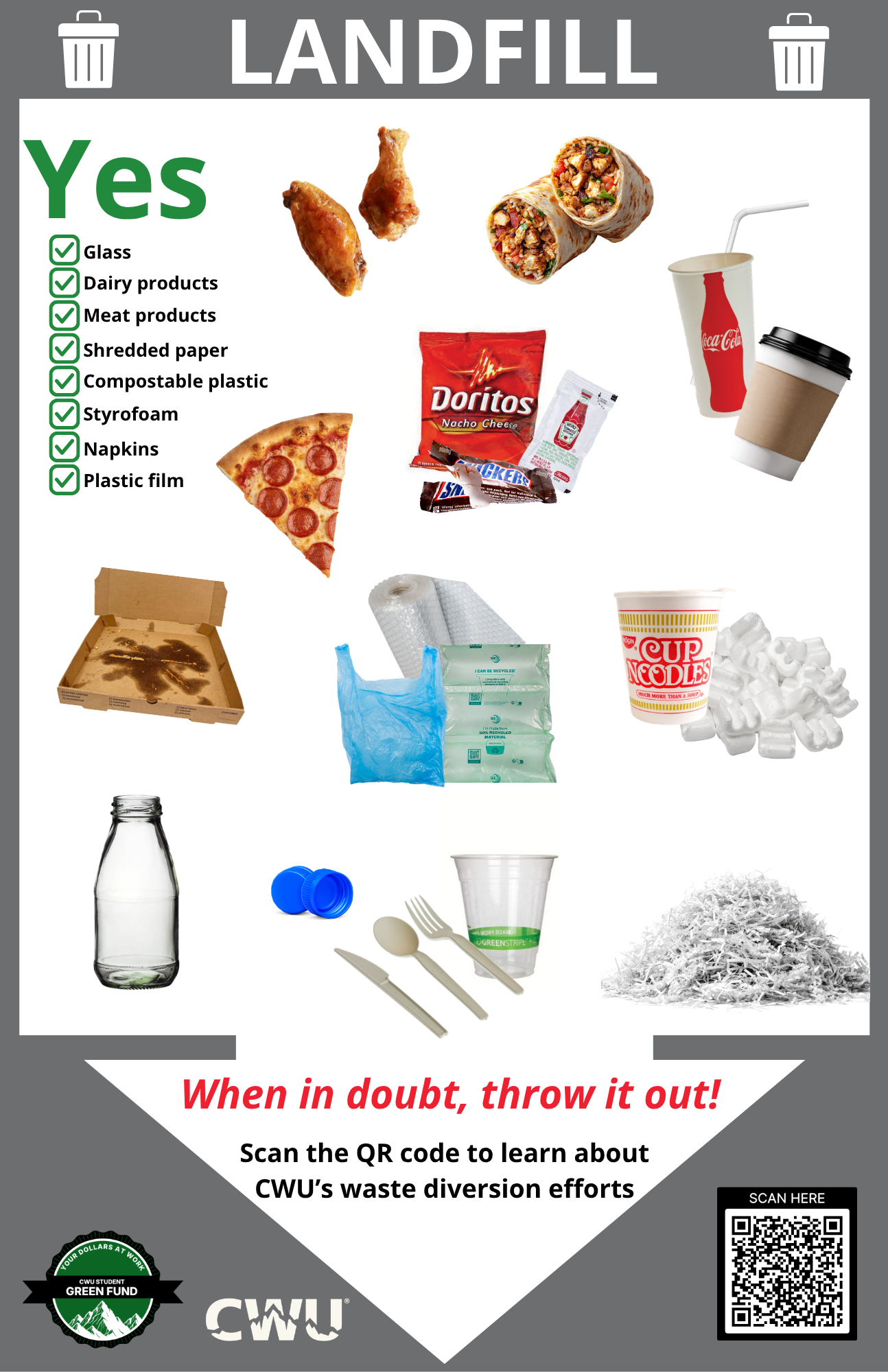
What Belongs in the Trash?
Accepted Items:
- Glass
- Dairy products
- Meat products
- Shredded paper
- Compostable plastic
- Styrofoam
- Napkins
- Plastic film
Not Accepted:
- Recyclable material
- Compostable food
- Hazardous waste
- Batteries
-
Looking to Donate?
Cleaning out your closet and finding items you never wear? Donate your clean, gently-used clothing and shoes to support fellow CWU students.
Career Services operates two clothing closets on the Ellensburg campus:
-
Professional Clothing Closet - Interview-appropriate and business attire
-
Casual Clothing Closet - Everyday clothing and accessories
Clothing of all sizes and styles is accepted. Items should be clean and in good condition.
Please do not donate:
-
Underwear or bras
-
Swimwear
-
Children’s clothing
Looking to donate furniture and other items?
Habitat ReStore accepts a wide range of items, including:
-
Furniture
-
Home goods
-
Building materials
-
Appliances (in working condition)
Goodwill accepts:
-
Clothing and shoes
-
Household items
-
Books
-
Small electronics (in working condition)
-
-
Move Out Guidance
Every year during spring move-out, CWU hosts Don’t, Waste Donate! to help keep usable items out of the landfill. Donation bins are placed around campus so students can easily give items a second life instead of throwing them away.
We accept:
-
Clothes & shoes
-
Non-perishable, unopened food
-
Furniture (in good condition)
-
Housewares (dishes, décor, small kitchen items)
-
School supplies
All donated items should be clean, usable, and in good condition.
We cannot accept:
-
Hygiene or personal care products (opened or used)
-
Opened or perishable food
-
Used bedding, pillows, or mattresses
-
Broken or heavily damaged furniture
-
Hazardous materials (chemicals, cleaners, batteries, etc.)
-
-
CWU Surplus
Need office supplies, furniture, or equipment? CWU Surplus offers a wide range of items that are still in good condition but no longer needed by campus departments.
-
Surplus items are available on a first-come, first-served basis.
-
Check the CWU Surplus website for current inventory and the next sale dates.
-
CWU News

Arts and Humanities Month continues to build momentum
October 21, 2026 by David Leder
New position at CWU-Des Moines aimed at improving student experiences
October 21, 2026 by David Leder