Search CWU Policies
Effective: May 29, 2024
Policy Review Date: 2030
Policy Executive: Senior Vice President - Finance and Administration
Responsible Office/Unit: Office of Policy and Ethics
Policy Statement:
The governance policies and procedures of Central Washington University (‘University”) will conform with this university standard and will be maintained in the Policy Framework. University policies exist to help the university be successful, comply with external obligations, and serve as an internal governing tool. In implementing this uniform process, the university seeks to enhance operational efficiencies, best practices, effective and ethical decision making, and compliance with federal and state laws and regulations. Furthermore, the university seeks to ensure its governing documents are easily accessible, understandable, consistent, widely disseminated, and approved through a transparent and participatory review process.
Applicability:
This policy pertains to all functions and operations at Central Washington University.
Content:
Policy
Appendix A – Policy Format and Definitions
Appendix B – Policy Management Procedure
Appendix C – Policy Flow Chart
Appendix D – University Policy Advisory Committee
(1) Introduction
A. Reason for policy
- This university policy provides the process and identifies the roles and responsibilities for developing and maintaining university policies and procedures.
B. University Governance Provisions
- All policies must conform to higher legal authorities and listed below is the order of their level of authority.
a. Laws (Revised Code of Washington): Rules developed by the state or federal legislature that have a binding legal force on the governance and operations of the university and its constituents. Title 28B (Higher Education) of the Revised Code of Washington (RCW) establishes all Washington State public institutions of higher education and prescribes state laws relative to institutional governance and operations. Laws are the highest legal authority governing university operations.
b. Regulations (Washington Administrative Code): Rules and regulations adopted by state and federal agencies. This includes legislatively required or authorized rules enacted by the university which are subject to a legally mandated review process prior to implementation, and which have the force of law following approval. Regulations are also outward facing and can govern the behavior of people outside of the campus community who come to campus. Title 106 of the Washington Administrative Code (WAC) contains the regulations expressly enacted by the university. Washington Administrative Codes, along with other federal and Washington State regulations, are the second highest legal authority governing university operations.
c. University Policies: Official policies of the university adopted by the Board of Trustees through the delegated authority to the president. These policies are governing statements and/or sets of expected behaviors with broad application and impact throughout the university community. Policies enhance the university's mission, promote operational efficiencies, manages institutional risk, and help ensure coordinated compliance with applicable laws and regulations. A University policy establishes rights, requirements, or responsibilities for the university community, and is approved in accordance with the procedures described in this policy document.
d. Department Policies: Operational procedures and standards developed at the department level.
C. General Definitions
- Board of Trustees: The Central Washington University Board of Trustees functions as the governing body of the university and is authorized under the provision of RCW 28B.35.120.
- President: The President of Central Washington University.
- Policy Executive: Division head (typically the Vice-President) or designee in charge of the policy. The Policy Executive is responsible for managing the policy and work with the UPA to facilitate updates and periodic review of policy according to schedule.
- Policy Template: Template of all policies that in clear and consistent manner lays out the policy language for easy readability and transparency.
- Policy Writer: Designated individual(s) by the Policy Executive to write, update or modify policies of the Responsible Office/unit. The Policy Writer works with the University Policy Administrator (UPA) to prepare policy documents and respond to feedback in consultation with the Policy Executive.
- Review Schedule: Schedule that lays out the periodic reviews of all policies. The Review Schedule is managed by the UPA in cooperation with the Policy Executive.
- University Policy Administrator (UPA): Responsible for managing the policy process and work with Policy Executives and Policy Writers on creation, periodic review, and updates to policies. The UPA manages the policy framework and is responsible for posting any signed changes to policies and submitted changes to appendices as well as assuring that all policies are adhering to the policy template.
- University Procedure: Written document that outlines and explains how a policy is implemented and the steps necessary to comply with the policy.
(2) Policy Framework
A. Structure
- University Governance Provisions will be functionally organized within the Policy Framework.
- Part: Each University Governance Provision will be organized into “Parts” within the Policy Framework as follows:
Part 0 – Policy Administration
Part 1 – Board of Trustees
Part 2 – University Operations
Part 3 – Employees
Part 4 – Civil Rights
Part 5 – Academic Affairs
Part 6 – Health, Safety and Security
Part 7 – Standards of Conduct
Part 8 – Students
Part 9 – Athletics - Section: Each Part may be divided into sections that can be assigned to different areas within the university.
- The policy framework will be maintained on the Policy Management website by the University Policy Administrator.
B. Contents
- The Policy framework includes all University Policies and Title 106 WAC policies. The policy management website will provide a catalog of all items in the framework in the form of hosted documents.
(3) Content and Format
A. Policy and Procedures
- A University Policy (Policy) is a governing statement and/or set of expected behaviors with broad application and impact throughout the University community. It enhances the university's mission, promotes operational efficiencies, manages institutional risk, and helps ensure coordinated compliance with applicable laws and regulations. A University policy establishes rights, requirements, and responsibilities for the university community. The policy language is contained within the body of the document. Attached to any policy may be its procedures.
- A University Procedure is a written document that outlines and explains how a policy is implemented and the steps necessary to comply with the policy. University Procedures can be changed to improve the way a policy is administered through the approval of the Policy Executive and does not need to go through the University policy process. Any changes to a University Procedure document must be submitted to the UPA before it can be published to the Policy Framework.
B. Style and format
- University Policies and associated procedures will be written as clearly and concisely as possible. The average reader should be able to easily understand the policy’s requirements.
- University policies and associated procedures will follow the formatting laid out in Appendix A. The University Policy Administrator is responsible for assuring compliance.
(4) Policy Management
A. General
- This chapter describes the process for adopting, revising, repealing, and reviewing University Policies.
B. Adoption and Revision of University Policies
- Authority: The President, through delegated powers from the Board of Trustees (see CWU 108-03) has the authority to adopt and revise University Polices.
- Detailed procedures for adopting and revising policies is found in Appendix B and will at a minimum include the following:
a. A review of the policy by various interested campus groups that are affected by the proposed policy.
b. A review by the Assistant Attorney General when deemed appropriate.
c. Allowing for University community feedback from all constituents and interested parties who post comments on Policy Management website or contact the University Policy Administrator.
d. A campus vetting process consisting of comment and input period of at least 20 calendar days.
C. Interim Policies
- A Policy can be created and immediately adopted as an “interim” policy under the authority of the president.
- Interim policies will expire 180 days following the effective date. To make an interim policy permanent, it must go through the standard review process before it expires. An interim policy can be extended for one period of 180 days with the President’s approval.
- Interim polices must, whenever possible, follow the policy structure outlined in this policy, when published to the Policy Framework and will be identified as an interim policy with an expiration date.
D. Housekeeping Changes
- Changes to the University Policy Framework and individual policies that do not materially affect the language and intent of a policy can be instituted by the University Policy Administrator outside of the policy vetting process.
- These changes can include, but are not limited to changes to:
a. Appendices
b. Referenced codes or officials due to statutory changes.
c. University Policies to reflect changed or adopted names of a university unit or program.
d. Incorrect spelling, punctuation, or formatting.
e. Grammatical mistakes in a manner that does not alter the scope, application, or meaning of the University Policy.
f. Incorrect references to other University Policies.
g. Incorrect contact information referenced in a University Policy.
h. Updated or incorrect web links.
i. Table of Contents - Changes made under this section must be approved by the University Policy Administrator before they can be posted to the Policy Framework and will be communicated to the Policy Executive prior to posting.
E. Repeal or Retirement of a Policy
- To repeal a Policy which includes any material provisions that have not been superseded or made obsolete, or to retire a policy that is no longer needed, the repeal or retirement will follow the normal Policy process outlined in Appendix B
- To remain current and pertinent, policies must be periodically reviewed. Every policy must go through the complete policy review process every 4 years. The University Policy Administrator will work with each Policy Executive to establish a policy review schedule for each policy in the Policy Framework.
- Policy Reviews will follow the procedure outline is Appendix D
G. Washington Administrative Codes
- Additions or changes to existing WACs will be managed by the University Policy Administrator (UPA) and processed in accordance with the Administrative Procedure Act, chapter 34.05 RCW, and WAC title 1, Office of the Code Reviser.
H. Conflicting Provisions
- When a conflict exists between University Governance Provisions, the highest authority provision takes precedence. Subordinate provisions must be modified to conform to the higher authority.
History:
Policy was recommended for approval by University Policy Advisory Committee (UPAC). May 29, 2024, Approved by A. James Wohlpart, President
12/1/2025 Updates to Appendix B, C and D, Approved by Joel Klucking, Policy Executive
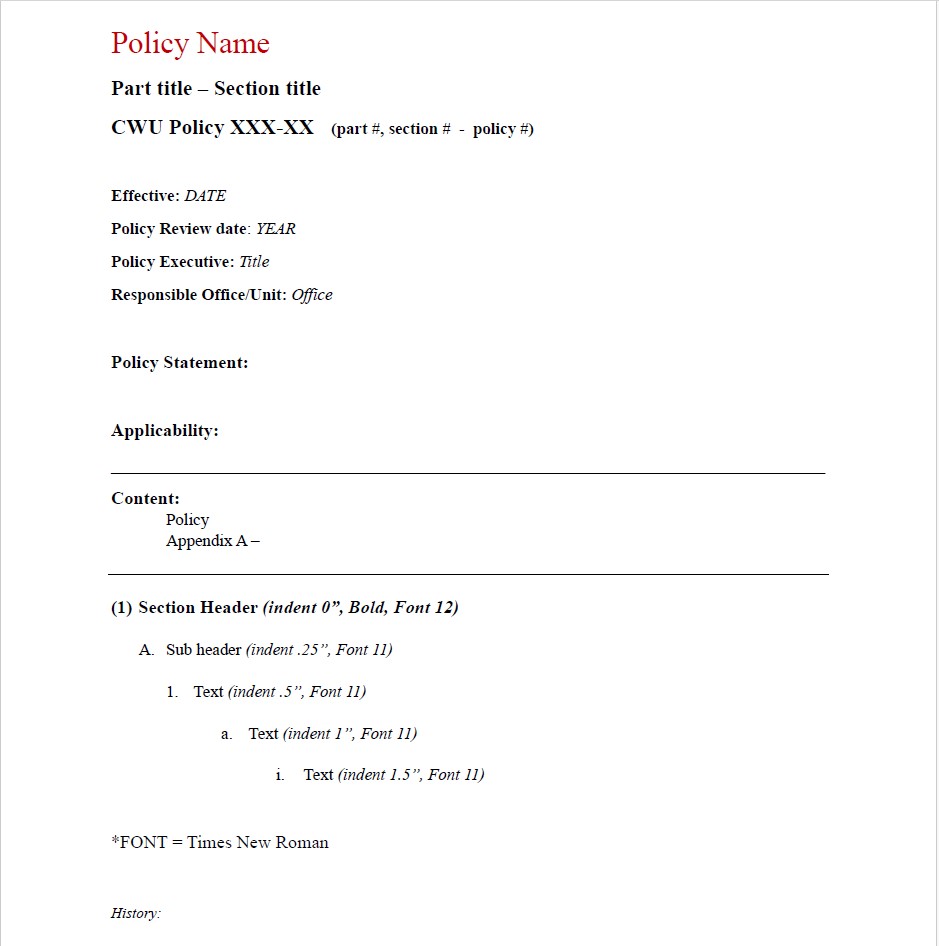
Appendix A - Policy Template and Definitions
(1) Policy Document Definitions
A. University Policies will contain the following sections:
- Policy Title: Short descriptive title of the policy.
- Effective: Date when policy was signed and enacted by signature of the president.
- Policy Review Date: Date by which the policy should go through the Policy Review Process.
- Policy Executive: Division head (typically the Vice-President) or designee in charge of the policy. The Policy Executive is responsible for managing the policy and work with the UPA to facilitate updates and periodic review of policy according to schedule.
- Responsible Office/Unit: Office or Unit that has the subject matter expertise to implement policy. The Policy Executive may often designate a policy writer from this unit for purposes of revising the policy.
- Policy Statement: Brief statement outlining the purpose of the policy.
- History: The history will describe whether the policy is new or a revision and should identify any superseded policies. It should state when and by who the policy was recommended and adopted. The history will also layout what created the need for the policy i.e., legislation, regulation, or any other external requirement.
- Applicability: Identifies to what persons, colleges, offices, units, and/or activities the policy applies.
- Identification: Each University Policy will be identified with a unique number consisting of the Part number, Section number, a dash, and a 2-digit number. Example, CWU 001-01 refers to Part 0 ’Policy Administration’, Section 01 ‘Operation’, and Policy 01 ‘Policy Management’.
(2) Policy Template
A. University Policies will follow the following template.
Appendix B – Policy Management Procedure
(1) Purpose
A. This Procedure document outlines the process for administering changes to University Policies. Exceptions to these procedures are permitted for interim policies and housekeeping changes as described in CWU Policy 001-01, section (4)C and section (4)D.
(2) Start of Policy Process
A. ACTION by university employee proposing new policy or policy edits:
- Notifies the University Policy Administrator (UPA) of the intention to revise or create a policy.
B. ACTION by University Policy Administrator:
- Records notice and provides a copy of the Policy Proposal & Impact Statement (PPIS) template to the university employee.
C. ACTION by proposing employee:
- Completes Policy Proposal & Impact Statement (PPIS) and forwards to responsible Policy Executive.
D. ACTION by Policy Executive:
- Approves or disapproves the Policy Proposal & Impact Statement (PPIS).
a. If approved, assigns Policy Writer and then forwards Policy Proposal & Impact Statement (PPIS) to UPA. The Policy Writer may be different from the proposing employee or the Responsible Unit.
b. If not approved, remands to proposing employee and UPA with explanation and possibly for additional consideration.
(3) Review by Assistant Attorney General
A. ACTION by University Policy Administrator:
- Records submission and forwards Policy Proposal & Impact Statement (PPIS) to the Assistant Attorney General for review.
B. ACTION by Assistant Attorney General:
- Completes review of Policy Proposal & Impact Statement (PPIS) and returns to UPA, with written comments and/or concerns (if any).
(4) Review by Executive Leadership Team and President
A. ACTION by University Policy Administrator:
- Presents Policy Proposal & Impact Statement (PPIS) including any written comments from the Assistant Attorney General to Executive Leadership Team (ELT).
B. ACTION by Executive Leadership Team:
- Reviews Policy Proposal & Impact Statement (PPIS) and makes one of the following recommendations to the President:
a. Proceed
b. Return
c. Reject
C. ACTION by President:
- Reviews recommendation by ELT and then decides to Procced with, Remand w comments, or Reject the Policy Proposal and Impact Statement (PPIS) and forwards completed signature sheet to the UPA.
a. Proceed with the Policy Proposal & Impact Statement (PPIS) – (Go to (5))
b. Return the Policy Proposal & Impact Statement back to Policy Writer for additional information. (Return to (2)C.1)
c. Reject the Policy Proposal & Impact Statement (PPIS) and return to Policy Writer with explanation. (End of Process) Example: a Policy Proposal & Impact Statement may be rejected if it violates state or federal law.
(5) Developing or Revising Policy
A. ACTION by University Policy Administrator:
- Develops Initial draft of policy and any supporting Procedures. Forwards to Policy Executive when it is ready for review through the University Policy process. For policy revisions and updates to current policy, the Policy Writer will submit draft with Track changes on policy document provided by UPA in (5)A.1.
B. ACTION by Policy Writer:
- Develops Initial draft of policy and any supporting Procedures. Forwards to UPA when it is ready for review through the University Policy process. For policy revisions and updates to current policy, the Policy Writer will submit draft with Track changes on policy document provided by UPA in (2)B.1.
- Reviews the draft Policy or policy edits and approves them for review by UPAC. If needed, work with the policy writer to make changes.
- Forwards to the UPA when it is ready for review through the University Policy Process.
D. ACTION by University Policy Administrator:
- Reviews and verifies that the draft Policy follows the policy format standards on Appendix A. If needed, work with the Policy Writer to make any corrections.
- Once finalized, the draft policy will be placed on the next UPAC meeting agenda (if within 7 days of the next meeting).
- Invites Policy Writer to attend the UPAC meeting to address any questions from the committee and to hear feedback on the policy draft.
(6) University Policy Advisory Committee – First Reading
A. ACTION by University Policy Administrator:
- Transmits entire Policy draft file to all members of UPAC, no later than 7 days prior to the next scheduled UPAC meeting.
- Review and discuss policy draft. Collect committee feedback for UPA to share with Policy Writer.
a. *Revised policy: the discussion and feedback are limited to the updated language of the policy.
b. *New policy: discussion and feedback are permitted for the entire policy.
c. *Full scheduled review of a policy: discussion and feedback are permitted for the entire policy regardless of whether language has been changed or not.
C. ACTION by University Policy Administrator:
- Share feedback from UPAC with Policy Writer. Works with Policy Writer on any adjustments to the Policy.
- Revises the Policy draft document (if needed) and returns to the UPA.
(7) University Community and other Reviews
A. ACTION by University Policy Administrator:
- Posts Policy draft on the University Policy Webpage for a 20-day public comment period.
- Communicates review to the University community via Central Today.
- At the conclusion of the review period, shares all University community comments and feedback, left on the University Policy webpage, or submitted directly to the UPA, with the Policy Writer..
B. ACTION by Policy Writer:
- Reviews comments and makes any needed adjustments or updates based on university community feedback via track changes and then forwards revised draft to the UPA.
- Forwards final version of the draft Policy to the Assistant Attorney General for their review.
D. ACTION by Assistant Attorney General:
- Reviews the Policy draft and provides any comments in writing to the UPA.
- Forwards any comments received from the Assistant Attorney General to the Policy Writer.
- If needed, review comments and makes any updates to the policy draft and returns the updated policy draft to the UPA.
- Forwards policy draft to the Policy Executive for their final review.
- Reviews the Policy draft and provides any comments in writing to the UPA.
- Forwards any comments received from the Policy Executive to the Policy Writer.
- Reviews comments and works with Policy Executive on any comments to create the Final Policy Draft and then forwards the Final Policy Draft to the UPA.
(8) University Policy Advisory Committee – Second reading and recommendation
A. ACTION by University Policy Administrator:
- Places Final Policy Draft on the UPAC agenda and transmits the entire policy file to all members of the committee at least 7 days prior to the next UPAC meeting.
- Reviews the Final Policy Draft including all feedback and other documentation included the policy file.
- Votes on committee recommendation. UPAC makes the recommendation to the President of either approval of Policy or remanding of policy to Policy Writer for further consideration. Recommendation decision by UPAC is done by majority vote of committee members present using Robert’s Rules and the vote is recorded in the policy file, listed by individual members. The UPA records each members individual vote.
C. ACTION by University Policy Administrator:
- Transmits entire policy file including the recommendation from UPAC to the President.
(9) President Review and Decision
A. ACTION by President:
- Reviews the policy file and considers the recommendation from UPAC.
- Decision:
a. If approved, sign and submit Policy and signature sheet to UPA for publication.
b. If not approved, remand to Policy Writer for revision with comments. (Return to (7)B.1)
(10) Board of Trustees review and Approval (if applicable, otherwise skip to (11))
A. If Policy needs the approval of the Board of Trustees (BOT) – the Final Policy Draft is forwarded to the Board Secretary for inclusion on the next Board of Trustees meeting and will follow board’s process for approval.
B. Once BOT approves, the policy will then be forwarded to the UPA and follow the process outlined in section 11.A for publication.
(11) Publishing of Policy
A. ACTION by University Policy Administrator:
- Notifies the Policy Writer and Policy Executive of approved Policy.
- Provides University wide notification of the approved Policy including post on University Policy Webpage, Central Today, and if needed, notice to ELT and campus shared governance groups.
- Publishes Policy in the online Policy Framework located on the Policy Management Webpage.
(12) End of the process.
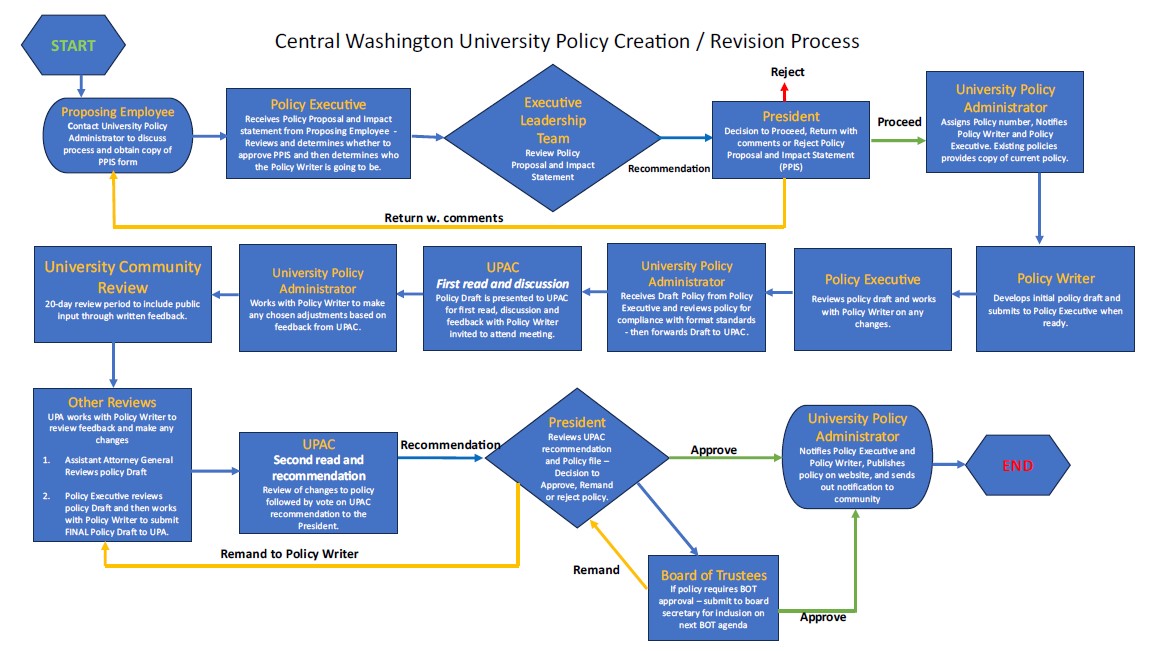
Appendix C – Policy Flow Chart
Appendix D – University Policy Advisory Committee
(1) University Policy Advisory Committee (UPAC)
A. The committee reviews and recommends University Policies to the President for approval to the policy framework.
B. UPAC membership includes representation from all divisions, various employee groups, and students.
C. Additional membership provides for input from areas that can provide an equity lens, academic department level knowledge, and university wide public relations and communications feedback.
(2) Membership:
A. University Policy Administrator (Chair / Non-Voting)
B. One Representative (voting) each from:
- Division of Academic Affairs
- Division of Finance and Administration
- Division of Student Engagement and Success
- Faculty Senate
- Exempt Employee Association
- Classified Staff Employee Council
- ASCWU
- President’s Division
- Dean’s Council
- ADCO
(3) Meetings:
A. UPAC will meet monthly during the academic year and as needed during the summer months. An annual schedule of meetings will be posted on the Policy Management webpage.
(4) Decision Making:
A. Recommendation decisions by UPAC are done by majority vote of committee members present using Robert’s Rules and the vote is recorded in the policy file, listed by individual members.