State Task Force to Visit CWU to Explore the Future of Work
- May 8, 2019
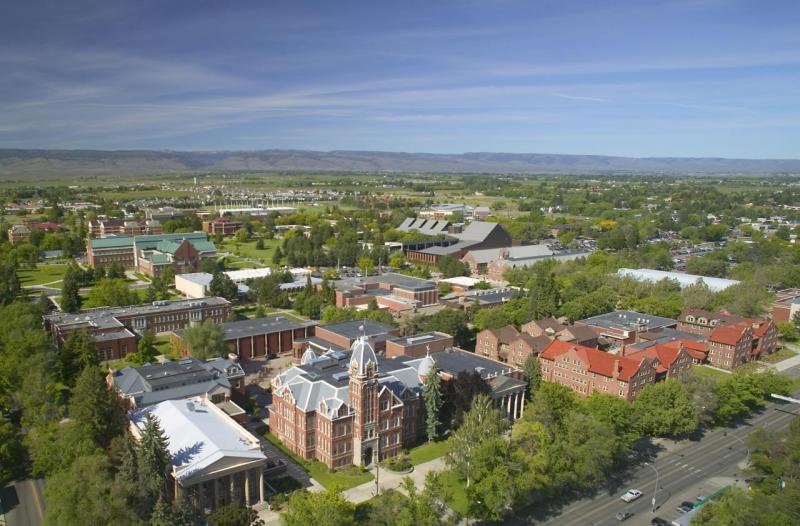

CWU will host the task force’s inaugural meeting in central Washington on Thursday, May 9, from 9:00 a.m. to 2:00 p.m. in the Wellington Events Center. It is open to the public.
The 16-member Future of Work task force—comprised of business and labor leaders, and state lawmakers—will get the chance to learn about how CWU is already working toward meeting the group’s charge to “future proof†Washington’s workforce and businesses.
The task force’s efforts come at a time when estimates indicate half all available jobs in the United States now require advanced skills. In the Pacific Northwest alone, more than three-fourths of job openings are for workers with four years or more of higher education.
“The workforce is changing in terms of the depth and quantity of preparation needed to join it and to have what would be considered a ‘good job,’ one that pays a living wage and has a sustainable future over time,†explained Liz Fountain, CWU Information Technology and Administrative Management (ITAM) lecturer, who will address the task force. “It used to be that you could gain entry into those good jobs with only a high school diploma. But, now, the balance is increasingly shifting and for good jobs, which meet that criteria, you must have a college degree.â€
That makes access to degree options vital. In response, CWU’s ITAM department and the university’s Office of Extended Learning and Outreach are working to provide degree opportunities for working adults through “stackable credentials.†It includes a new FlexITrade Pathways program, which is referred to as “a degree built for tradespeople.â€
Through FlexITrade Pathways, performance-based, flexible-paced learning will be offered, leading to “stackable†certificates and, eventually, college degrees. The modular, fully online program will allow enrolled students to gain immediate career advancement benefits, while simultaneously advancing toward their degree. Prior learning will also be taken into account for each student.
Despite being online in nature, students will have essential access to university advising online, in Ellensburg or at one of the University Centers or instructional sites located throughout Washington. Students will actually be paired with ITAM faculty advisers—“success coachesâ€â€”before they enroll in the program.
“We are also working on implementing a transfer and transition center here at CWU,†pointed out Gayla Stoner, CWU’s associate provost for Extended Learning and Outreach. “That center will serve transfer students and will also focus on student’s prior learning efforts, which are a major component of the FlexITrade Pathways program.â€
Prior learning enables students to have the opportunity to gain college credit for their work experience or knowledge gained elsewhere that would not be available through traditional academic courses or included on a typical educational transcript.
Last month, the Chronicle of Higher Education reported that 36 million adults now in the work force have some college experience but no degree. It’s also believed that many of the estimated 24 million low-wage American workers will also need to upgrade their skills to fill openings in professions from nursing to software developers, human resources specialists to sales representatives.
FlexITrade offers needed instruction needed in those areas, and in specific soft skills which are also now in demand, such as budgeting, scheduling, project management, sales, and teamwork.
“Whether it’s hard skills or soft skills, lifelong learning is really underlying all of this,†stated Fountain, who serves as the university’s FlexIT program coordinator. “The economy now is one in which you really can’t stand still, you can’t simply learn just one thing and then bank on it for the rest of your life. You have to be versatile and always be able and willing to develop further knowledge and skills.â€
The changes in labor characteristics are also being driven by automation and artificial intelligence, which are replacing some jobs but also opening opportunities for those will skills gained through higher education. It’s thought that, while different, work in the future will, overall, involve less repetitive tasks and be more creative and fulfilling overall.
“Right now, those working in the trades have more work that they know how to deal with. However, looking down the road, in terms of their individual careers and the economy as a whole, it’s one where more knowledge will be necessary,†said Fountain. “The shift will be to help people who are very well prepared for a skill-based economy transition into what will increasingly become a partnership involving skills and knowledge. That’s where a bachelor’s degree comes in,â€
Over the next year, task force members, based on what they hear at CWU and at other meetings around the state, will develop policy recommendations for the legislature, establish success indicators and craft a measurement tracking system to evaluate progress.
Media contact: Robert Lowery, Department of Public Affairs, 509-963-1487, Robert.Lowery@cwu.edu.
CWU News
Arts and Humanities Month continues to build momentum
October 21, 2026 by David Leder
New position at CWU-Des Moines aimed at improving student experiences
October 21, 2026 by David Leder