CWU’s Oldest Building Becomes Focus of Newest Surveying Methods
- August 24, 2018
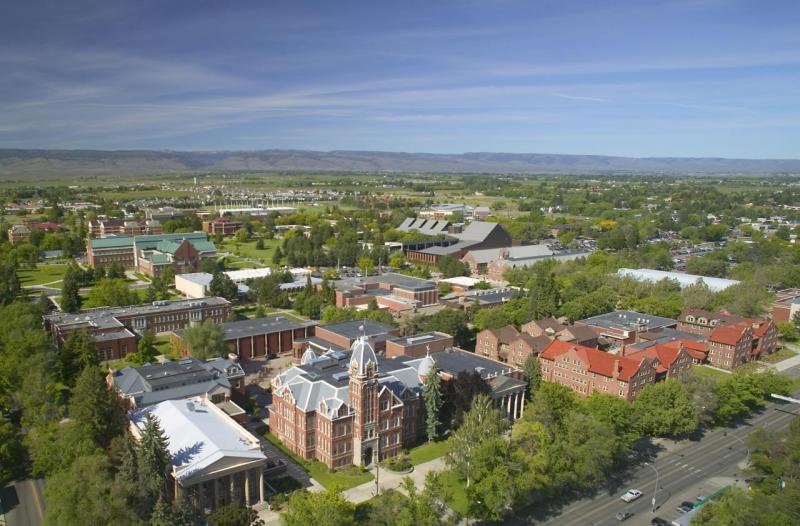

“We take overlapping photos with a [special, camera-equipped] drone—about a 75-percent overlap,†explained Paul Tice, the chief executive officer for ToPa 3D, based in Beaverton, Oregon. “From that, we use stereoscopic pairs of those photos to extract a 3D model. Because the drone uses a Global Positioning System, those individual images also contain valuable GPS information embedded in them.â€
CWU employed ToPa 3D in conjunction with the university’s updated preventative maintenance program, which calls for all university buildings to have full maintenance and safety reviews annually.
“We allocate a significant amount of resources to our preventative maintenance program because it’s so important to keep the asset [university infrastructure] in good working order,†said Hunter Slyfield, assistant director of Maintenance for CWU Facilities Management. “The day you stop caring for it is the day it stops working.â€
The ToPa 3D drone was used with the company’s Light Detection and Ranging (LiDAR) scanner, which marked selected spots on the building. The digital photos taken were then aligned to the LiDAR points.
Tice added, “We end up with an accurate scale model, to within about a quarter inch. So, this is going to be a very precise representation of the building, so exact that we will actually be able to tell if anything is even out of plumb [not exactly vertical].â€
Such measurable imagery will be available for the entire building, providing detailed information for remodeling or restoration work that may be required in the future.
Tice continued, “Anytime a plan is developed for, say, a new window, or replacing the roof, extraordinarily accurate information will be available, rather than having to take measurements by hand with a laser or a tape measure.â€
Slyfield continued, “What he was able to get done with the drone is far superior to any data we could have gathered. You can compile pretty good data doing it through a more manual process—taking photos, references, scaling, things of that nature. But what they have the capability of doing with the drone is leaps and bounds ahead of what we have been doing.â€
The entire building, roof included, was documented in a single day, which will end up saving money for the university in the long run and a significant number of personnel hours right now.
“Time is money, especially in labor costs,†Slyfield estimated. “It would have taken about 80-percent ‘man-lift’ [hours], using our 85-foot snorkel lift, along with additional scaffolding and ladder work. To do what Paul and the drone were able to do in a day would have taken us upwards of a week, maybe a week-and-a-half.â€
Along with that, the drone provided a measure of additional safety for CWU facilities personnel, university contractors, and the public in general.
“Anytime you have an employee on a lift and you have to send them up, whether it be on a man-lift or scaffolding, there’s an inherent risk with that,†Slyfield acknowledged.
While such surveying technology has been available for about 20 years, it recently has become cost-effective for such architectural work. Tice’s company has conducted similar projects at the Old Capitol Building in Olympia and Denny Hall at the University of Washington.
Tice was quick to note that, “We work closely with Peter Meijer Architect, a company out of Portland, on the project here at Central, and all of the projects in Washington, as well as several others in Oregon. Their team does the professional evaluation of the data that we provide through the drone process and then provides recommendations to our clients.â€
While the Barge Hall data is still being analyzed, Slyfield points out the drone did isolate some brick veneer and areas of the building’s zinc roof that will require maintenance in the near future.
Slyfield noted, “The building is still very structurally sound. Even so, that type of brick doesn’t hold up to conditions as well as the modern brick does. The rule of thumb, for buildings such as Barge, is to do this type of [survey] work on a five-year cycle, to allow for good comparative analysis on the condition of the exterior brick, the roofing, flashing and windows to see how well they are weathering, and any work that may be needed.â€
In addition, university officials will be able to glean valuable information for historic preservation purposes and archival material.
“It’s impressive how they built Barge, and other structural-brick buildings back in the day—row-upon-row of stacked, structural brick, which you just don’t see anymore,†Slyfield said. “What they were able to accomplish with the materials and technology they had at the time—I’m amazed at what those brick masons could do.â€

Media contact: Robert Lowery, Department of Public Affairs, 509-963-1487, Robert.Lowery@cwu.edu
CWU News

Arts and Humanities Month continues to build momentum
October 21, 2026 by David Leder
New position at CWU-Des Moines aimed at improving student experiences
October 21, 2026 by David Leder