CWU Astronomers to Track Sunday’s Supermoon Lunar Eclipse
- August 18, 2016
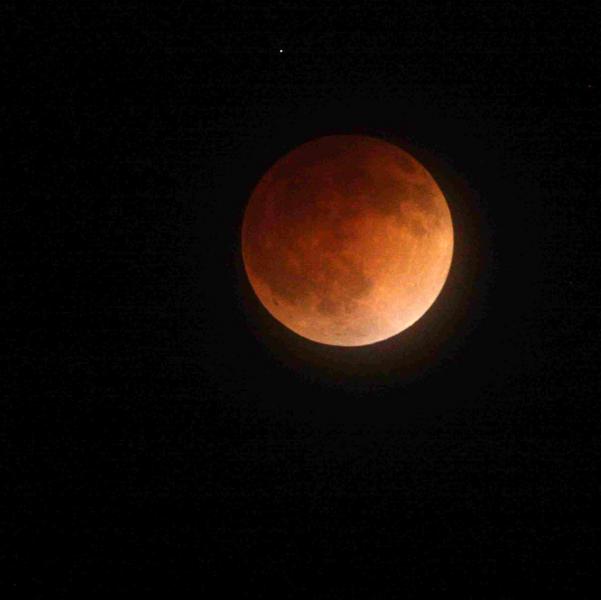 This Sunday night, you’ll have the opportunity to witness a rare astronomical event: the eclipse of a “supermoon.”
“The moon has an elliptical orbit around the Earth, so once a month it is closer to Earth—also known as perigee,” said Cassandra “Cassie” Fallscheer, Central Washington University professor of physics. “When a full moon coincides with this point in orbit, it is called a supermoon.”
The visual effect is not really as dramatic as the word sounds, she remarked. However, there have been higher than normal tides recorded during the supermoons.
It is the eclipse of this month’s moon that makes it such a rare event. It is the first time it has happened in 30 years, and won’t occur again until 2033. An eclipse is when the Earth moves between the sun and the moon, creating a shadow on the moon. Often the only rays of light that reach the moon’s surface are in the red spectrum, giving the moon a rosy hue—hence the term “blood moon.”
The eclipse will begin at 8:00 p.m. Eastern Standard Time, so it won’t be visible in the West for several hours.
“At 7:30 p.m., the students in the Astronomy Club will start setting up telescopes,” said Fallscheer. “The moon should be fully eclipsed when it rises at sunset, and at 8:20 p.m., begin egress, or coming out of the shadow of the Earth.
“Of course, you can see the eclipse without a telescope,” said Fallscheer, “but it’s more interesting to get a close-up view of the moon’s surface.”
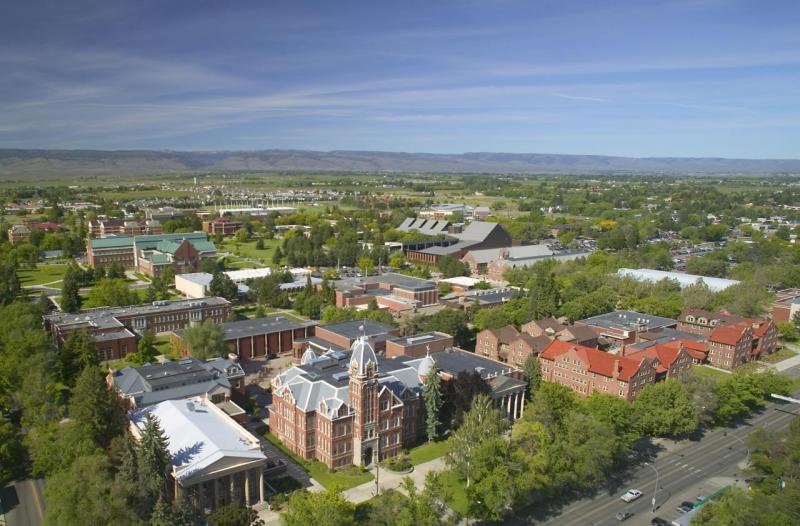
Fallscheer and her students will set up on the roof of Lind Hall, and members of the public are invited to join her in studying the eclipse.
“People should come to the west entrance of Lind,” she said. “We’ll have signs directing you through the maze. Unfortunately, to get to the roof, there are a couple of flights of stairs to climb.”
Cassandra Fallscheer earned her PhD from the Max Planck Institute for Astronomy in Heidelberg, Germany. She worked with Herschel Space Telescope data as a postdoc at the NRC-Herzberg research facility in Victoria, BC, Canada. Fallscheer has used telescopes at multiple locations around the world as well as in space, and has attended astronomy conferences on nearly every continent. She is active in astronomy public outreach and interacting with amateur astronomers. She was also a member of the faculty on Semester at Sea.
Media Contact: Valerie Chapman-Stockwell, Public Affairs, 509-963-1518, valeriec@cwu.edu
Photo courtesy of NASA
September 2015
CWU News
Arts and Humanities Month continues to build momentum
October 21, 2026 by David Leder
New position at CWU-Des Moines aimed at improving student experiences
October 21, 2026 by David Leder