CWU’s new Business and Community Services organization off to a strong start
- March 31, 2025
- Rune Torgersen
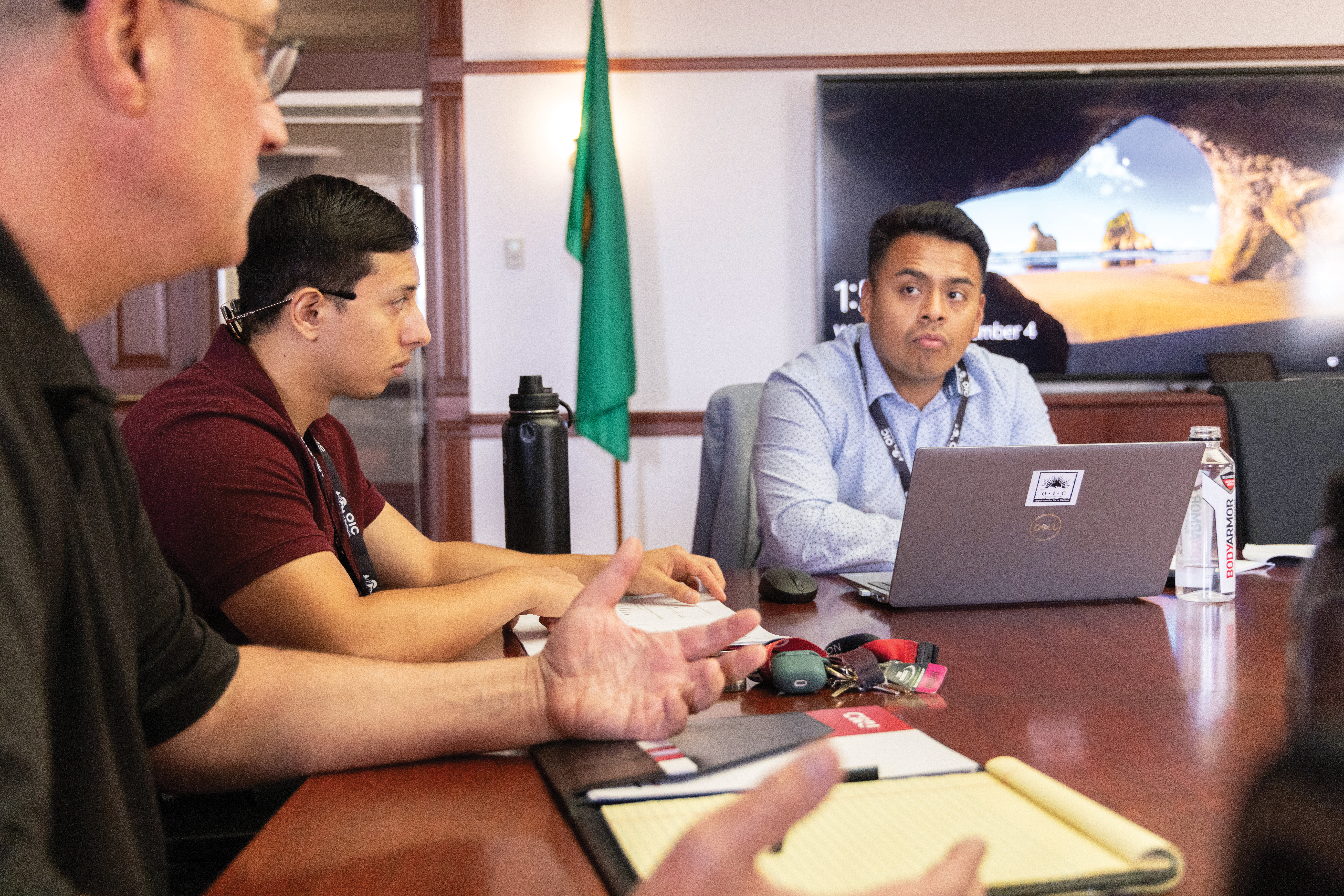
The word “stewardship” gets thrown around a lot in the ongoing conversation about the role universities play within their communities.
Indeed, the American Association for State Colleges and Universities defines stewardship of place as one of the key responsibilities held by regional comprehensive universities like CWU. The concept is baked into our vision and mission statements, reminding us to give back to the communities we serve in as many ways as we can.
Since August 2023, the newly formed Department of Business and Community Services (BCS) has been aiming to do just that. Led by Executive Director Rob Ogburn, BCS has been spinning a web of connections and resources with the end goal of nourishing the communities and economies of Central Washington through careful listening and humble collaboration in the face of the adaptive challenges facing the region.
Ogburn and his colleagues know that this approach is the best way to fulfill the promise of CWU.
“As a regional comprehensive university, we have a responsibility to be an economic and cultural support mechanism for our community,” he said. “This means we don’t show up and act like we have all the answers, but rather, we join the conversation with a long list of questions and the willingness to work with local leaders to find answers that work for everyone involved.”
Innovation Steeped in Tradition
The economic development work being initiated by BCS has its roots in CWU’s nationally acclaimed College of Business, having sprouted from the Institute for Innovation and Entrepreneurship (I4IE), directed by Dr. Bill Provaznik since 2008. The institute serves as a hub for networking and resource-gathering for aspiring and experienced entrepreneurs alike, facilitating workshops, listening sessions, and ongoing conversation across Washington state. In his time overseeing I4IE, Provaznik noticed an ongoing need for a similar program but on a larger, more interdisciplinary scale.
“I got a chance to see the different cities, towns, and rural communities across Central Washington working with the schools and districts, and noticed that while this state has some of the richest people on the planet, there’s also a lot of poverty here,” he said. “It became apparent that the university had a role to play in bringing up the next generation of small business owners and entrepreneurs to help this region thrive.”
In addition to building on the foundation created by I4IE, BCS draws inspiration from a similar program at the University of Northern Iowa (UNI), where President Jim Wohlpart served as provost before coming to Ellensburg in 2021. UNI’s program, also called Business and Community Services, has gestated over a period of 30 years, and currently serves all 99 of Iowa’s counties, fielding over 3,000 projects annually.
With Wohlpart and Ogburn’s support, it became clear that CWU was both willing and able to undertake a similar approach to the work before us in seven Central Washington counties.
“Once Jim Wohlpart and Rob Ogburn and a handful of other people came on board and started championing this kind of work, things really shifted into high gear,” Provaznik said. “Having a dedicated team and support from all corners of campus and community leadership has really put wind in our sails.”
Personalized Solutions
BCS’ primary objective is to facilitate economic development across the Central Washington region by leveraging the knowledge, expertise, and resources of the university to directly address the concerns of individual communities. According to Ogburn, that starts with open, honest conversation and a respect for the intricacies of each situation.
“We have the opportunity to create dialogue, and we do that by showing up and being small,” he said. “We don’t solve problems—we don’t even necessarily define them—but we are experts in process, dialogue, and bringing the right people to the table to have the conversations that need to be had. It’s a hard, intense, and humble approach to inquiry that needs to exist in order to bring about lasting progress.”
The key to the operation is flexibility, and avoiding a one-size-fits-all mentality at all costs. Ellensburg City Manager Heidi Behrends Cerniwey has been involved in developing the partnership between the city and BCS since the program’s inception, and she sees a distinct advantage in the work being done at a university, as opposed to a private agency.
“Local answers and local solutions take local problem solving and leadership,” she said. “Having this effort come from a local university makes a lot of sense, and our conference of governments in Central Washington is very supportive of it, and understanding of the fact that we need to do this work differently.”

In order to create the kind of sustainable, lasting economic growth that BCS aims to bring about, the temptation to inflate the local economy by bringing in pre-existing businesses must be balanced by nurturing an environment wherein locally minded endeavors have the opportunity to thrive.
“When most people think about economic development, they think about attracting existing businesses,” Behrends Cerniwey said. “We’re more focused on growing our own, and making sure they have a sustainable environment here to continue operating in. That’s how you get jobs that people can live on, and businesses that have a vested interest in giving back to their community.”
Once those critical early conversations are had, BCS can then provide support through data collection, networking, training, and a whole host of other options tailored to the needs of the community in question. Provaznik has seen firsthand how drastically each community’s priorities may vary from the next.
“We can’t go in and start fussing about external markets and increasing competitiveness if the local population is most concerned about trash not being cleaned up,” he said. “If that’s the primary issue facing the town government, then that has to be addressed in order to move forward with the bigger picture. Nothing is trivial if it matters to the people living in that community.”
Learning Opportunities Everywhere
In addition to assisting small, rural communities in economic development, BCS provides an opportunity for CWU business students to expand their skillsets. Last year, BCS employed two graduating seniors, supply chain management major Daizie Jones and accounting/marketing major Miguel Gomez, who assisted the department in data gathering and communication tasks as it got off the ground.
Gomez found inspiration in knowing he had a hand in work that could lift up his loved ones in the region.
“I have cousins that are 10 years old, and knowing that the work I’m doing could have a positive impact on them down the line is huge for me,” he said. “They might be able to make their way into some of the biggest industries in the state without having to leave their community behind.”
Jones agreed, noting a sense of pride in their work and a newfound perspective on what goes into crafting sustainable growth.
“I feel very proud to be on these projects, because we’re making a tangible difference in our community,” she said. “It may not be visible right now, but in five to 10 years, it’s going to compound into a big shift in how Central Washington does business, making it a better place for students to find jobs in the process.”
For Ogburn, involving students in the process is imperative to the success of BCS as a whole.
“Our student employees will enter their careers with a deep understanding of the potential that Central Washington has to offer,” he said. “Having professionals out there who understand how to cultivate meaningful relationships between communities and industry will move the whole region forward.”
As BCS expands and takes on more clients, students from across the university may end up getting involved through research projects or consultation assignments, giving them fresh ways to apply their education to the real world.
Just the Beginning
Only a year into its existence, BCS has already forged critical connections and drawn partners from across the region into the mix through events like last spring’s Economic Development Workshop, which saw participation from entities as far away as Canada and Oregon. Continued funding for the endeavor has been secured through a $400,000 Enabling Partnerships to Increase Innovation Capacity (EPIIC) grant from the National Science Foundation, among other sources of funding.
From where Behrends Cerniwey is sitting, it looks like BCS is off to the strong start that this kind of work demands.
“I think Central is just getting started, and there are a lot of exciting places this work could go,” she said. “It’s so easy to see all the positives at the beginning of a journey like this, but we’re prepared for the challenges that may arise along the way and ready to collaborate in the face of adversity. That’s what will make all the difference in changing the face of business in Central Washington.”
Ogburn is equally optimistic, although he realizes it will take time for BCS to gain a stronghold among its target market. He and his colleagues won’t feel comfortable measuring their success until they are able to step back and let their community partners take the wheel.
“Our job is to engage with communities on a demand-driven basis in a way that augments their ability to self-sustain,” he said. “Our measure of success is whether or not the community is meeting its own standards of success, as opposed to ours. We don’t develop the metrics and we don’t provide the values; we bring processes and tools and curiosity to the task at hand. Our goal is to work ourselves out of a job.”
••••••
This story appears in the latest edition of Crimson & Black magazine, which was published in December 2024.
CWU News
Arts and Humanities Month continues to build momentum
October 21, 2026 by David Leder
New position at CWU-Des Moines aimed at improving student experiences
October 21, 2026 by David Leder