CWU math professor on the cutting edge of diabetes research
- August 30, 2024
- Rune Torgersen
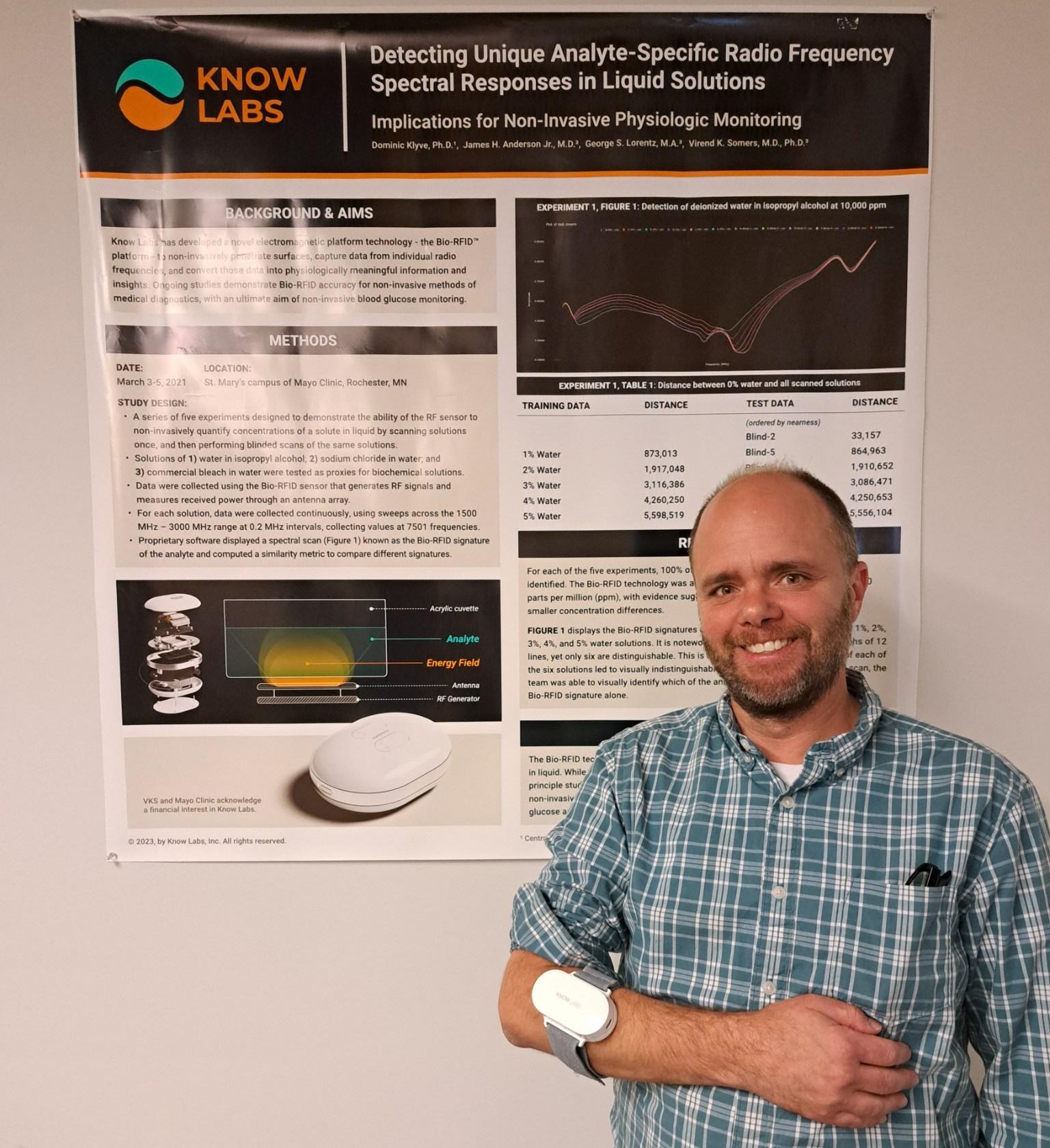
For the more than a half billion people in the world with diabetes or pre-diabetes, monitoring blood sugar levels is quite literally a matter of life and death.
All current solutions for obtaining these measurements are invasive in some form, requiring either an implant or a blood sample to function. Central Washington University Professor of Mathematics Dominic Klyve and Seattle-based medical device company Know Labs are working to make that reality a thing of the past.
“There’s a lot of daily medical decisions that folks with diabetes need to make on the basis of their blood sugar levels, so if that’s difficult or painful to track, those decisions might not be made the way they should,” Klyve said. “Making that easier, cheaper, and painless is a huge opportunity to make life better for a very large group of people all at once.”
Klyve is serving as a senior data scientist on Know Labs’ in vivo project, an initiative to make a device capable of reading a person’s blood glucose level using radio-microwave spectroscopy. The technique is based on Albert Einstein’s work on the photoelectric effect, sending over 10,000 different radio frequencies through the body in order to learn which molecules are present by analyzing the way those frequencies interact with electrons. Read more about the science in the Institute of Electrical and Electronics Engineers Sensor Journal.
“Somewhere in that mess of signals is one combination that indicates glucose levels, so we’re using machine learning to figure out precisely what that looks like,” Klyve said. “It’s almost certainly not a single frequency or wavelength, so this project involves a lot of data aggregation and sorting to determine exactly what we’re looking for.”
Klyve has served as a consultant for Know Labs on multiple projects in recent years, and he finds that working in the field helps him keep his own skillset current.
“The fact that I get to do this kind of work is a huge perk of my job,” he said. “Going out and working in my field is one of the best ways for me to bump shoulders with people who’ve just gotten their PhD three weeks ago and have new ideas to share with the world. I’m learning a tremendous amount, and being able to go back and forth between here and there makes me do my job at CWU better, too.”
Currently, the in vivo device has proven effective at predicting blood glucose levels in a lab setting, but there is more work to be done before it’s ready for widespread use. As part of his involvement with the project, Klyve has been presenting the concept and the supporting research at conventions across the world, garnering interest and support for the project along the way. He says that while the in vivo project still has a long way to go, the potential of the device goes beyond measuring blood glucose levels.
“Since these waves interact with every molecule they pass through, there’s no reason to think glucose is the only thing we can measure,” Klyve said. “We’ve been able to tell the difference in different cubes of metal with the sensor and are actively working on making that more broadly applicable.”
Klyve is excited about the work and looks forward to telling his students at CWU all about it.
“I’m so proud and excited to be part of a team working on something this transformative, and I’m thrilled that it’s possible in the first place,” he said. “The reason I love my job is that I can take time to work on things like this, and then turn around and bring that experience into my classroom.”
CWU News
Arts and Humanities Month continues to build momentum
October 21, 2026 by David Leder
New position at CWU-Des Moines aimed at improving student experiences
October 21, 2026 by David Leder