Trio of CWU students earn research awards at annual AAAS conference
- July 17, 2024
- University Relations

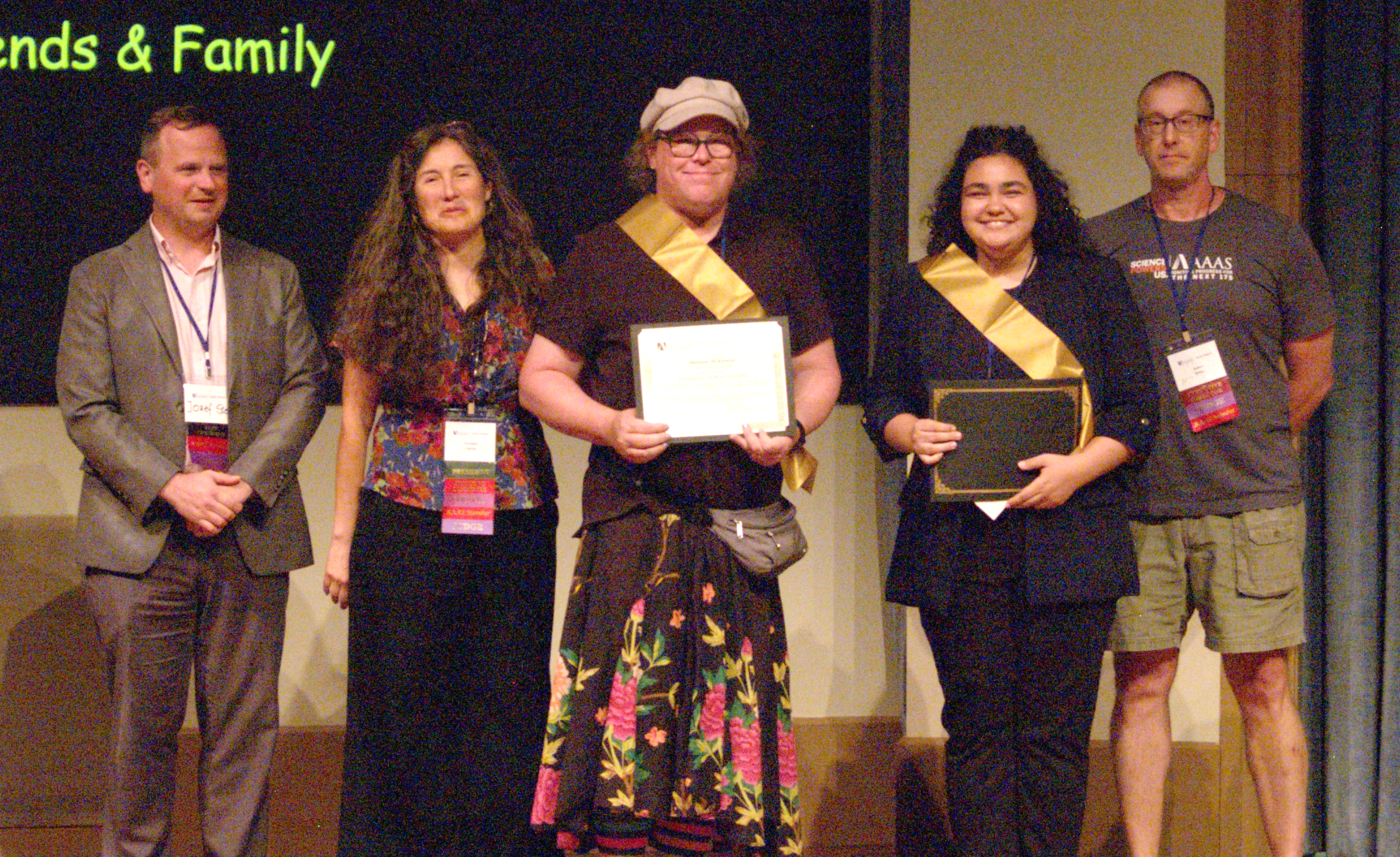
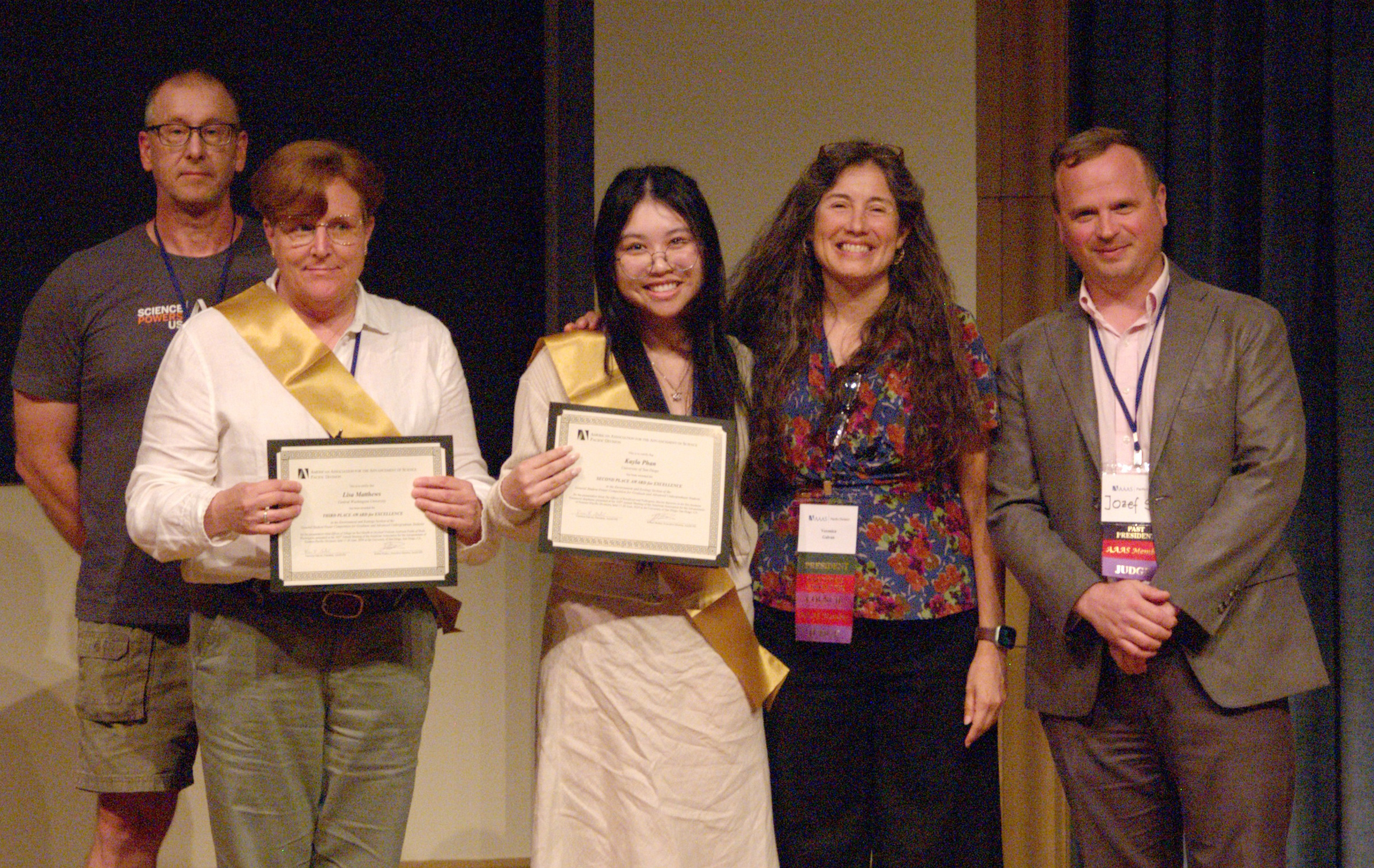
Three Central Washington University student researchers were recognized by the American Association for the Advancement of Science – Pacific Division (AAAS-PD) at last month’s annual meeting at the University of San Diego.
Kalila Garrison received a second-place award in the Social Sciences Section, Shannon McKinnion earned second-place honors in the Physical Sciences Section, and Lisa Matthews received a third-place award in the Environment and Ecology Section.
Garrison’s research, titled “The Auricular surface of chimpanzees as an indicator of age,” was advised by Professor Nicole Jastremski; McKinnion’s work, titled “Using LIDAR to study tsunami traces at selected sites in Alaska,” was advised by Professor Bre MacInnes; and Matthews’ project, titled “Effects of tillage on soil health in dryland triticum aestivum fields of mold, Washington,” was advised by Professors Bob Hickey and Holly Pinkart.
“We are so proud of our students’ hard work,” Pinkart said. “When you consider that there were a few hundred presentations, many of which were by PhD students and post-docs at R1 research institutions, this really speaks well of the work we’re doing at CWU.”
Below are brief overviews of the three winning research projects.

“The Auricular surface of chimpanzees as an indicator of age” (Garrison) — Great ape skeletal remains are scarce and their use in biological profile estimations has been limited. We were curious to see if the Buckberry and Chamberlain Method of using the auricular surface of the ilium to age human skeletal remains could be applied to chimpanzees (Pan troglodytes). The sample consisted of n=8 individual left auricular surfaces from known age groups of both sexes. The Buckberry and Chamberlain Method assigns numerical values to five different traits on the auricular surface: transverse organization, surface texture, microporosity, macroporosity, and apical changes. … We recommend that future studies look at differences between wild vs captive chimpanzees, increase sample sizes, and species and subspecies specific populations.
“Using LIDAR to study tsunami traces at selected sites in Alaska” (McKinnion) — There are multiple remote viewing tools that a geologist has to look at a site of interest. One of the most recent being LiDAR as a way of looking at an approximation of surface features. Of particular interest is the concept of using this tool to examine sites subjected to high-energy water events, such as tsunamis or glacial outburst flooding. By using LiDAR to examine known tsunami sites, the intent is to develop tools and techniques that would allow the evaluation of suspected sites that have not been examined in the field. A primary goal of my project is to determine how effective LIDAR is as an additional remote sensing technique, when investigating and identifying sites where unknown tsunami-type events have happened in the past.
“Effects of tillage on soil health in dryland Triticum aestivum fields of mold, Washington,” (Matthews) — Producers in the drylands of Eastern Douglas County, Washington, use crop-fallow rotation with conventional tillage (CT) to produce triticum aestivum (winter wheat). The United States Department of Agriculture (USDA) recommends no till/direct seed (NT) and placing land in Conservation Reserve Program (CRP) status to mitigate the negative environmental impacts associated with CT. Studies regarding the efficacy of NT conversion and CRP status on improving soil health in various regions of the inland Pacific Northwest have yielded mixed results. In this study, physical, chemical, and biological soil health indicators (SHIs) from a small geographic area (less than 10 square kilometers) of low-precipitation Eastern Douglas County dryland CRP, CT, NT, and unaltered native soil were compared. … Results indicate that within 6 years, conversion from CT to NT prevents erosion, preserves soil texture, increases soil moisture retention, reduces soil temperatures, increases soil organic carbon and total nitrogen.
The three award-winning students were joined at the June 17-20 conference by three of their CWU peers: Madalyn Hagan, Jonathan Fores-Brito, and Kevin Lomax.
Hagan (Anthropology) conducted a research project titled “Bioarchaeological Investigation of a Manteno Urn from Salango, Ecuador,” and was advised by Professor Jastremski; Fores-Brito (Chemistry) completed a project titled “Investigations of Interactions Between Polyelectrolytes and Redox-Sensitive Dyes,” and was advised by Professor Anthony Diaz; and Lomax (ITAM) researched “Ecophone sustainable smartphone development,” and was advised by Professor Susan Rivera.
Read more about the AAAS-Pacific Division Annual Meeting on the organization’s website.
CWU News
Arts and Humanities Month continues to build momentum
October 21, 2026 by David Leder
New position at CWU-Des Moines aimed at improving student experiences
October 21, 2026 by David Leder