Groups share an affinity for building community
- June 24, 2024
- Katherine Camarata

Culturally focused groups at CWU unite alumni, students, community members
In a time of shifting cultural narratives and expansion of visibility for all populations, affinity groups at Central Washington University play a more crucial role than ever in allowing those of marginalized identity groups the space to freely express and gather among others who share similar experiences.
Sigrid Davison, associate director of Diversity, Equity and Inclusivity, shed light on the significance of affinity groups and the resounding impact they generate.
“It's one of the ways to mitigate inequities that happen organizationally and interpersonally,” she says. “So, while a person can feel and have very inequitable experiences, injustice happens. By having an affinity group, they can create a community of belonging even though these other things are happening. If something is happening globally, organizationally, it will be even more so among the marginalized groups. We, in some ways, could even play a role in the decision-making of changing climate and changing the campus, because we are going to feel it first.”
CWU is home to affinity groups that focus on the Latinx population, Black men’s and women’s groups, a group for the LGBTQ+ community, among others on a growing list that has diversified over the years. Students, faculty, and alumni alike participate in affinity groups at CWU, which are run on a volunteer basis to serve the social and systemic needs of people with certain identities. Examples of CWU affinity groups include:
Davison coordinates for affinity groups by contacting people who belong to different populations via blind-copied email lists to protect identity, or reaching out personally when she hears of somebody new on campus who may be interested in joining a particular group. She recommends that students look for these emails early in the quarter to become aware of opportunities for connection.
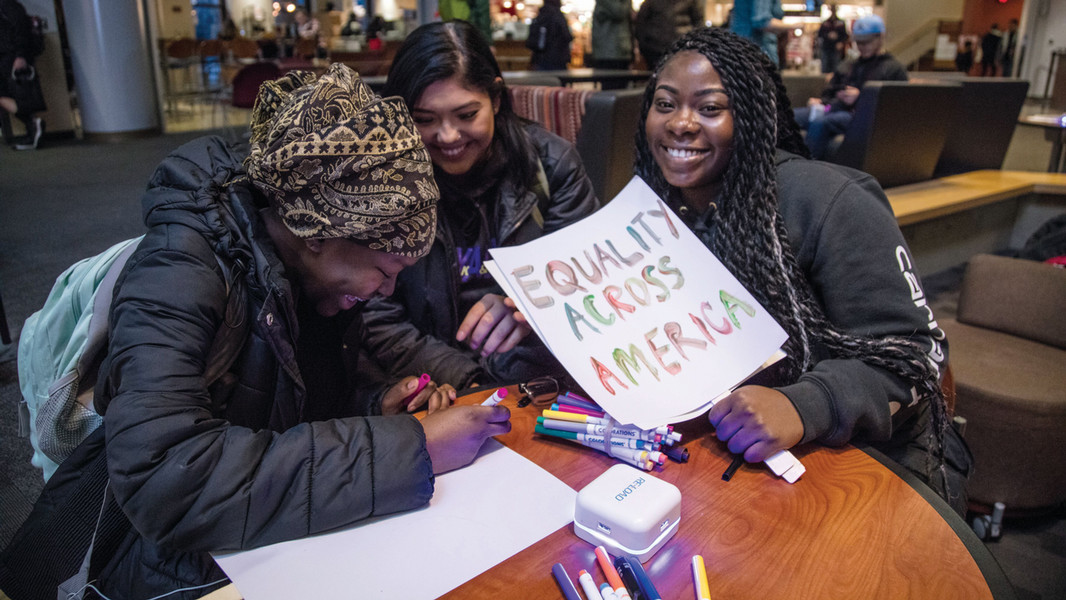
Rahel Mashawa, who leads the THRIVE group for women of color, echoed the significance of affinity groups, especially in this area.
“Affinity programs are necessary because it gives people the space to have as much agency as they want and take up as much space as they want in an institution and a country where that's not really celebrated otherwise,” Mashawa says.
Mal Stewman, director of the Diversity and Equity Center (DEC), recalls the many transformations and phases of affinity groups as they have evolved into what they are now.
“When I first was a student here in 1988, the first iteration of what I would call an affinity group was called the Minority Students Association,” says Stewman, who leads the Black Men of Ellensburg affinity group.
“It was a club, but really it was geared toward more social aspects, the support aspects between students of color, in a time back then, when there were actually a lot less. A lot of other groups were geared more toward action and activism, this one was more a group that was meant to help us meet social needs that we have. Affinity groups have the express purpose of really building community.”
Davison, who leads the Employees of Color Equity Council (ECEC) affinity group, says there are opportunities for expansion if students feel their identity is not yet represented by the already existing affinity groups.
“If people want to find a space for them, but they don't feel what is currently being offered is what they would feel comfortable with, or even if they don't know what they would feel comfortable with, I think just talking with Mal would help at least start that conversation and even start him trying to figure out how to engage more students,” she said.
Davison expressed goals for affinity groups “to increase engagement, to increase people's feeling of ownership over it, and for people to create community, to strengthen our own community among people of color, regardless of their shade.”
Anyone interested in getting involved with affinity groups at CWU can email Malbert.Stewman@cwu.edu or Sigrid.Davison@cwu.edu.
••••••
Editor's note: Katherine Camarata was the University Relations student writer for winter and spring 2024.
CWU News
Arts and Humanities Month continues to build momentum
October 21, 2026 by David Leder
New position at CWU-Des Moines aimed at improving student experiences
October 21, 2026 by David Leder