Susan Kaspari
Professor

Susan Kaspari
Climate and environmental variability, sustainability
I have been a professor at Central Washington University since 2009. In addition to research and teaching, I also work on sustainability efforts at CWU. In my spare time I enjoy skiing, mountain biking, hiking, backpacking, running, birding, travelling and reading, and spending time with my family, friends and huskies.
Teaching
I teach in the Department of Geological Sciences, Environmental Studies Program, and through the Sustainability Minor, and am an active mentor of undergraduate and graduate research students.
Courses I teach include:
- GEOL 201 Water and Climate
- GEOL 384 Ocean, Atmosphere and Climate Interactions
- SUST 301 Introduction to Sustainability
- ENST 480 Campus Sustainability
Research
My primary research interest is investigating the role that light absorbing particles play in current and past climate change. Light absorbing particles include black carbon, mineral dust and colored organics. When deposited on snow and glacier surfaces, light absorbing particles contribute to snow darkening, leading to greater absorption of energy, and accelerated snow and ice melt. This impacts the availability of water resources, and the Earth’s energy balance.
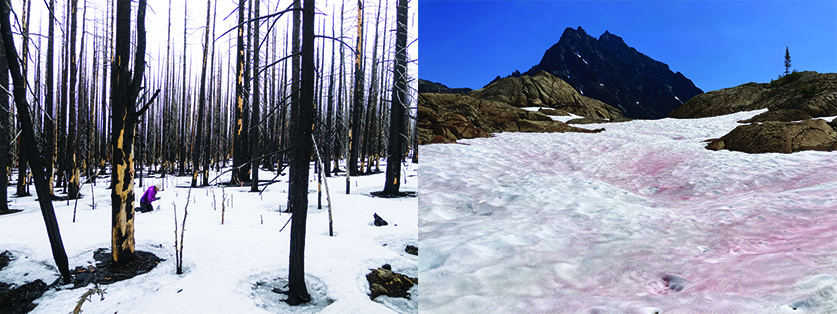
Photos: Light absorbing particles in snow near Central Washington University. Black carbon deposited on snow at Table Mountain post-wildfire (left), and snow algae near Mt. Stuart (right).
Light absorbing particles include:
- Black carbon, a dark absorptive particle produced by the incomplete combustion of fossil and bio-fuels. In addition to causing snow/ice darkening and melt, atmosphere black carbon absorbs energy and causes atmospheric heating. Black carbon is a major contributor to observed climate warming, but remains a large source of uncertainty in analyses of climate change.
- Mineral dust from arid regions and rocky outcrops. Dust production has increased in some regions due to land use change including agricultural and grazing practices, and development.
- Colored organics, including snow algae and bacteria.
To conduct this research we analyze the chemical composition of snow samples and ice cores retrieved from high elevation mountain glaciers, polar ice sheets, and the seasonal snowpack, make direct atmospheric measurements, and characterize the optical properties of light absorbing particles.
In addition to my light absorbing particle research, I am interested in reconstructing past climate (paleoclimatology) to achieve an understanding of how the Earth’s climate system operates, and documenting recent environmental change related to human activities. By analyzing the chemistry (trace and major elements, stable isotopes, and black carbon) of ice cores, the composition of the atmosphere can be reconstructed. Through my research, I have worked in Antarctica, China (Tibetan Plateau), Nepal, Tajikistan, New Zealand, Switzerland, Washington State and Svalbard.
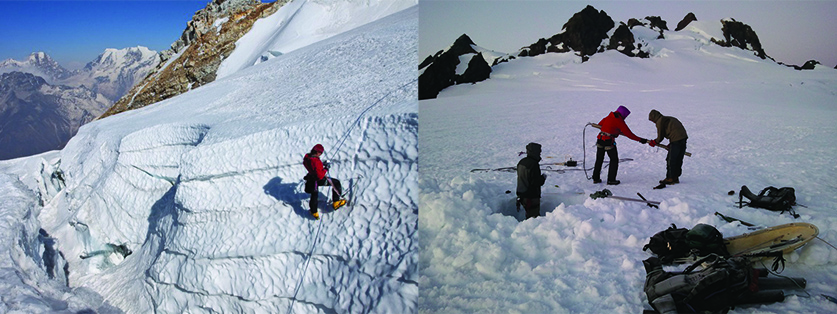
Photos: Collecting snow samples on Mera Peak in Nepal (left), and drilling shallow ice cores on Mt. Olympus, Washington (right).
Instrumentation and Facilities
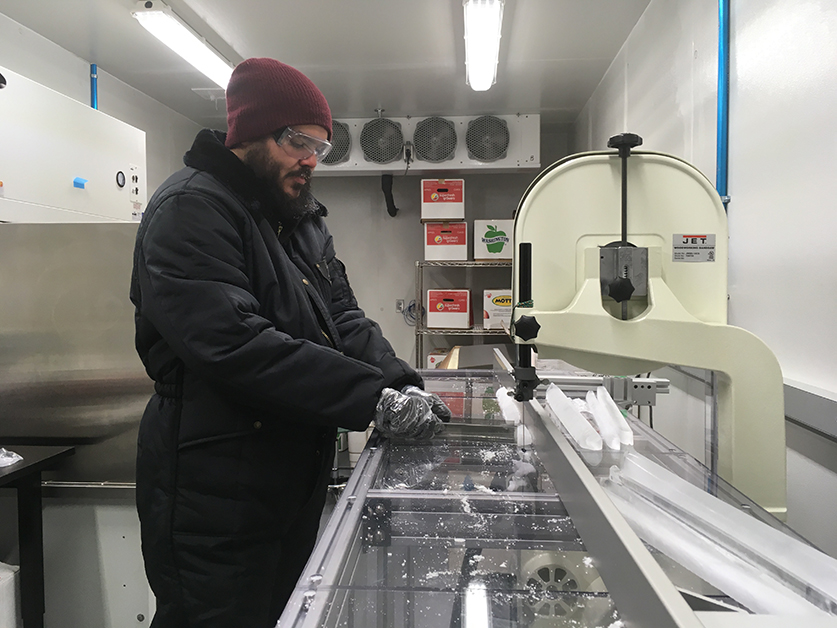
Instrumentation in my laboratory includes a Single Particle Soot Photometer (SP2), a Sunset organic-elemental carbon analyzer, a Portable UV-VIS-NIR Spectroradiometer (Spectral Evolution), a Hyperspectral Microscope (Cytoviva), and a Simultaneous Thermogravimetric Analyzer (STA 449 F5 Jupiter). Further information about laboratory facilities is available on the Murdock Research lab web page. My research space includes an ice core/snow walk in freezer, shown below, and clean room facilities.
Contact
Discovery Hall 329